AWS Storage Blog
Category: Amazon Elastic Block Store (Amazon EBS)
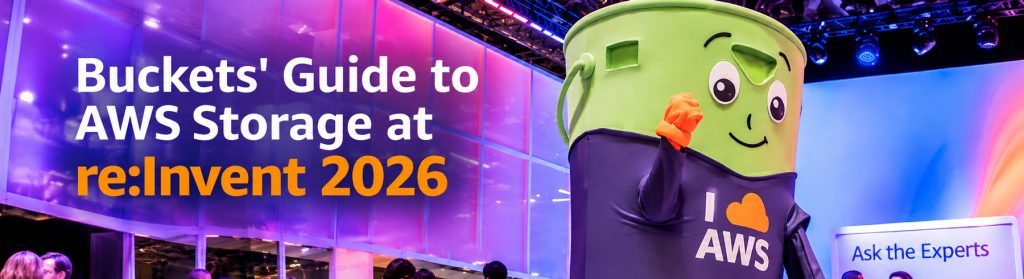
Buckets guide to what’s in store with AWS Storage at re:Invent 2026
Hi, I am Buckets. The official AWS Storage mascot, self-appointed guardian of all things durable, scalable, and correctly permissioned. At re:Invent, I PUT in a lot of steps and GET a lot of selfies. Perhaps we have met before, fist bumped, or had a dance off. It’s OK if you don’t want to talk about […]
Scaling a Weaviate vector index 26× with one Amazon EBS gp3 command
Weaviate took a 10-million-vector HFresh vector index from 9.8 to 260 queries per second, a 26.5x throughput gain with no re-indexing and no added RAM, by raising one Amazon EBS gp3 volume from 3,000 to 80,000 IOPS with a single API call.
How Proscia built unlimited observability with Amazon S3 and the Altinity Kubernetes Operator
Observability can claim a growing share of IT budgets. Learn how Proscia, a pathology AI company, built a self-hosted observability platform on Amazon S3, Amazon EKS, and ClickHouse managed by the Altinity Kubernetes Operator, achieving unlimited telemetry retention at object-storage cost under HIPAA, GDPR, and data-residency requirements.

Inside the AWS Storage Assessment: How intelligent analysis replaces guesswork
A completed storage assessment looks simple: an AWS Storage service recommended per workload, capacity and performance recommendations, and cost. This post walks through the analysis of how we go from analyzed data to right-sizing on AWS. In Part 1 of this series, we covered what an AWS Storage Assessment delivers: service recommendations, right-sized configurations, and […]
Optimize Amazon EBS volumes to get the right performance at the right time
Business-critical applications depend on reliable storage performance. However, workloads aren’t static and can vary by time of day, day of week, or business cycle. Matching storage performance to these shifting demands is essential for maintaining application reliability without overspending. Under-provisioning can affect your applications when demand peaks, while provisioning too much for too long means […]
Automate Amazon EBS gp2 to gp3 migration at scale with AWS Step Functions and AWS Lambda
Organizations managing thousands of Amazon Elastic Block Store (Amazon EBS) volumes across multiple AWS Regions have a significant cost optimization opportunity: migrating from gp2 to gp3 can deliver up to 20% savings, as highlighted by AWS Cost Optimization Hub. With AWS providing the ModifyVolume API for in-place, zero-downtime conversions, the path to savings is clear. […]
Accelerate development workflows with Amazon EBS Volume Clones
Providing a copy of production data to developers, testers, or disaster recovery (DR) teams quickly is a common operational challenge our customers face. Whether it’s a daily database refresh for a support environment, a one-time troubleshooting session that requires real-world data, or a disaster recovery drill that needs to run against a current replica, the […]
Implementing Persistent Storage for AWS Fargate and Amazon EBS
Users love the simplicity of AWS Fargate for running containerized workloads without managing servers, scaling infrastructure, or worrying about underlying compute capacity. As users expand their Fargate adoption, they increasingly want to run applications that require block data storage – content management systems like WordPress that retain uploaded media and plugin configurations, retail applications that […]

AWS Storage at re:Invent 2025: Every session, organized by topic
Hi, I’m Buckets. The official AWS Storage mascot, self-appointed guardian of all things durable, scalable, and correctly permissioned. I’ve attended every re:Invent since 2006, and I have never once missed a storage breakout session. Not even the one scheduled at 8am on a Friday. Some call it dedication. I call it having strong consistency. re:Invent […]
Enhancing co-located Kubernetes Pod data access with Amazon EBS Node-Local volumes
Modern containerized applications running on Kubernetes enable organizations to deploy read-heavy workloads—such as machine learning inference, data analytics, and High Performance Computing (HPC)—at unprecedented scale. However, when multiple pods on the same node need to access identical datasets, a performance challenge emerges. Each pod typically fetches files from external storage independently over the network. This […]