AWS Compute Blog

AWS re:Invent 2017 Guide to All Things Containers
Contributed by Tiffany Jernigan, Developer Advocate for Amazon ECS Get ready for takeoff! We made sure that this year’s re:Invent is chock-full of containers: there are over 40 sessions! New to containers? No problem, we have several introductory sessions for you to dip your toes. Been using containers for years and know the ins and outs? […]

Resume AWS Step Functions from Any State
Update March, 5 2021 – Disclaimer: This blog precedes the introduction of map state to the Amazon States Language and requires modifications to work with the map state. This post is written by Aaron Friedman, Partner Solutions Architect and Yash Pant, Solutions Architect. When we discuss how to build applications with customers, we often align […]
Event-Driven Computing with Amazon SNS and AWS Compute, Storage, Database, and Networking Services
Contributed by Otavio Ferreira, Manager, Software Development, AWS Messaging Like other developers around the world, you may be tackling increasingly complex business problems. A key success factor, in that case, is the ability to break down a large project scope into smaller, more manageable components. A service-oriented architecture guides you toward designing systems as a collection of […]

Accelerating Precision Medicine at Scale
This post courtesy of Aaron Friedman, Healthcare and Life Sciences Partner Solutions Architect, AWS and Angel Pizarro, Genomics and Life Sciences Senior Solutions Architect, AWS Precision medicine is tailored to individuals based on quantitative signatures, including genomics, lifestyle, and environment. It is often considered to be the driving force behind the next wave of human […]

Capturing Custom, High-Resolution Metrics from Containers Using AWS Step Functions and AWS Lambda
Contributed by Trevor Sullivan, AWS Solutions Architect When you deploy containers with Amazon ECS, are you gathering all of the key metrics so that you can correctly monitor the overall health of your ECS cluster? By default, ECS writes metrics to Amazon CloudWatch in 5-minute increments. For complex or large services, this may not be sufficient to make […]

Introducing Cloud Native Networking for Amazon ECS Containers
This post courtesy of ECS Sr. Software Dev Engineer Anirudh Aithal. Today, AWS announced task networking for Amazon ECS. This feature brings Amazon EC2 networking capabilities to tasks using elastic network interfaces. An elastic network interface is a virtual network interface that you can attach to an instance in a VPC. When you launch an […]
Under the Hood: Task Networking for Amazon ECS
This post courtesy of ECS Sr. Software Dev Engineer Anirudh Aithal. Today, AWS announced task networking for Amazon ECS, which enables elastic network interfaces to be attached to containers. In this post, I take a closer look at how this new container-native “awsvpc” network mode is implemented using container networking interface plugins on ECS managed instances (referred […]

Cross-Account Integration with Amazon SNS
Contributed by Zak Islam, Senior Manager, Software Development, AWS Messaging Amazon Simple Notification Service (Amazon SNS) is a fully managed AWS service that makes it easy to decouple your application components and fan-out messages. SNS provides topics (similar to topics in message brokers such as RabbitMQ or ActiveMQ) that you can use to create 1:1, 1:N, or […]
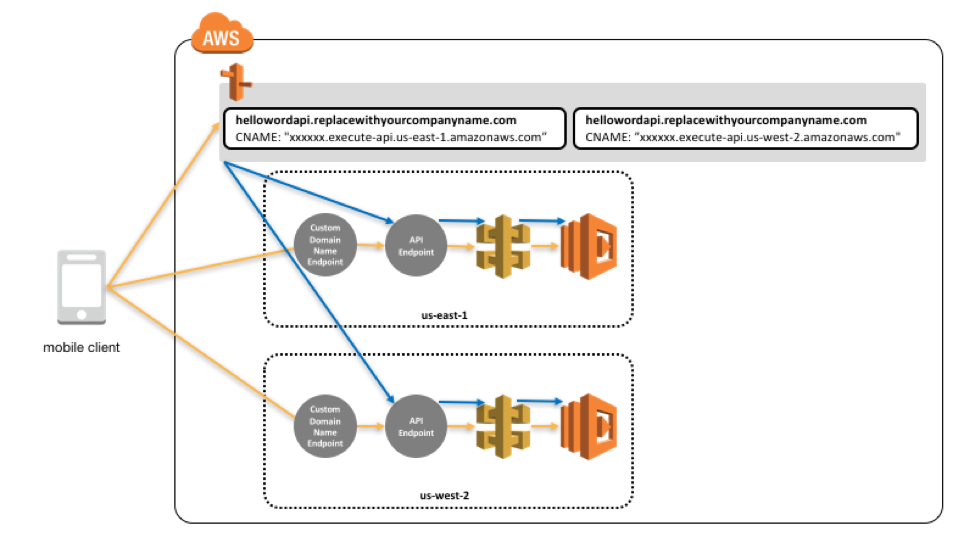
Building a Multi-region Serverless Application with Amazon API Gateway and AWS Lambda
This post written by: Magnus Bjorkman – Solutions Architect Many customers are looking to run their services at global scale, deploying their backend to multiple regions. In this post, we describe how to deploy a Serverless API into multiple regions and how to leverage Amazon Route 53 to route the traffic between regions. We use latency-based […]

Bringing Datacenter-Scale Hardware-Software Co-design to the Cloud with FireSim and Amazon EC2 F1 Instances
The recent addition of Xilinx FPGAs to AWS Cloud compute offerings is one way that AWS is enabling global growth in the areas of advanced analytics, deep learning and AI. The customized F1 servers use pooled accelerators, enabling interconnectivity of up to 8 FPGAs, each one including 64 GiB DDR4 ECC protected memory, with a […]