- AWS Solutions Library
- Guidance for Multimodal Data Processing Using Amazon Bedrock Data Automation
Guidance for Multimodal Data Processing Using Amazon Bedrock Data Automation
Simplify data extraction and process automation across multimodal data-centric workflows, including Intelligent Document Processing (IDP)
Overview
How it works
Intelligent document processing
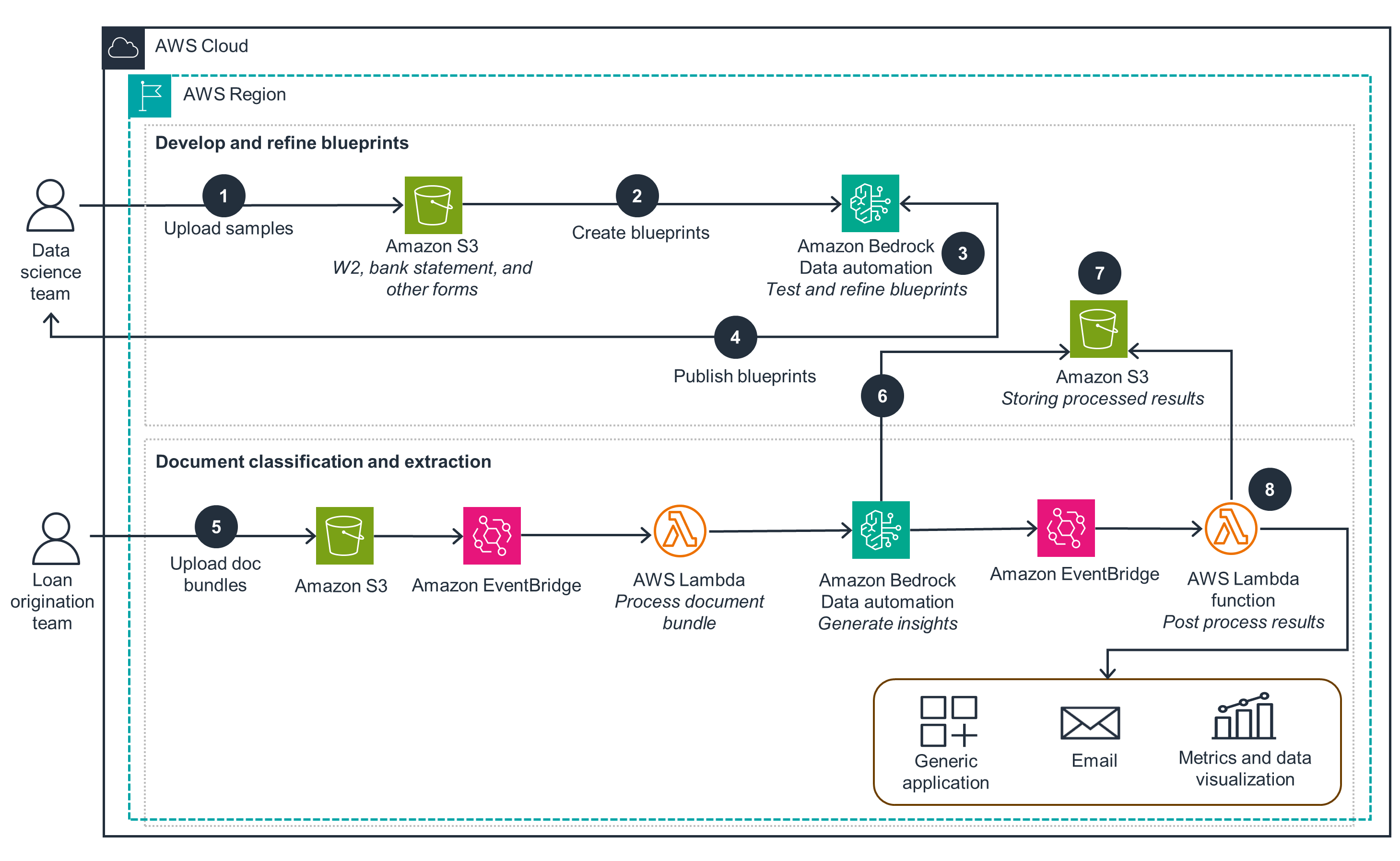
This architecture diagram shows how to perform document classification and extraction using a loan origination processing example for a financial services company.
Medical claims processing
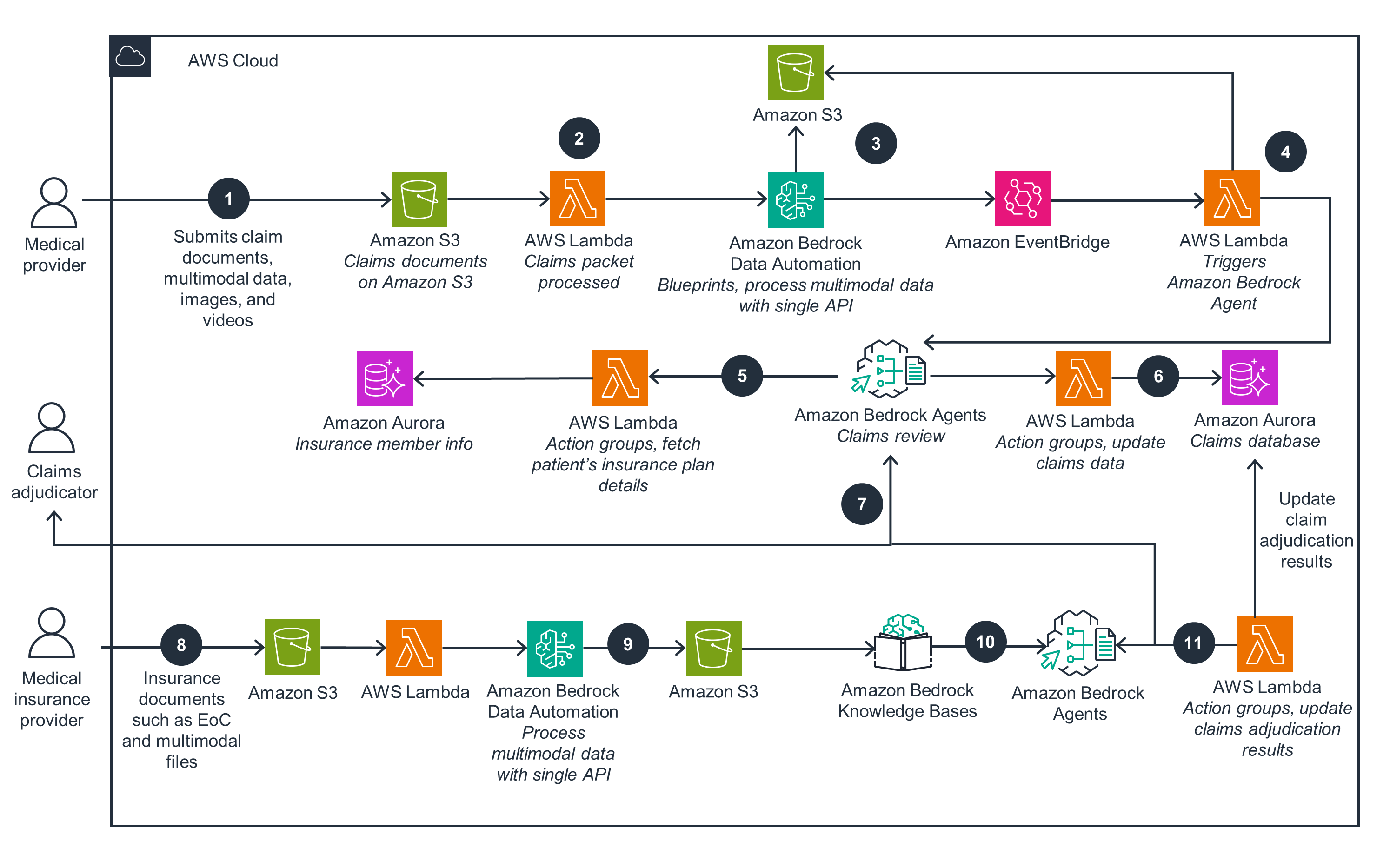
This architecture diagram shows how to automate medical claims processing with multimodal input data and processing to improve efficiency and accuracy.
Get Started
Deploy this Guidance
Use sample code to deploy this Guidance in your AWS account
Well-Architected Pillars
The architecture diagram above is an example of a Solution created with Well-Architected best practices in mind. To be fully Well-Architected, you should follow as many Well-Architected best practices as possible.
Amazon S3, EventBridge, and Lambda create a seamless, automated workflow for document processing and data extraction through secure storage for various document types. Amazon Bedrock Data Automation streamlines the extraction and normalization of data, reducing manual effort and increasing accuracy. Amazon Bedrock Knowledge Bases index the processed information, making it easily searchable and accessible, while Amazon Bedrock Agents leverages this structured data to make intelligent decisions and route claims efficiently. Aurora serves as a robust database for storing and retrieving critical information. Together, these services enable a highly efficient, scalable, and reliable system that minimizes human intervention and maximizes productivity.
Read the Operational Excellence whitepaperAmazon S3 offers encrypted storage, Lambda executes code in isolated environments, and Amazon Bedrock leverages secure AWS infrastructure with built-in encryption and access controls. Aurora provides advanced database security features. These services create a comprehensive security approach that protects data throughout its lifecycle while maintaining strict access controls and audit trails. The ability to centrally manage security policies and leverage continuous AWS security updates and improvements allows you to maintain a strong security posture while focusing on your core business operations.
Read the Security whitepaperAmazon S3 provides durable and highly available storage for documents. EventBridge helps ensures consistent event-driven processing by reliably triggering Lambda functions, which scale seamlessly to handle varying workloads without downtime. Aurora, a highly available database, offers automated backups and failover capabilities. These services offer a robust, fault-tolerant system that can withstand component failures, scale automatically, and maintain consistent performance under high loads, minimizing downtime and data loss risks.
Read the Reliability whitepaperAWS services enhance performance efficiency through scalable, high-performance solutions for document processing. Amazon S3 provides low-latency access to stored documents, while EventBridge enables real-time event processing. Lambda offers rapid, on-demand compute power. The serverless nature of Lambda and EventBridge eliminates bottlenecks associated with server provisioning. Additionally, Amazon Bedrock leverages AI models for efficient processing of complex data analysis tasks.
Read the Performance Efficiency whitepaperAWS services contribute to cost optimization through pay-as you-go models (meaning you only pay for resources consumed) and elimination of upfront infrastructure investments. Amazon S3 offers tiered storage options balancing performance and cost. The serverless nature of EventBridge and Lambda means paying only for actual compute time used. Amazon Bedrock provides AI capabilities without expensive in-house infrastructure or expertise, and Aurora offers performance comparable to commercial databases at a fraction of the cost.
Read the Cost Optimization whitepaperAWS services contribute to sustainability by optimizing resource utilization and energy efficiency. Amazon S3 uses efficient storage technologies, while EventBridge and Lambda provide serverless architectures that minimize idle capacity. These cloud-based services significantly reduce on-premises infrastructure, lowering energy consumption and carbon emissions. Their scalability ensures optimal resource use, avoiding over-provisioning and waste.
Read the Sustainability whitepaperDisclaimer
Did you find what you were looking for today?
Let us know so we can improve the quality of the content on our pages