AWS Compute Blog

Author: Chris Barclay
Deep Learning on AWS Batch
Thanks to my colleague Kiuk Chung for this great post on Deep Learning using AWS Batch. —- GPU instances naturally pair with deep learning as neural network algorithms can take advantage of their massive parallel processing power. AWS provides GPU instance families, such as g2 and p2, which allow customers to run scalable GPU workloads. You […]
Amazon ECS Events in February
Here are some upcoming events for Amazon ECS this month: Container World: Abby Fuller, senior AWS technical evangelist, will be speaking about Amazon ECS at Container World on Feb 21-23. Check out her schedule. Microservices Day @ AWS NY Loft: Microservices Day is on Feb 24 as part of the DevOps | AWS Loft Architecture […]
Managing Secrets for Amazon ECS Applications Using Parameter Store and IAM Roles for Tasks
Thanks to my colleague Stas Vonholsky for a great blog on managing secrets with Amazon ECS applications. —– As containerized applications and microservice-oriented architectures become more popular, managing secrets, such as a password to access an application database, becomes more challenging and critical. Some examples of the challenges include: Support for various access patterns across container […]
Amazon ECS at The Climate Corporation: Using Amazon ECR and Multiple Accounts for Isolated Regression Testing
This is a guest post from Nathan Mehl, Site Reliability Engineering Manager at The Climate Corporation. — The Climate Corporation aims to help all the world’s farmers sustainably increase their productivity through the use of digital tools. The integrated Climate FieldView™ digital agriculture platform provides farmers with a comprehensive, connected suite of digital tools. Bringing […]
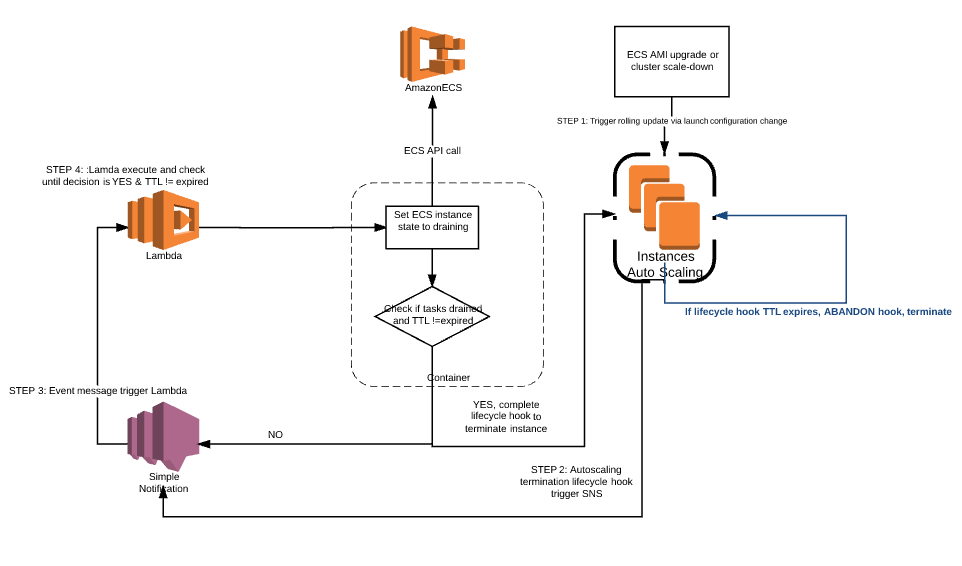
How to Automate Container Instance Draining in Amazon ECS
Update 24 Aug 2023: The approach described in this post relies on a recursive AWS Lambda function. Lambda announced a recursion control to detect and stop Lambda functions in July 2023. Accounts having recursive Lambda functions were automatically opted-out during the launch, we recommend contacting AWS Support to disable the Lambda feature to use this […]
Continuous Deployment to Amazon ECS using AWS CodePipeline, AWS CodeBuild, Amazon ECR, and AWS CloudFormation
Thanks to my colleague John Pignata for a great blog on how to create a continuous deployment pipeline to Amazon ECS. — Delivering new iterations of software at a high velocity is a competitive advantage in today’s business environment. The speed at which organizations can deliver innovations to customers and adapt to changing markets is […]
Introducing Amazon ECS Task Placement Policies
Today, Amazon ECS announced capabilities that provide granular control over how tasks are placed onto clusters. Previously, if you needed to place a task on a container instance with specific resource requirements (e.g., a specific instance type), you would have had to write custom schedulers to filter, find, and group resources. The following diagram outlines […]
Amazon EC2 Container Service at AWS re:Invent 2016 – Wrap-up
We wanted to summarize a few of the highlights from this year’s AWS re:Invent. Announcements On Thursday December 1, Werner Vogels announced two new features for Amazon ECS. Blox is a new open source project that enables users to build custom schedulers and other tooling on top of Amazon ECS. Our goal with Blox is […]
Automated Cleanup of Unused Images in Amazon ECR
Thanks to my colleague Anuj Sharma for a great blog on cleaning up old images in Amazon ECR using AWS Lambda. —- When you use Amazon ECR as part of a container build and deployment pipeline, a new image is created and pushed to ECR on every code change. As a result, repositories tend to […]
Create and Manage Clusters on the Amazon ECS Console
We recently added three Amazon ECS console improvements to help you create and manage clusters. Resource provisioning The first change is a wizard for creating clusters that takes care of provisioning all the resources required by the cluster such as the Auto Scaling group, VPC, subnets, and security group. You can also choose to use […]