AWS Database Blog

Author: Andrea Caldarone
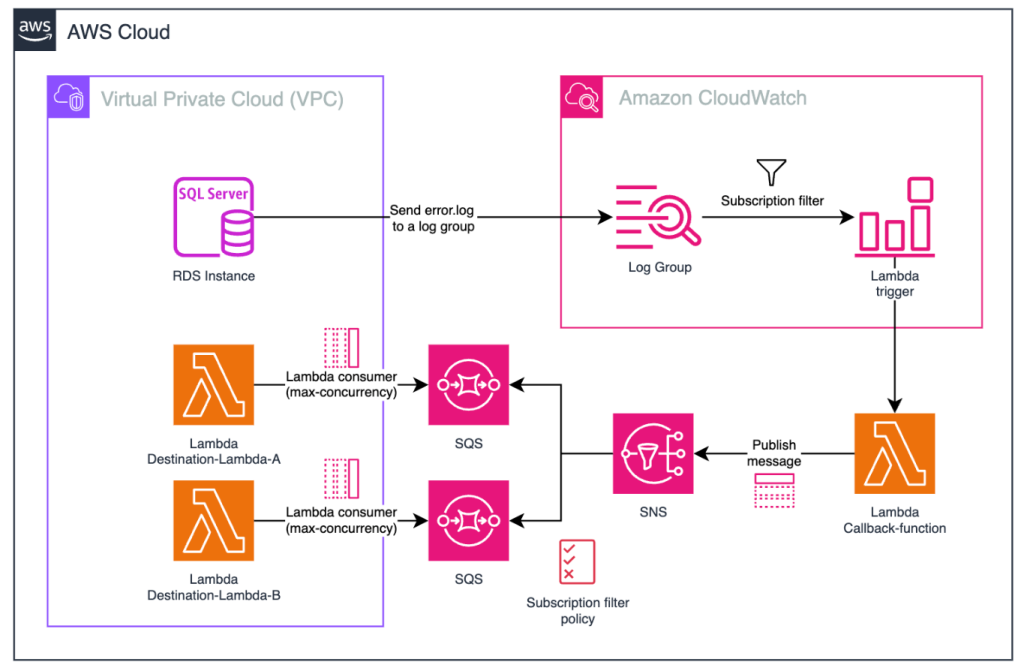
Trigger AWS Lambda functions from Amazon RDS for SQL Server database events
The ability to invoke Lambda functions in response to Amazon RDS for SQL Server database events enables powerful use cases such as triggering automated workflows, sending real-time notifications, calling external APIs, and orchestrating complex business processes. In this post, we demonstrate how to enable this integration by using Amazon CloudWatch subscription filters, Amazon SQS, and Amazon SNS to invoke Lambda functions from RDS for SQL Server stored procedures, helping you build responsive, data-driven applications.

Customer-managed process for configuring Kerberos authentication on an Amazon RDS for SQL Server DB instance, joined to a self-managed Active Directory
Many organizations rely on Windows Authentication and Kerberos for secure access to their SQL Server databases. When using Amazon RDS for SQL Server with a self-managed Active Directory, organizations can enhance their authentication beyond the default NTLM protocol to support Kerberos authentication. In this post, we show you how to manually configure and maintain Kerberos authentication for Amazon RDS for SQL Server DB instances joined to a self-managed Active Directory. We walk through the process of configuring service principal names (SPNs), adding necessary user principal name (UPN) suffixes, and automating SPN updates to handle failovers and host replacements.

Benchmark Amazon RDS for PostgreSQL Single-AZ DB instance, Multi-AZ DB instance, and Multi-AZ DB Cluster deployments
In this post, we present a qualitative performance comparison between RDS for PostgreSQL Single-AZ DB instance, Multi-AZ DB instance, and Amazon RDS Multi-AZ DB Cluster deployments.