AWS for Industries
Aeron on AWS: 2025 Performance Benchmark Results
Advances in cloud performance continue to accelerate the shift of capital markets to the cloud. This shift demands that core market infrastructure be re-engineered for cloud-based resilience and performance. Aeron’s high-performance messaging and clustering technology is purpose-built to support this move, enabling front-office trading and risk workflows, liquidity provision, trade execution, and market data to run in the public cloud, while meeting market participants’ demanding requirements.
In our last joint report between the Aeron team at Adaptive, and Amazon Web Services (AWS), we demonstrated that Aeron could achieve low-latency, high-throughput messaging on AWS. Since then, both Aeron and AWS infrastructure have advanced. This update shares the results of our latest benchmarking of Aeron Open Source (OSS) and Aeron Premium on AWS.
Key Results
- Cloud is now more ready than ever for Capital Markets workflows: Aeron Transport Premium is capable of a round-trip latency of 29 microseconds. Aeron Cluster Premium is capable of a 98-microsecond round-trip latency.
- Open Source performance has improved by 70% for Aeron Transport and 64% for Aeron Cluster since our last published results.
- Aeron Premium continues to outperform Open Source by 33% for Aeron Transport and 29% for Aeron Cluster.
These results show that most latency-sensitive trading workloads can run efficiently with Aeron Transport, with the security of Aeron Transport Security (ATS) for encrypted messaging, and resiliently with persistence and state management of Aeron Cluster on AWS.
Introducing Aeron Messaging and Cluster Technology
Aeron is an open-source, low latency message transport and “state machine” replication technology built by Adaptive. Aeron is an industry standard used globally by financial institutions to build high-performance and resilient trading systems (see references below). State machine replication is a fault-tolerance technique where multiple servers run the same deterministic process and logic (state machine) against the same sequence of inputs. This ensures all processes stay in sync and provide consistent quorum of results even if some processes or servers fail.
Adaptive has worked with AWS since 2014 perfecting Aeron’s design to deliver predictable low latency and high throughput on ephemeral infrastructure. This makes it possible for capital markets workloads to achieve on AWS what was once only possible on dedicated on-premises hardware.
- Aeron Transport provides ultra-low-latency messaging
- Aeron Cluster ensures sequenced and persisted state replication
- Aeron Premium adds advanced capabilities for performance, resilience, and security, including kernel bypass and encrypted transport
Benchmarking approach
Since our last update, we have revised our methodology to better reflect capital markets workloads. Previously, we measured maximum throughput while maintaining a 1 millisecond latency ceiling at the 99th percentile. This was useful for certain scenarios, but it did not fully represent sustained, high-throughput conditions in real-world trading.
In this update, we ran benchmarks at a fixed throughput of 100,000 and 1 million messages per second, with the 1m rate reflecting realistic peak and burst rates in trading infrastructure. This provides a more representative view of Aeron’s performance under load and accounts for the fact that production systems are typically over-provisioned to avoid network saturation.
We benchmarked two configurations:
Aeron Transport (Low-Latency Messaging)
- Aeron OSS with BSD (Berkeley Software Distribution) sockets
- Aeron Premium with kernel bypass for lower latency and higher throughput
- Aeron Premium with kernel bypass and Aeron Transport Security (ATS) for encrypted messaging
Aeron Cluster (state replication with high availability)
- Aeron OSS with BSD sockets
- Aeron Premium with kernel bypass
- Aeron Premium with kernel bypass and ATS
The benchmarks were run on Amazon EC2 c6in.16xlarge instances within Cluster Placement Groups and Amazon Elastic Block Store (EBS). Open Source Aeron uses BSD sockets, while Aeron Premium uses DPDK (Data Plane Development Kit) for kernel bypass on AWS Nitro System instances. Kernel bypass allows direct access to network interfaces and hardware resources, reducing latency and jitter in the network stack, and increasing throughput.
We believe in results that are easy to understand, repeatable, and independently verifiable.
Customers can replicate these benchmarks themselves using the same open-source test harness available at the GitHub repository and accompanying benchmarking guide.
See the technical deployment guide at the bottom of this article to provides an overview of the steps required to get started.
Results
Aeron Transport: Messaging with and without encryption
Aeron Transport delivers ultra-low-latency messaging on cloud infrastructure. Compared with our previous benchmarks, performance has improved significantly thanks to enhancements in Aeron and AWS infrastructure, including updated instance types, networking, and the benchmark harness itself.
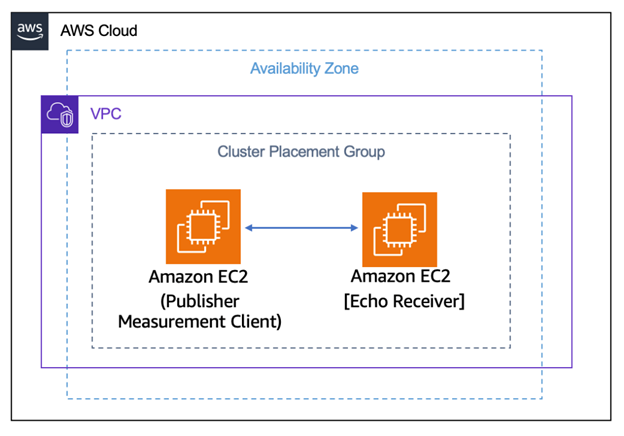
Setup: The diagram below illustrates the Transport benchmark architecture on AWS, showing instances deployed in a Cluster Placement Group for optimal network proximity and low-latency communication.
Key Finding: Aeron Premium with kernel bypass cuts P99 latency by over 50% compared to Open Source at high volume.
At 1 million messages per second, Aeron Premium maintains a 99th percentile latency of just 39μs compared to 84us with Aeron Open Source. Encrypting the transport with ATS adds only a single microsecond of latency, making it an excellent choice for secure, high-performance messaging.
The tables below show Aeron Open Source and Aeron Premium results in more detail.
For 100k messages per second with c6in.16xlarge instances
| P50 (μs) | P99 (μs) | P99.9 (μs) | |
| Aeron Open Source – Java driver | 21 | 32 | 46 |
| Aeron Open Source – C driver | 22 | 43 | 60 |
| Aeron Premium kernel bypass | 24 | 29 | 31 |
| Aeron Premium Transport Security and kernel bypass | 25 | 30 | 32 |
For 1 million messages per second with c6in.16xlarge instances
| P50 (μs) | P99 (μs) | P99.9 (μs) | |
| Aeron Open Source – Java driver | 30 | 57 | 206 |
| Aeron Open Source – C driver | 35 | 84 | 413 |
| Aeron Premium kernel bypass | 30 | 39 | 43 |
| Aeron Premium Transport Security and kernel bypass | 31 | 40 | 45 |
Aeron Cluster – High-throughput and low-latency with high-availability
For mission-critical workloads, Aeron Cluster delivers the proven resilience and simple coding model of state machine replication, but with the ultra-low latency that capital markets demand. It provides sequenced and persisted state replication across nodes, and our performance benchmarks show significant improvements thanks to enhancements in both Aeron software and AWS instances.
Setup: The diagram below illustrates the Cluster Placement Group benchmark architecture on AWS. A three node cluster is deployed in an Availability Zone. Messages from a measurement client are sent into the cluster and are replicated and persisted to an EBS volume on each of the nodes. Once a quorum of nodes have persisted the message, an acknowledgment is returned to the measurement client.
For more details on how Aeron Cluster works and how to deploy it, refer to the Aeron documentation.
Key Finding: Aeron Premium avoids the latency spike seen in Open Source at high throughput, making it ideal for critical systems.
At 1 million messages per second, the latency for Aeron Open Source climbs past 8 milliseconds (8,577μs) at the 99th percentile. In contrast, Aeron Premium with kernel bypass handles the same load with a P99 latency of just 143μs, a 59x performance improvement. This demonstrates its ability to reliably sustain low latency for high-availability workloads without compromise.
The tables below show Aeron Open Source and Aeron Premium results in more detail.
For 100k messages per second with c6in.16xlarge instances
| P50 (μs) | P99 (μs) | P99.9 (μs) | |
| Aeron Open Source – Java driver | 95 | 136 | 197 |
| Aeron Open Source – C driver | 97 | 139 | 203 |
| Aeron Premium kernel bypass | 76 | 98 | 106 |
| Aeron Premium Transport Security and kernel bypass | 79 | 102 | 114 |
1million messages per second with c6in.16xlarge instances
| P50 (μs) | P99 (μs) | P99.9 (μs) | |
| Aeron Open Source – Java driver | 3,301 | 8,479 | 9,306 |
| Aeron Open Source – C driver | 4,948 | 8,577 | 8,987 |
| Aeron Premium kernel bypass | 106 | 143 | 158 |
| Aeron Premium Transport Security and kernel bypass | 122 | 166 | 202 |
Summary
The combination of Aeron’s design and AWS’s continuous infrastructure enhancements has unlocked new levels of performance. These benchmarks confirm that Aeron on AWS is not just viable but a leading choice for latency-critical capital markets systems.
- Mission-Critical Architecture at Speed: State machine replication is an extremely resilient and recoverable way to build mission-critical systems. These performance numbers show it is ready for capital markets in the cloud, delivering predictable, microsecond-level latency for resilient state replication at high throughput.
- Security with Performance: Aeron Premium’s encrypted transport offers robust security with negligible performance overhead.
- Premium Delivers Unmatched Performance: Kernel bypass via Aeron Premium is the key to unlocking near bare-metal speeds and avoiding performance degradation under heavy load, making it essential for mission-critical and low latency systems.
Aeron is widely used in electronic trading and is relied upon for mission-critical systems. A public list of references can be found at http://www.aeron.io/.
For more background, see the previous benchmarks in the original AWS blog post or visit aeron.io.
Deployment Guide
Prerequisites
The benchmarks were conducted on c6in.16xlarge EC2 instances running Ubuntu 22.04 LTS, deployed within a Cluster Placement Group for optimal network proximity. You’ll need:
- Provisioned EC2 instances
- Java 17+ and build tools (Gradle)
- System utilities including: numactl, jq, hwloc
For infrastructure provisioning modules and detailed setup instructions, refer to the accompanying technical guide.
System Configuration
Achieving microsecond-level latency requires careful system tuning across three key areas:
Kernel Parameters: Optimize virtual memory, networking buffers, and file system behavior for low-latency workloads. Configuration includes tuning parameters like ‘vm.swappiness’, ‘net.core.rmem_max’, and TCP settings.
CPU Core Isolation: Aeron pins critical threads to dedicated CPU cores to eliminate scheduling jitter. This involves isolating cores using kernel boot parameters and determining the optimal core topology based on your instance’s NUMA architecture.
File System Optimization: Mount options and in-memory file systems (‘/dev/shm’) minimize I/O latency for Aeron’s media driver and archive components.
The complete system configuration guide, including all sysctl parameters, GRUB settings, and mount commands, is available in the technical setup documentation.
Aeron Configuration
Aeron’s performance is controlled through configuration files (‘low-latency-driver.properties’ and ‘low-latency-archive.properties’) and benchmark script parameters:
- MTU Sizing: Aeron’s default 1408-byte MTU aligns with standard 1500-byte network MTU. For jumbo frames (9000 MTU), configure 8KB Aeron MTU.
- File Sync Levels: Control persistence behavior (0=async, 1=fdatasync, 2=fsync) to balance durability and latency requirements.
- CPU Pinning: Assign specific CPU cores to conductor, sender, receiver, and archive threads for predictable performance.
Benchmark wrapper scripts use parameters like ‘–mtu’ and ‘–fsync’ to override these settings during test execution.
Running the Benchmarks
To execute the benchmarks:
1. Clone the repository:
git clone https://github.com/aeron-io/benchmarks aeron-benchmarks
2. Build the benchmark package using Gradle, which generates a deployable archive.
3. Deploy the archive to your test instances and create wrapper scripts that configure SSH connections, CPU core assignments, and network channels.
4. Execute the benchmark tests using your configured wrapper scripts.
Detailed build instructions, complete wrapper script examples, and configuration templates are available in the benchmark scripts documentation.
Next Steps
If you are interested in using Aeron to move your trading infrastructure to AWS, you can:
- Contact the Aeron team to discuss your requirements
- Request the Aeron Performance Testing guide to run benchmarks in your own environment
- Join the Aeron community mailing list to connect with other users
You can also explore more AWS Partners or speak with an AWS representative to learn how we can help accelerate your business.