AWS for Industries
Agentic AI in Financial Services: Choosing the Right Pattern for Multi-Agent Systems
Financial institutions of various sizes, including major players like NASDAQ, are finding that agentic AI offers concrete advantages over traditional generative AI approaches. A recent Moody’s study highlights this rapid adoption, revealing that 70 percent of participants surveyed prioritize AI for risk and compliance, while significant percentages are using AI for accelerating analysis (66%), reducing costs (64%), handling larger data volumes (56%), and improving accuracy (51%).
Agentic AI system use distributed reasoning and agent collaboration to handle concurrent tasks like real-time market analysis and transaction processing. These agents access distributed financial knowledge bases to support loan approvals and investment strategies. Strands Agents and Amazon Bedrock AgentCore now make AI capabilities accessible to financial institutions of all sizes, enabling them to implement tailored multi-agent AI systems using AWS’s managed AI services. Within agentic AI systems, these agents often extend trained knowledge using curated tools. These tools can range from a small calculator application or another agentic system and extend through the model context protocol (MCP), and Agent2Agent (A2A) protocols.
In this blog you will learn about three real-world financial services use cases for Agentic AI. Each section identifies the business case, explains which agentic AI pattern best fits the given use case, and dives deep on the specific workflow pattern.
Financial Services Use Cases
Autonomous Claims Adjudication
Organizations face four key problems when approaching autonomous claim adjudication: document processing and analysis through computer vision and natural language processing (NLP), fraud detection using pattern recognition and anomaly detection, policy validation through automated cross-referencing, and decision standardization through machine learning-based standardization. Failure to implement such automation leads to significant operational consequences including competitive disadvantage, scaling limitations, quality inconsistency, and strategic risks such as market share loss to AI-enabled competitors.
Autonomous claims adjudication using agent workflows with Strands Agents addresses the complex challenge of automating multi-step insurance claims across the entire process. This starts with first notice of loss (FNOL), which represents the initial claim notification an insurer receives. The FNOL process captures incident details, damage assessments, and policyholder information that triggers the claims investigation process. Following this, damage appraisal, and settlement phases continue and conclude the clam adjudication process. This implementation uses a workflow pattern with sequential processing capabilities. The implementation has three phases: FNOL automation, intelligent appraisal, and autonomous settlement. Each phase uses specialized AI agents for specific tasks.
Figure 1 illustrates the First Notice of Loss (FNOL) process flow, showing how claims move through initial notification, assessment, and processing stages.
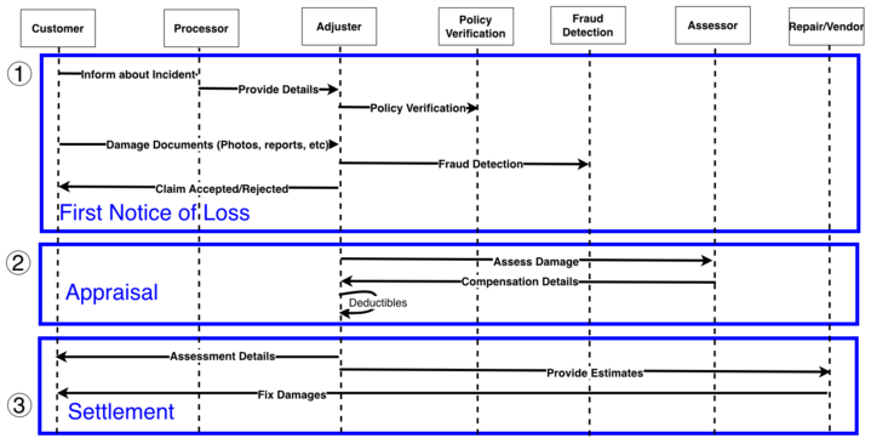
Figure 1: FNOL Process
The solution automates straightforward claims, which improves efficiency and reduces operational costs. It also improves the combined ratio to generate revenue and reduces regulatory violations to mitigate risk. These improvements enhance customer satisfaction.
Figure 2 demonstrates how the FNOL process can be implemented using both sequential and parallel workflow patterns to optimize processing efficiency.
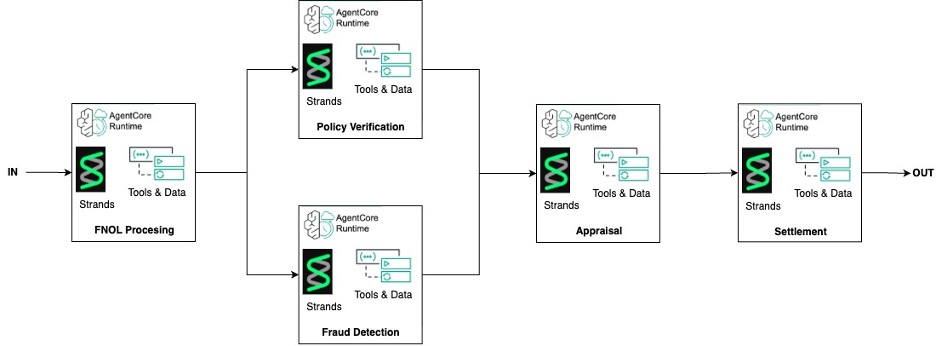
Figure 2: FNOL with Sequential and Parallel Workflow
Workflow Pattern
Workflow patterns represent one of the most fundamental and reliable approaches to multi-agent AI architectures. This is characterized by a methodical, step-by-step progression where each agent completes its designated task before passing results to the next in the chain.
| Reasoning Paradigm | Other applications | Performance Considerations |
|
Chain-of-thought processing. Complex tasks broken down into manageable steps with clear dependencies and information flow |
Anti-money-laundering/Know-your-customer compliance: follows a progression from basic identity verification to high-sensitivity persons screening and enhanced due diligence. | The pattern provides methodical progression with clear dependencies and information flow. While speed is limited by the slowest component, it excels in scenarios requiring accuracy and thorough validation. This makes it valuable for regulated industries where audit trails and systematic task breakdown are essential. |
Financial Research and Analysis
Financial research faces several challenges: integrating diverse data sources is complex, processing multiple data types requires specialized tools, and maintaining consistent analysis quality becomes difficult in fast-changing markets. The financial research and analysis system powered by Amazon Bedrock AgentCore addresses these obstacles through a collaborative multi-agent system using a swarm pattern that transforms financial research from a manual, time-intensive process into an automated intelligence platform. By deploying specialized Amazon Bedrock AgentCore agents for stock price analysis, financial metrics calculation, company profiling, and news sentiment analysis, all coordinated through shared memory and Amazon Nova Pro, this multi-agent solution generates comprehensive equity research reports in minutes rather than hours.
In figure 3, the implementation delivers business value through research processing, reducing manual tasks, improvement in investment performance, expanding research coverage, and reduces operational inefficiencies often found in manual research workflows.
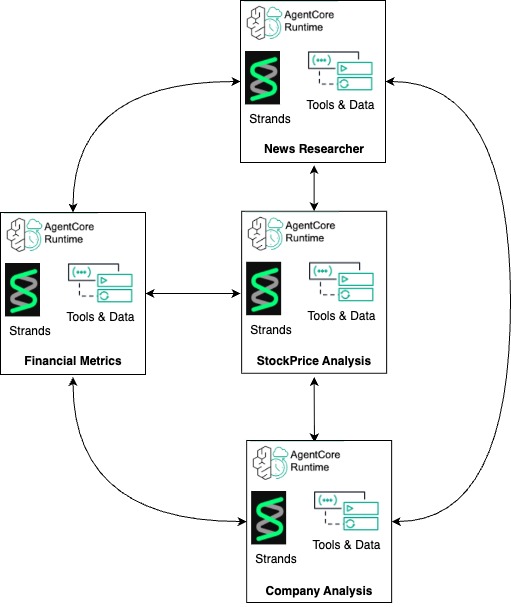
Figure 3: Financial Research and Analysis using Swarm Pattern
Swarm Pattern
Similar to how swarms of bees achieve collective behaviors, swarm patterns using a mesh show one of the most innovative approaches to multi-agent architectures, leveraging collaborative reasoning and distributed information sharing. Unlike hierarchical or workflow patterns, this architecture allows complex behaviors to arise through simple agent interactions.
| Reasoning Paradigm | Other Applications | Performance Considerations |
| Collaborative reasoning, information sharing and emergent intelligence |
Peer-to-peer lending platforms Data augmentation in commercial underwriting, Distributed trade settlement networks where decentralized coordination is essential |
The pattern enables collective behaviors through simple agent interactions, offering high fault tolerance and adaptability. However, it presents challenges in managing communication overhead and debugging complexity. Success depends on balancing emergent behavior benefits against regulatory compliance and system predictability requirements. The collective intelligence of multiple agents can surpass single-agent or centralized system capabilities. |
Intelligent Loan Application Processing
Significant challenges impact traditional loan application processing, challenges including time-intensive manual underwriting, complex documentation handling, and the need to maintain strict compliance standards while managing risk across multiple departments. The intelligent loan application processing system addresses these obstacles by demonstrating the power of graph pattern, which use hierarchical multi-agent architectures in automating complex financial decision-making processes. This Amazon Bedrock AgentCore implementation, using Strands Agents, mirrors real-world financial institution structures with a loan underwriting supervisor orchestrating specialized departments including financial analysis and risk analysis managers, each overseeing domain-specific agents for credit assessment, verification, risk calculation, fraud detection, and policy documentation.
The hierarchical topology utilized by the graph pattern enables loan processing workflows where borrower documentation including credit reports, bank statements, pay stubs, tax returns, and property information flow through specialized agents that perform credit scoring, income verification, fraud detection, and risk modeling before culminating in automated approval or rejection recommendations.
Outlined in figure 4, the graph pattern reduces manual underwriting time while showcasing how multi-agent systems can transform traditional financial processes. Through coordinated AI collaboration that combines domain expertise with organizational structure, enterprise-grade automation can be delivered in critical business operations.
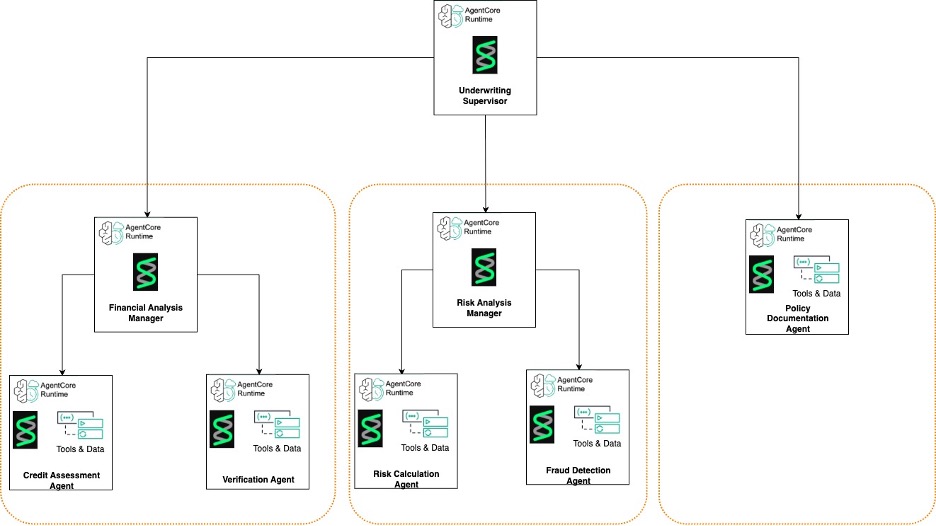
Figure 4: Intelligent loan application processing – Graph Pattern
Graph Pattern
Graph patterns in multi-agent systems use a layered approach to task management, where a coordinator agent in Amazon Bedrock AgentCore sits at the beginning of a decision tree, orchestrating the delegation and supervision of tasks to specialized subordinate agents. This structure mirrors traditional organizational hierarchies, employing a clear chain of responsibility that enables complex tasks to be decomposed into manageable components.
| Reasoning Paradigm | Other Applications | Performance Considerations |
|
Precise control over agent interactions Well-defined data flow Persistent agent state Compliance-driven processes |
Payment gateway operations Insurance claims processing Loan underwriting Customer service interactions |
The pattern enables systematic decomposition of complex tasks with clear chains of responsibility. However, it can create single-point-of-failure risks where coordinator agent issues may disrupt downstream processes. This necessitates robust failover mechanisms and monitoring systems in critical financial applications. Despite these challenges, the structure excels in scenarios requiring coordinated decision-making and task triage. |
Supplementary Patterns
The loop pattern represents an additional pattern that can function either as a standalone solution or as a supplementary mechanism in multi-agent architectures. By enabling agents to refine their work through feedback cycles, this pattern creates systems capable of iterative refinement.
The loop pattern introduces a dynamic, self-improving dimension to multi-agent systems through iterative processing cycles where agents refine their outputs based on feedback and evaluation. This additional pattern can be considered as a supplementary component for a graph pattern when feedback is necessary to complete a given section of the workflow.
| Reasoning Paradigm | Other Applications | Performance Considerations |
|
Reflective reasoning approach to problem solving. Self-improvement, allowing agents to iteratively refine solutions until they meet specified quality thresholds. |
Algorithmic trading systems: Use iterative cycles for testing, parameter optimization, and market simulation to refine trading strategies. Credit scoring models: Evaluate and adjust risk assessments against real-world outcomes. Insurance premium optimization: Cycle between risk assessment, pricing models, and market competitiveness analyses to determine optimal pricing. |
The pattern enables dynamic self-improvement through continuous feedback and evaluation cycles, allowing systems to adapt to changing conditions. While this creates opportunities for progressive enhancement and refinement, careful attention must be paid to termination conditions to prevent infinite processing loops. The architecture excels in dynamic financial markets where optimal solutions evolve over time but requires balanced implementation to ensure effective convergence of solutions. |
Shown in figure 5 below, the loop embodies reflective reasoning, allowing systems to enhance their performance through repeated cycles of assessment and adjustment.
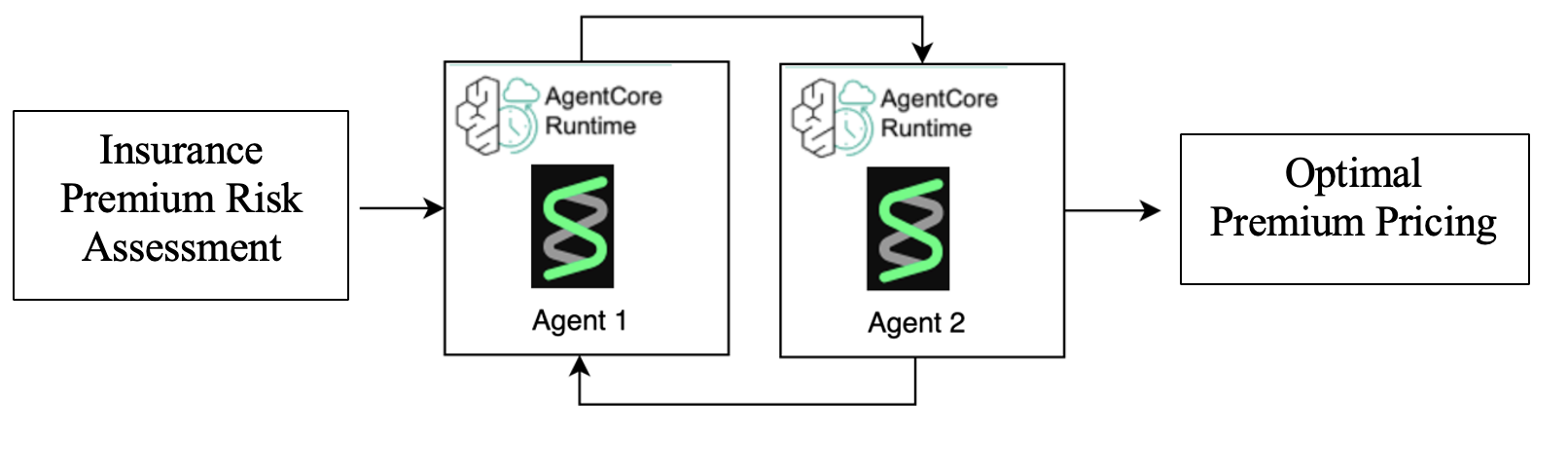
Figure 5: Loop Pattern
Anti-patterns
While agentic architectures provide powerful benefits, anti-patterns have emerged. The patterns diminish the value of agentic architectures and only add to sub-optimal outcomes as organizations try to measure value and strive for successful AI initiatives.
1. Large Singleton
Single Agents often start small and are successful but extending them with an excessive number of tools leads to significant challenges in production environments. Consider an underwriting agent deployed to handle multiple areas of the underwriting process – from calculating commissions and modeling risk to interacting with agency brokers and accessing knowledge bases. As the agent’s responsibilities expand, task execution becomes complicated as the agent begins to exhibit confusion by calling the wrong tools, passing incorrect arguments, and producing inconsistent responses. As the prompt size grows, the agent also becomes slower and more expensive to operate, increasing execution time and cost. This pattern is often seen in overloaded single agents, demonstrates how initial simplicity can evolve into a problematic implementation. This anti pattern can be avoided by ensuring agents have focused, small-scope responsibilities and tasks to execute with only a few select tools. The example above can be broken out into multiple agents, ensuring task accuracy and speed.
2. Agent Washing
We’ve observed a concerning trend of “agent washing” across the industry, where there is a rebranding of existing automation technologies or basic GenAI implementations as “agentic solutions” without delivering the corresponding capabilities. This creates both unrealistic expectations of single agent capabilities and unnecessary complexity from large system prompts to tool choice for the agent. Instead, focus on the right tool for the job. Sometimes the right tool is a multi-agent system and often, reducing scope to a single task for a single agent delivers results which are more reliable and cost-effective.
One observed example of agent washing is using an agent to host a single Lambda function, or a single tool, and adding a multi-agent supervisor just to create the illusion of using a multi-agent system, without really using agentic capabilities. This multi-agent supervisor would be more appropriate and effective when used for dynamic tool selection, orchestration, agency to explore different solution trajectories, and agent collaboration with data sharing.
Figure 6 depicts a common example of agent washing to show this in further detail. Notice how each collaborator hosts a single tool.

Figure 6: Agent Washing using AI Agents only to host a single lambda function
Conclusion
The evolution from generative AI to agentic AI represents a pivotal shift in how financial institutions use artificial intelligence. Multi-agent architectures, ranging from sequential workflows to complex swarm patterns, offer new capabilities in automating and enhancing financial operations. These patterns may evolve with time with new and hybrid patterns emerging as tool use through MCP and A2A protocols evolve.
Transitioning away from a simple generative AI architecture using a single agent or prompting a model allows you to use large language models to their fullest. Doing so enables the capability to automate larger system that cannot easily be performed by a single prompt or agent. These agentic systems not only handle larger complexity, they can perform tasks with a high degree of accuracy by focusing each agent on selective tasks with tools. We covered how distributed reasoning with Agentic AI is a paradigm where multiple autonomous AI agents collaborate and communicate to solve complex problems that no single agent could handle alone. This approach differs from centralized AI by distributing decision-making power, knowledge, and tasks among specialized agents, enabling greater scalability, resilience, and adaptability.
The flexibility offered by frameworks like Strands Agents and AgentCore enables rapid experimentation and validation of both existing and new architectures, while maintaining high performance standards. By avoiding anti-patterns such as large singletons, organizations can ensure optimal agent performance, prevent system overload, and maintain clarity in their AI implementations. As the financial landscape continues to evolve at an increasing pace, the application of these AI architectures will not only drive innovation but also serve as a crucial differentiator for organizations aiming to maintain their competitive edge in an increasingly technology-driven market.
Now that you understand the value and specific architectural patterns, you can reference code for these patterns here, to deploy each pattern and see them work for these real-world scenarios. If you would like to learn more about these patterns and how you can implement them within your environment, please reach out to your AWS account team who can help you determine the best patterns to enable for your use case.