AWS Pioneers Project
European innovation, told by those who built it
Proximie: AI-powered operating room technology cuts waiting lists and connects global experts
Proximie is a start-up on a mission to connect operating rooms and make them more efficient, and its CTO Richard Carter has lived and breathed his work in more ways than most.
"I may be the only person I know who has had their body operated on by their own product."
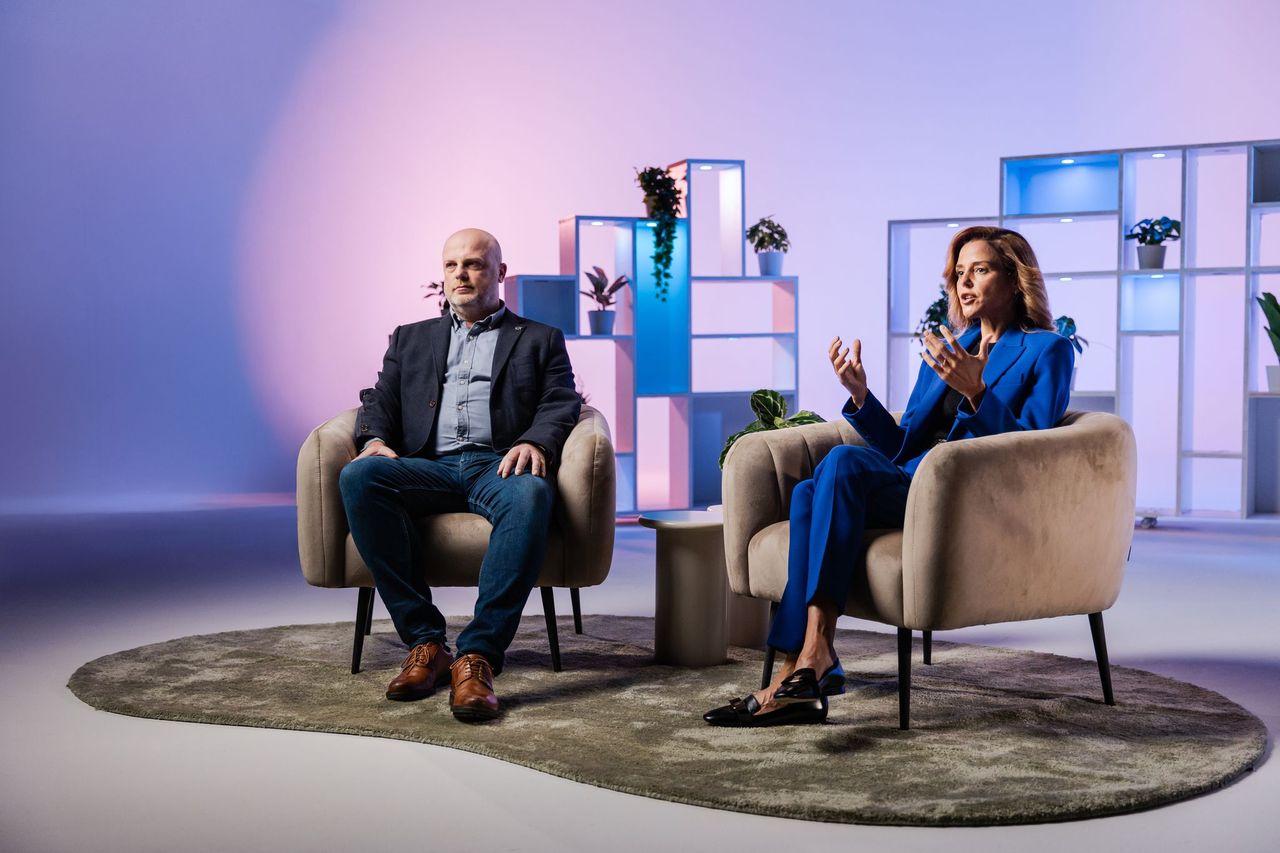
Meet Dr Nadine Hachach-Haram and Richard Carter
Founder/CEO and CTO, Proximie
After a dog bite left his thumb rather mangled, he sent a picture of the damage to Proximie's founder and CEO Nadine Hachach-Haram, who also happens to be a reconstructive surgeon.
She recognised that he needed an urgent operation and sent him to her clinic in the UK while she dialled in from New York to assist in the operation.
"My surgery was supervised, very weirdly, by my boss using my product," said Carter.
Perhaps nothing illustrates real-world impact better than that.
Dial a doctor
Proximie's mission is two-fold. In a world where 5 billion people are lacking access to safe surgery, it aims to connect operating rooms around the world so that patients can get the expertise they need regardless of where they live.
"We deploy our software into any operating room, and that can be the most sophisticated ones or the most remote ones in the middle of nowhere. We can enable doctors to work together to support and guide each other through complex cases," explains Hachach-Haram.
For example, when a patient at St. Thomas' hospital in London needed complex reconstruction surgery following testicular cancer, the surgeon was able to dial up the world expert on that type of case.
"They worked together to deliver the absolute best in quality care for this patient. It enabled us to upskill the local team, and it provided support, mentoring, and coaching."
Proximie's second aim is to drive efficiency in overworked operating rooms, helping alleviate pressure on healthcare systems and the huge backlogs for operations.
"How do we get more patients in theatre? It's not going to be about building more hospitals but about sweating the assets that we have. And to do that, we need real objective intelligence," explains Hachach-Haram.
Cutting waiting lists
Proximie collects and collates data via sensors that are placed in the operating room. The data is throwing up some interesting discoveries.
One thoracic surgeon at St. Thomas' couldn't understand why he could only ever get through three operations a day.
"We put our sensors in the operating rooms, we collected the data, and we identified the issue, which was that they were operating first on the left side of the body and then on the right. If you do right, left, right that is much less efficient than doing right, left, left right. We found other examples of where equipment was being prepared sequentially and it could have been prepared in parallel," explains Carter.
Now the surgeon has added a fourth or fifth surgery to their day.
"That's really impactful, both from a business and patient perspective," says Hachach-Haram.
All the tech
Overall, the firm estimates that its platform can save nearly a quarter of the time in operating rooms, which means there is capacity for an extra procedure each day.
That translates to hospitals being able to perform an estimated 297 additional surgeries per year, generating roughly £600,000 in extra revenue per department, while reducing delays for patients.
The firm can also help identify issues with patients that can avoid cancelled operations, as well as cut down on the infection risk from constantly opening the door to the operating room.
Connecting multiple data sets from devices, medical records, and imaging is a mammoth task, and one the firm relies on Amazon Web Services (AWS) for.
"We use a wide range of AWS technologies," says Carter. "If you want to collect data across multiple rooms, multiple health systems, and you want to do this safely and securely, a public cloud provider is essential. AWS has the real-time technologies and healthcare expertise that we rely on."
Examples of other tech use include the use of dynamic provisioning of hardware from AWS so that the firm doesn’t have to run lots of computers all the time. AWS also enables Proximie to manage video streams in real-time, train its AI models to the specifics of any operating room, and track the various AI models it is running with the problem it is answering.
AI agents
The firm is deploying AI agents, which could have a major impact on how healthcare data is shared.
"One of the big points of friction in healthcare is that you tend to have a lot of legacy systems that just don't talk to each other. With agents, that will help move the information around and flow better," explains Carter.
Agents may in future work hand in hand with surgeons but will never tell them what to do, he believes.
"I don't think that's realistic. What I do think is that agents will be able to say, 'You're at this part of the procedure, perhaps bring up this previous X-ray or CAT scan before you do the next step'. It's about making sure clinicians have the context that they need to do their job."
Worldwide help
AWS's role goes beyond technology. It is also partnering with Proximie on the Health Equity Project, a multi-year program currently deployed across six countries in East Africa for a range of surgeries, including cleft lip and palate care, neurosurgery, and obstetrics.
"We're in a world where two-thirds of the world's population is lacking access to the most basic surgical procedures, and we need to do something about that," says Hachach-Haram. "Take Kenya, where they have a high amount of obstetrics deaths, women dying during delivery and childbirth for a whole host of issues, and they have one obstetrician for the whole country."
"We can't magically create more doctors and nurses, but technology can make a big difference. This program is not an afterthought but is part of the DNA of what we do. We are incredibly fortunate to partner with AWS, who also believes in the impact that this could have for patients."
"Proximie was born out of a desire to turn these pretty analogue environments into smart, connected, data-driven, real-time intelligent environments where we can layer in technology to connect experts and share best practice," explains Hachach-Haram.
Behind the scenes