AWS Pioneers Project
European innovation, told by those who built it
Building the quantum machines that can power the future
Some quantum computers are stunningly beautiful - large golden chandeliers which look like they could be the operating system of a futuristic spaceship.
Jean Senellart, the CPO of photonic quantum computing firm Quandela, admits its machines are more down to Earth.
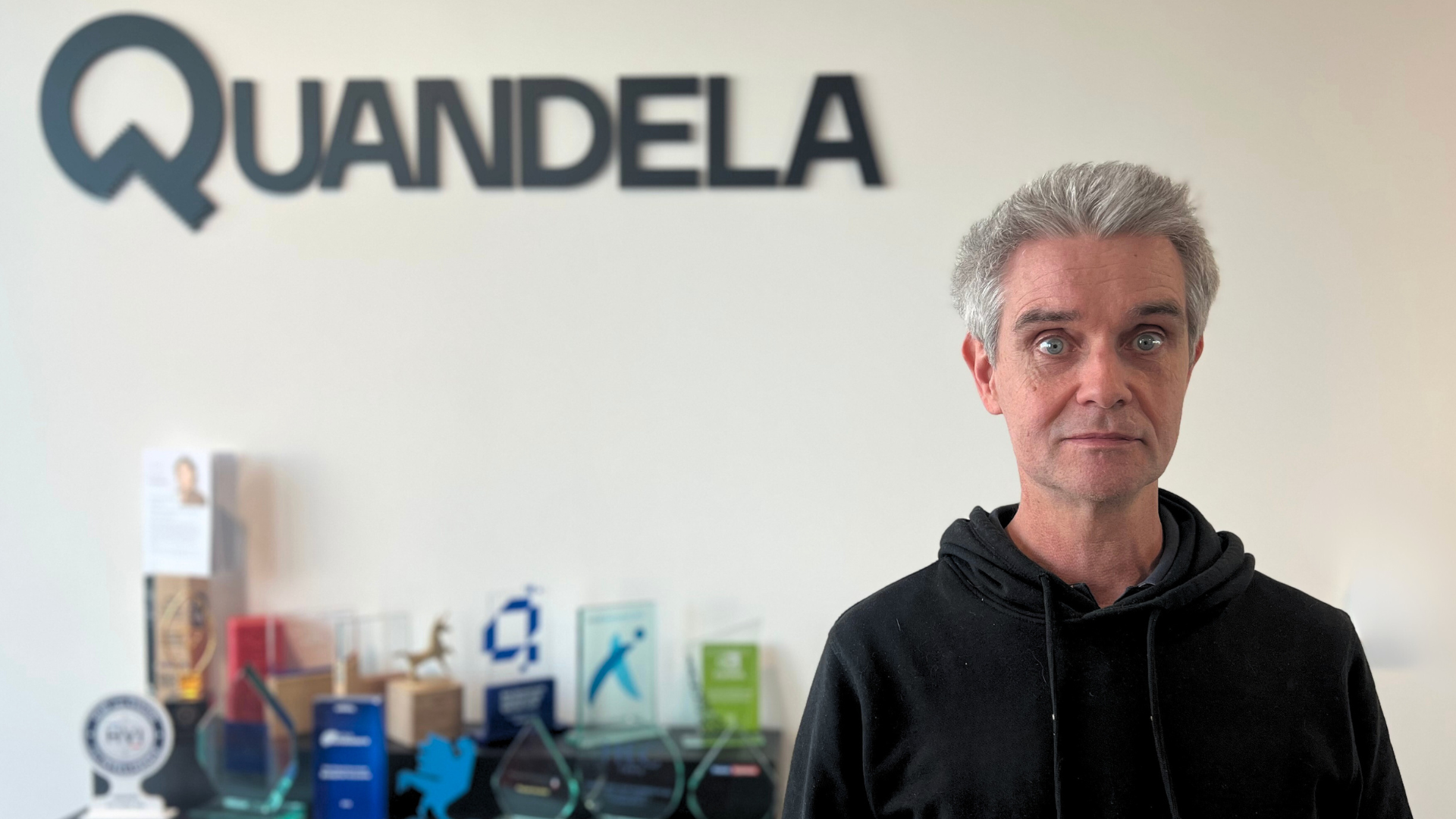
Meet Jean Senellart
CPO Quandela
“It’s very nice for us but not spectacular. It is a standard computer rack that you can find in a data centre.”
The look may be standard, but the ultimate ambition is not.
Quandela is building hardware and software that it hopes will “reframe the impossible”.
It has engineers working on building the machines themselves while others are looking at how to build the algorithms that will power the machines, and a third team is considering how to combine quantum with AI.
AI and the quantum advantage
“It is a new computing resource and also a challenge to understand how we can use this type of computing, especially in combination with AI,” he says.
The history of classical computing is one that spans 100 years, from Colossus, the codebreaking machines built during World War Two, to the mainframe computers of the 1960s through to the personal laptops we use now. They may have got faster, more powerful, and smaller, but many of the fundamental principles remain.
“They are all bound by the same mathematical model that was invented about 100 years ago by Alan Turing,” explains Senellart.
What the quantum world is waiting for is a turning point. “It’s what we call the quantum advantage. It is the point at which a quantum computer can solve a problem that would be practically impossible for even the most powerful classical ones,” he explains.
In simple terms, quantum computing processes information in a fundamentally different way, allowing it to explore many possible solutions at once. For certain complex problems — such as optimisation, molecular simulation or aspects of AI model training — this could dramatically reduce the time and computing power required.
Empowering researchers around the world
There are many ways of getting there, from superconducting qubits to trapped ions, neutral atoms and photons.
Photonic-based quantum computers can operate at room temperature and use existing fibre networks for communication, making them easier to integrate into standard data centre environments than systems that need to be kept at extremely low temperatures.
“If you want to connect the quantum computers, the only way will be with a photonic quantum link,” says Senellart.
The firm currently has five machines, including Belenos, a 12-qubit machine that is accessible via the cloud to more than 1,700 researchers across 30 countries. More recently the firm delivered Lucy, another 12-qubit machine that is installed in The Very Large Computing Center (TGCC), France’s national high-performance computing centre located in a town just outside Paris.
“The first application for these computers is research, and we have universities around the world that are using them,” explains Senellart.
“We are looking at use cases for finance, for chemistry, for optimising logistics. There is not one single use case, there are a lot of problems that we know we don’t have a good solution for from classical computers that we are trying to unlock.”
Pushing the boundaries of discovery
It is cutting edge stuff and AWS is both “a provider of the technology and an enabler of large-scale testing”, says Senellart.
“Where we and all the quantum companies are aiming in 10 to 15 years is a quantum computer that will provide a new type of computing capability and that will be able to do things that we cannot do today,” he adds.
Quandela are using AWS as a discovery engine to find quantum algorithms, where they combine GPUs, to do the AI part, and then make simulations of quantum. “To do that at scale we can’t use quantum computers because there are not enough around.”
Last year in Paris, the company was able to push quantum simulation of a photonic quantum computer up to a world-record 30 photons, using more than 200 GPUs in parallel on AWS.
“What we are trying to do with the collaboration with AWS today is that massive exploration of quantum algorithms at small scale to try to identify the best candidate that will give us a hint where we should push the technology,” says Senellart.
Quandela is also experimenting by using AWS’s Neuron software development kit which is designed to be more efficient for certain types of applications and uses less energy.
As to some of the bolder claims for what quantum will achieve – from solving climate change to ending disease - Senellart is more circumspect.
“Pinpointing the exact application is a bit of a strange game because it is just speculation. Quantum will not be solving all problems, it will just be a new tool that will be more efficient and more accurate for specific types of problems.”