Canada's AI Innovators
Creating breakthroughs in Canada and beyond
Haply Robotics: How AI is opening doors for democratized physical automation
In a neurosurgery simulation lab at Canada's National Research Council, a surgeon's hands move across a virtual brain with extraordinary precision. She can feel the texture of healthy neural tissue, sense the boundary between grey matter and tumour, experience the consequences of every micro-movement. It's revolutionary training—practically inaccessible to the thousands of surgeons and specialists who need it most.
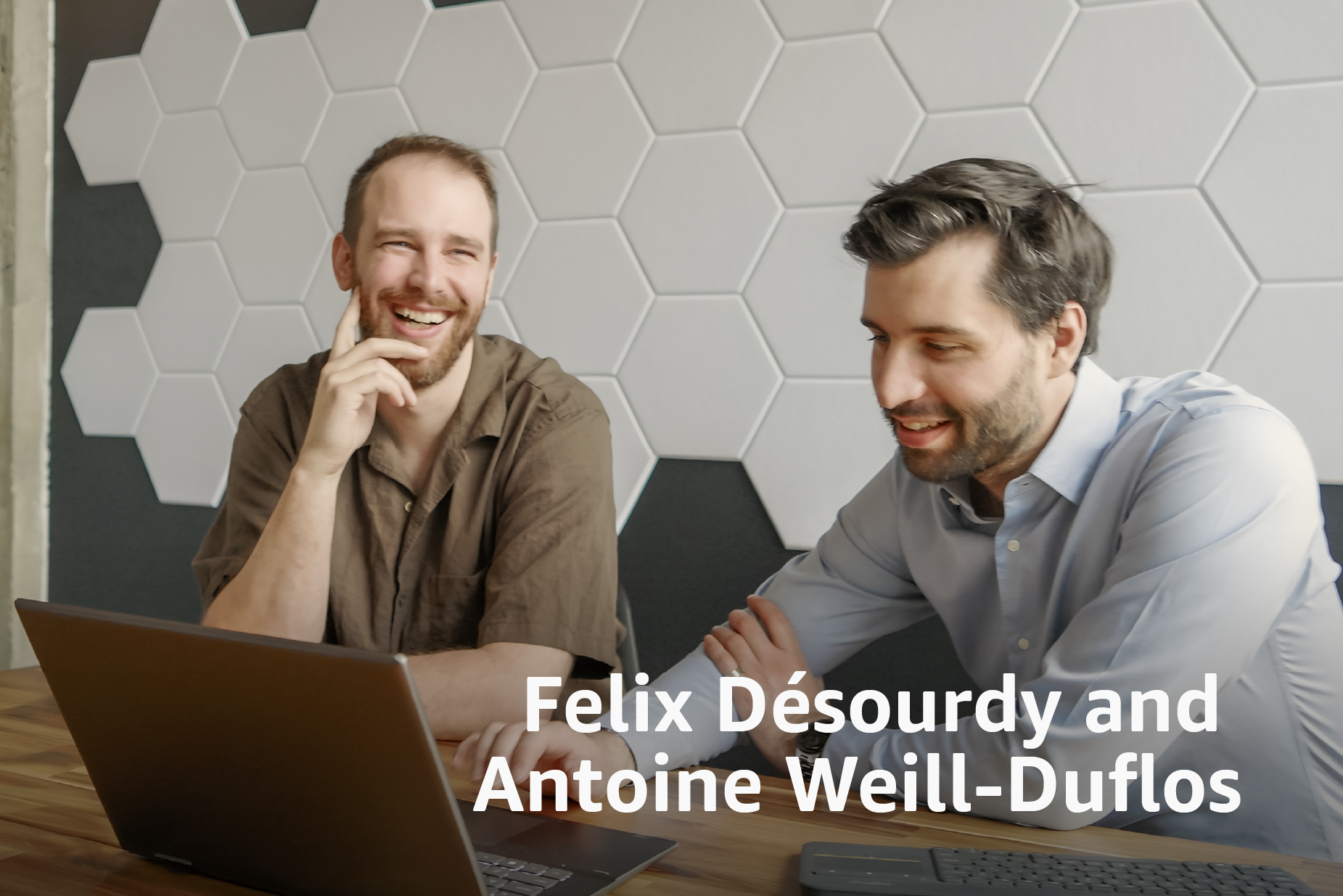
Meet Félix Désourdy and Antoine Weill-Duflos
Co-founder/head of mechanical engineering and head of technology and applications, Haply Robotics
This is the paradox Haply Robotics confronts: transformative technology that remains confined behind laboratory walls and prohibitive costs.
Félix Désourdy, co-founder and head of design at Haply Robotics, sees this differently.
"For decades, the technology existed only in research settings," Désourdy explains. "We asked ourselves: what if we could bring this into the real world? What if we could make it affordable? What if we could make it portable?"
Understanding expertise through touch
Founded in Montréal, Haply Robotics operates on a core conviction: humans learn through their senses, particularly touch. A master surgeon develops intuition through thousands of hours feeling tissue resistance. A skilled manufacturer understands material properties through tactile feedback. Yet robots have largely been denied this fundamental learning mechanism.
Haply started with a question: what if robots could learn from expert demonstration the way apprentices learn from masters—by observing and absorbing the tactile dimension of skill?
Traditional robotics required explicit programming. Engineers code every possible action and decision tree. But embodied expertise doesn't translate neatly into lines of code. It lives in sensation, in judgment calls made in milliseconds, in intuitions developed through years of practice.
"The first language we learn is touch," Désourdy notes. "We forget that robots need to learn it too."
Haply recognized that the pathway to scaling expertise wasn't through more programming—it was through capturing the sensory reality of skilled performance.
Building the infrastructure for knowledge transfer
To transform this insight into operational capability, Haply needed a platform that could capture rich haptic data from expert demonstrations, make sense of it, and deploy actionable models to field systems worldwide.
"We worked with AWS to construct the underlying architecture," explains Antoine Weill-Duflos, head of technology and applications at Haply Robotics.
AWS provides scalable compute resources, sophisticated data pipelines, and machine learning services that allowed Haply to ingest haptic recordings, extract patterns, and distribute trained systems globally. What previously existed solely within individual research institutions—a surgeon's refined technique, an engineer's instinctive precision, a specialist's decades of accumulated judgement—could now be recorded, analyzed, and made available.
"AWS enables us to host models in the cloud, train them on accumulated demonstrations, and deploy them to partners and clients," Weill-Duflos says. "Our customers access these systems without purchasing expensive specialized hardware."
Artificial intelligence: the translator of tacit knowledge
Processing raw haptic recordings was merely the beginning. The real challenge: extracting meaning. Understanding why experts perform actions precisely as they do.
Haply developed an AI system leveraging AWS's generative AI infrastructure to analyze haptic demonstrations and distill actionable intelligence. The system identifies not just what experts do, but why—the underlying logic of precision, the relationship between force and outcome, the patterns that distinguish mastery from competence.
"AI lets us capture specialized talent and ensure that people can continue executing remarkably intricate work. We're making complex motor skills reproducible and scalable," Weill-Duflos explains.
The practical implications are substantial. Surgical procedures that once demanded years of supervised practice can be learned through guided demonstration. Manufacturing processes requiring artisanal skill become standardized and repeatable. Organizations gain access to world-class capability previously reserved for elite institutions.
And all of this thanks to a portable controller that enables intuitive 3D navigation and interaction.
Transforming what's possible across sectors
The impact materializes in measurable ways across multiple domains:
Medical Practice: Surgeons train on minimally invasive procedures with genuine tactile simulation. Diagnostic specialists feel accurate feedback during ultrasounds and examinations. Clinicians in underserved regions access mentorship from leading practitioners without geographic barriers. "We're infusing more of the human element into clinical practice," Désourdy notes.
Industrial Operations: Assembly work requiring master-level dexterity becomes teachable and consistent. Quality processes that once depended on individual judgment transform into repeatable systems. Manufacturers deploy sophisticated capability throughout their operations rather than concentrating it in a few experts.
Workforce Development: Geographic location no longer determines access to premier training. Complex manual skills become learnable for broader populations. The traditional path—years of apprenticeship under scarce mentors—accelerates dramatically.
"The applications span genuinely every sector," Désourdy observes. "Manufacturing, medical, paramedical, industries we haven't yet imagined."
Reshaping what organizations expect from automation
"We're building solutions for organizations of every size," Désourdy emphasizes. "That expansion moves us from benefiting specific companies to transforming entire sectors. We're recalibrating what people believe automation should accomplish."
The conventional restrictions on deploying advanced automation—equipment costs, talent scarcity, learning curves measured in years—may seem immovable. Haply demonstrates that systems can be simultaneously more powerful for organizations and more achievable for workers—grounded in superior data and more natural learning.
Specialized knowledge previously confined to individual institutions or retained by individual practitioners can now be preserved, refined, and deployed universally.
"In Montréal, we're creating the next generation of robotics," Désourdy reflects. "And we’re transforming physical AI with the most human sense of all—touch.’’
Did you find what you were looking for today?
Let us know so we can improve the quality of the content on our pages