- AWS Solutions Library›
- Guidance for AI-Driven Robotic Simulation and Training on AWS
Guidance for AI-Driven Robotic Simulation and Training on AWS
Overview
This Guidance demonstrates how to build an AI-assisted robot training and fleet management system using Amazon Bedrock foundation models and AWS Trainium. It helps organizations overcome the complexity of training robots for precise tasks and managing fleets at scale through two complementary methodologies: imitation learning using NVIDIA Isaac Sim on Amazon EC2, and reinforcement learning with Bedrock-generated reward functions. The solution accelerates training with AWS Trainium, standardizes data processing with LeRobot datasets, and enables seamless fleet deployment through AWS IoT Core. This guidance also showcases Reinforcement Learning with Vision Language Action Model reference architecture that shows how to train robot policies using reinforcement learning with Vision-Language-Action (VLA) models on AWS infrastructure. This comprehensive approach reduces implementation time, ensures scalability, and delivers robust industrial robotics capabilities without requiring deep AI expertise.
Benefits
Deploy continuous integration workflows that automatically build, train, and version Vision-Language-Action models when code updates occur. Reduce manual intervention and accelerate iteration cycles by orchestrating distributed GPU training across scalable compute resources.
Train complex robotic policies using centralized storage for camera frames, joint states, and language annotations with elastic compute provisioning. Handle large demonstration datasets and distribute training workloads across multiple nodes to fine-tune sophisticated models faster.
Transition trained VLA models from development to production using containerized inference services with automated artifact management. Maintain model lineage and version control while serving real-time action commands to your robot fleet with consistent performance.
How it works
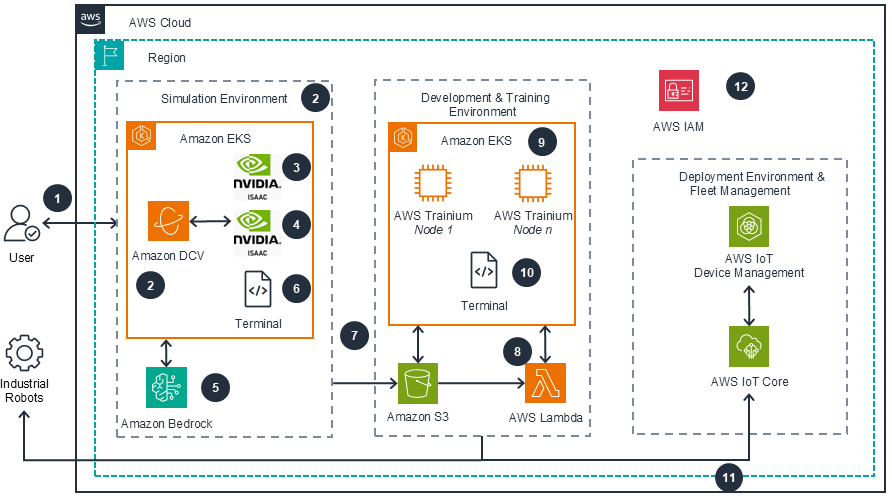
Imitation Learning Simulation Environment
This architecture diagram shows a robotic learning system integrating the intelligence of foundation models with ML and mathematical algorithms, accelerated by AWS Trainium/GPU infrastructure and managed through cloud-native technologies.
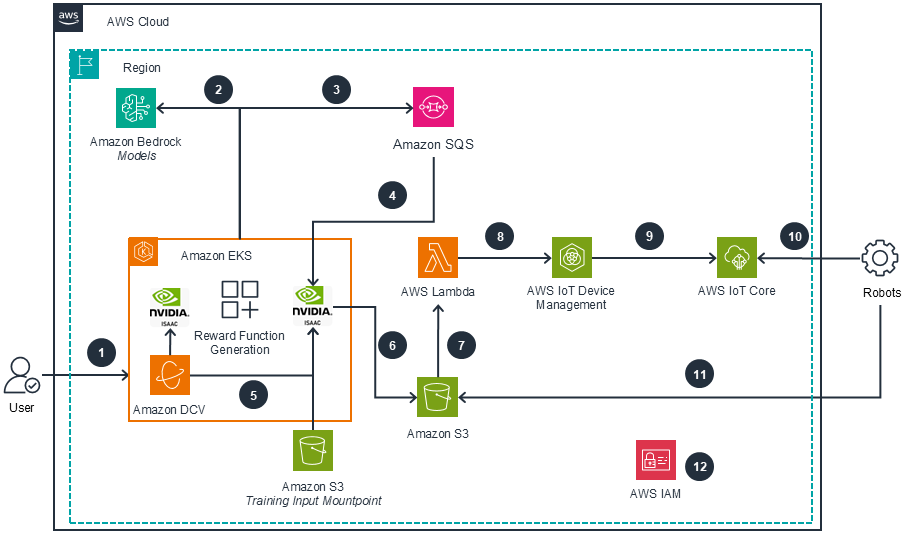
Reinforcement Learning Training Environment
This architecture diagram shows developers how to train robotic agents using NVIDIA Isaac Sim on Amazon EKS with LLM-generated reward functions, then automatically deploy trained models to physical robots using AWS IoT services.
Deploy with confidence
Ready to deploy? Review the Imitation Learning in Simulation Environment sample code on GitHub for detailed deployment instructions to deploy as-is or customize to fit your needs.
How it works
This Reinforcement Learning with Vision Language Action Model reference architecture demonstrates how to train robot policies using reinforcement learning with Vision-Language-Action (VLA) models on AWS infrastructure.
Deploy with confidence
Ready to deploy? Review the Reinforcement Learning with Vision Language Action Model sample code on GitHub for detailed deployment instructions to deploy as-is or customize to fit your needs.
Disclaimer
The sample code; software libraries; command line tools; proofs of concept; templates; or other related technology (including any of the foregoing that are provided by our personnel) is provided to you as AWS Content under the AWS Customer Agreement, or the relevant written agreement between you and AWS (whichever applies). You should not use this AWS Content in your production accounts, or on production or other critical data. You are responsible for testing, securing, and optimizing the AWS Content, such as sample code, as appropriate for production grade use based on your specific quality control practices and standards. Deploying AWS Content may incur AWS charges for creating or using AWS chargeable resources, such as running Amazon EC2 instances or using Amazon S3 storage.
Did you find what you were looking for today?
Let us know so we can improve the quality of the content on our pages