- AWS Solutions Library›
- Guidance for Building Hybrid Satellite Imagery Processing Workloads on AWS
Guidance for Building Hybrid Satellite Imagery Processing Workloads on AWS
Overview
This Guidance demonstrates how to deploy satellite data processing pipelines on AWS and on-premises environments with consistent infrastructure and user experiences. In the aerospace industry, a dual deployment is important for a variety of reasons, such as satisfying data residency requirements or protecting existing investments. With the same APIs and automation, deployment, and security tools, this Guidance helps you maintain your pace of innovation in either deployment while also diminishing your operational overhead. This approach allows for flexibility in managing hybrid infrastructure, streamlining operations, and maximizing efficiency in satellite data processing.
Benefits
Deploy containerized processing pipelines using GitOps automation with AWS CodePipeline and Flux CD. Reduce manual configuration errors while maintaining consistent environments across hybrid infrastructure.
Run machine learning inferencing and batch processing locally using Amazon EKS on Outposts or EKS Anywhere. Meet data residency requirements while leveraging AWS-managed Kubernetes orchestration for satellite workloads.
Gain centralized visibility into your satellite processing pipelines with Amazon CloudWatch. Track performance metrics and operational health across both AWS Region and on-premises infrastructure from a single interface.
How it works
Deployment on AWS Outposts
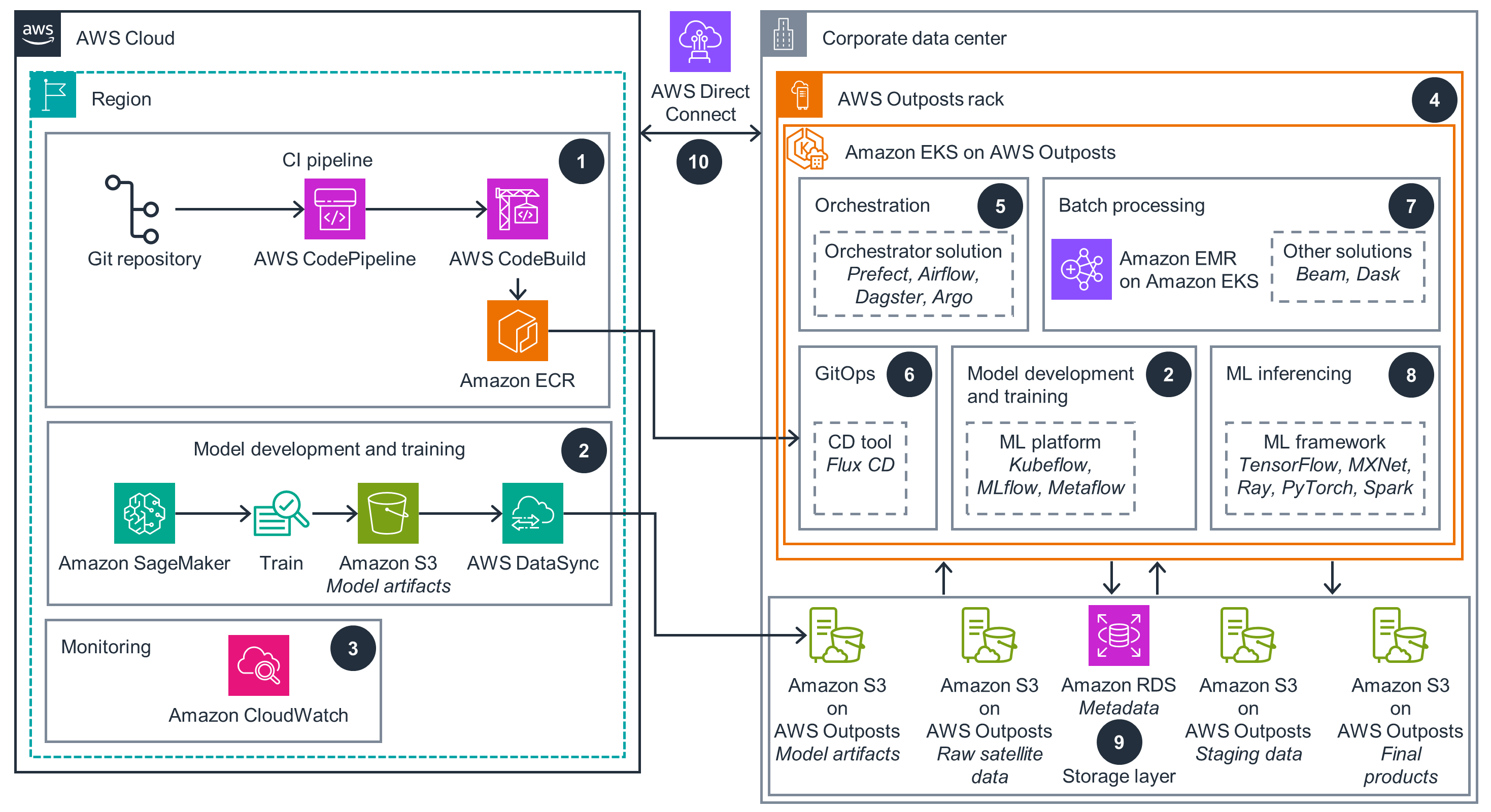
This architecture diagram shows how to build a hybrid workload containing a satellite imagery processing pipeline deployed on an AWS Outposts rack.
Deployment on premises
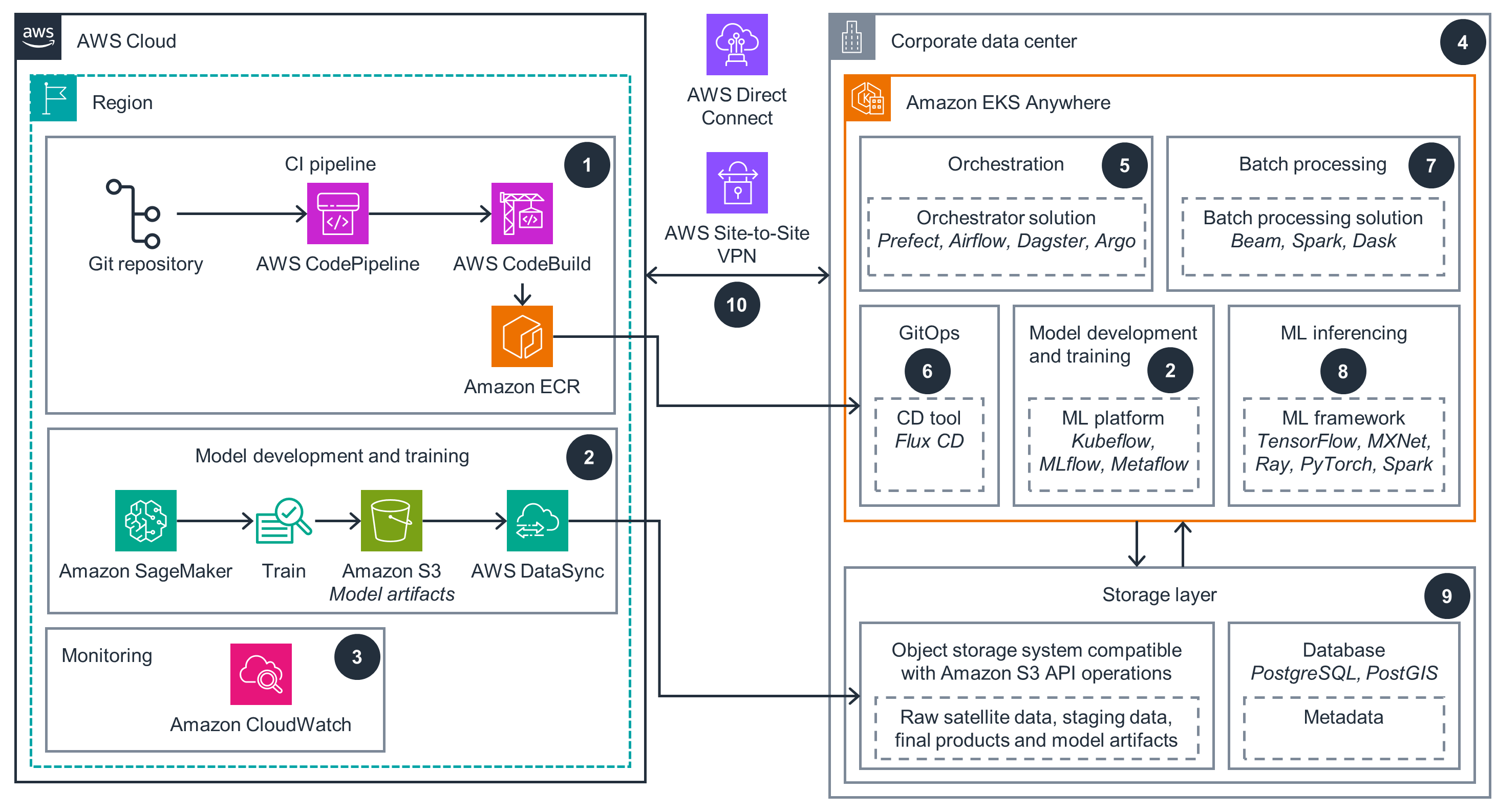
This architecture diagram shows how to build a hybrid workload containing a satellite imagery processing pipeline deployed on your infrastructure.
Disclaimer
The sample code; software libraries; command line tools; proofs of concept; templates; or other related technology (including any of the foregoing that are provided by our personnel) is provided to you as AWS Content under the AWS Customer Agreement, or the relevant written agreement between you and AWS (whichever applies). You should not use this AWS Content in your production accounts, or on production or other critical data. You are responsible for testing, securing, and optimizing the AWS Content, such as sample code, as appropriate for production grade use based on your specific quality control practices and standards. Deploying AWS Content may incur AWS charges for creating or using AWS chargeable resources, such as running Amazon EC2 instances or using Amazon S3 storage.
Did you find what you were looking for today?
Let us know so we can improve the quality of the content on our pages