AWS in Switzerland and Austria (Alps)
Teaching Healthcare Innovation with Kiro: Turn Ideas into Working Prototypes
Healthcare educators and innovators can take an idea from concept to a working prototype, deployed on AWS, in a single day, without a dedicated software engineering team. At a hands-on workshop at the University of St. Gallen (HSG), five teams of students, start-up founders, and industry experts used Kiro, an agentic AI-powered integrated development environment (IDE) from Amazon Web Services (AWS), to build and deploy prototypes for real healthcare challenges.
Prof. Zoe Jonassen launched this initiative to accelerate healthcare innovation. This post shares the workshop format, what the teams built, and what we learned about helping healthcare builders move from concept to cloud, so you can run it with your own teams.
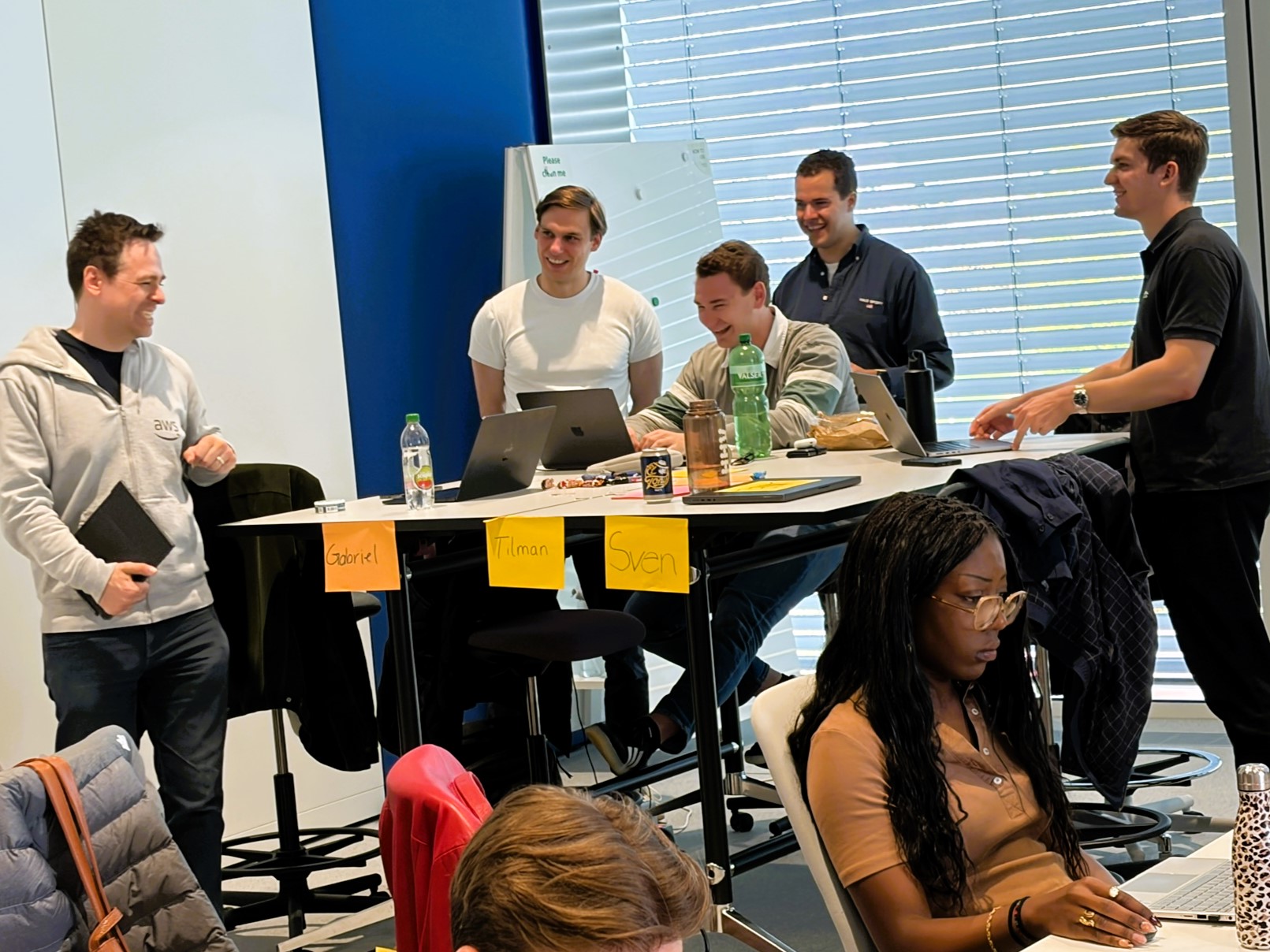
The workshop proved inspiring and educational, showing the five teams how to accelerate innovation and build on AWS.
The challenge: from healthcare idea to working application
Healthcare organizations across Europe want to accelerate innovation. Building working applications faster would help improve clinical workflows, supporting personalized treatment, or making research data more accessible.
Traditional software development requires months of planning, specialized engineering teams, and deep knowledge of cloud infrastructure, security, and compliance. For healthcare professionals, researchers, and early-stage innovators, this creates a gap. They understand the clinical problem statement but can’t quickly validate their ideas through working software. The result is that promising concepts stall at the whiteboard stage or require lengthy procurement cycles.
At the same time, healthcare builders face unique constraints. Applications handling patient data must be designed with privacy, security, and regulatory compliance in mind from the start. This adds complexity for anyone attempting to build prototypes.
The question we set out to answer: What can you build with agentic AI in a day to accelerate prototype application development for the healthcare domain?
The University of St. Gallen: where healthcare meets innovation
The University of St. Gallen (HSG) is one of Europe’s top-ranked business universities, consistently ranked among the top institutions for management and innovation as one of the most entrepreneurial universities, placed in the Top 3 across the German-speaking region. The healthcare course, led by Prof. Zoe Jonassen at the Chair of Assessing Innovation in Healthcare, brings together participants from clinical, business, and technical backgrounds to explore how emerging technologies can improve healthcare delivery. The format includes invited guest lectures at HSG from thought leaders across the industry on AI in healthcare, creating a launchpad for innovation. The session delivered by Dr. Christoph Russ on how agentic AI is transforming healthcare set the scope for participants to propose their ideas and to see what is possible today.
The approach: rapid prototyping with Kiro
Unlike traditional coding tools that require developers to write every line manually, Kiro uses spec-driven development: you describe what you want to build in natural language, and Kiro’s AI agent generates requirements, designs the architecture, breaks the work into tasks, and writes the code. For healthcare builders, this means, instead of needing a full engineering team to validate an idea, a domain expert can describe their clinical workflow, data model, or user experience, and Kiro translates that into a working application, deployed in the cloud, and accessible through a user interface. During the workshop, students received an introduction to Kiro and spec-driven development, a Kiro subscription, and access to an AWS account to start rapid prototyping.
Three capabilities of Kiro proved critical for this workshop. First, spec-driven development let teams describe their healthcare use case in plain language. Kiro generated structured specifications (“specs”) that include requirements, proposed architecture, and help break the implementation into discrete tasks, so teams spent their time refining what to build rather than struggling with how. Second, Kiro’s agentic coding wrote, tested, and iterated on code autonomously; when a team needed a REST API, a database schema, or a frontend component, they described it and Kiro implemented it with the help of the AWS API MCP Server, including error handling, input validation, and AWS service integration. Third, guardrails and steering allowed teams to define project-level rules (for example “use Fast Healthcare Interoperability Resources (FHIR) compliant data models”) that Kiro enforced throughout development, addressing specific healthcare needs from the start with the help of tools such as an open-source Model Context Protocol (MCP) server for AWS HealthLake.
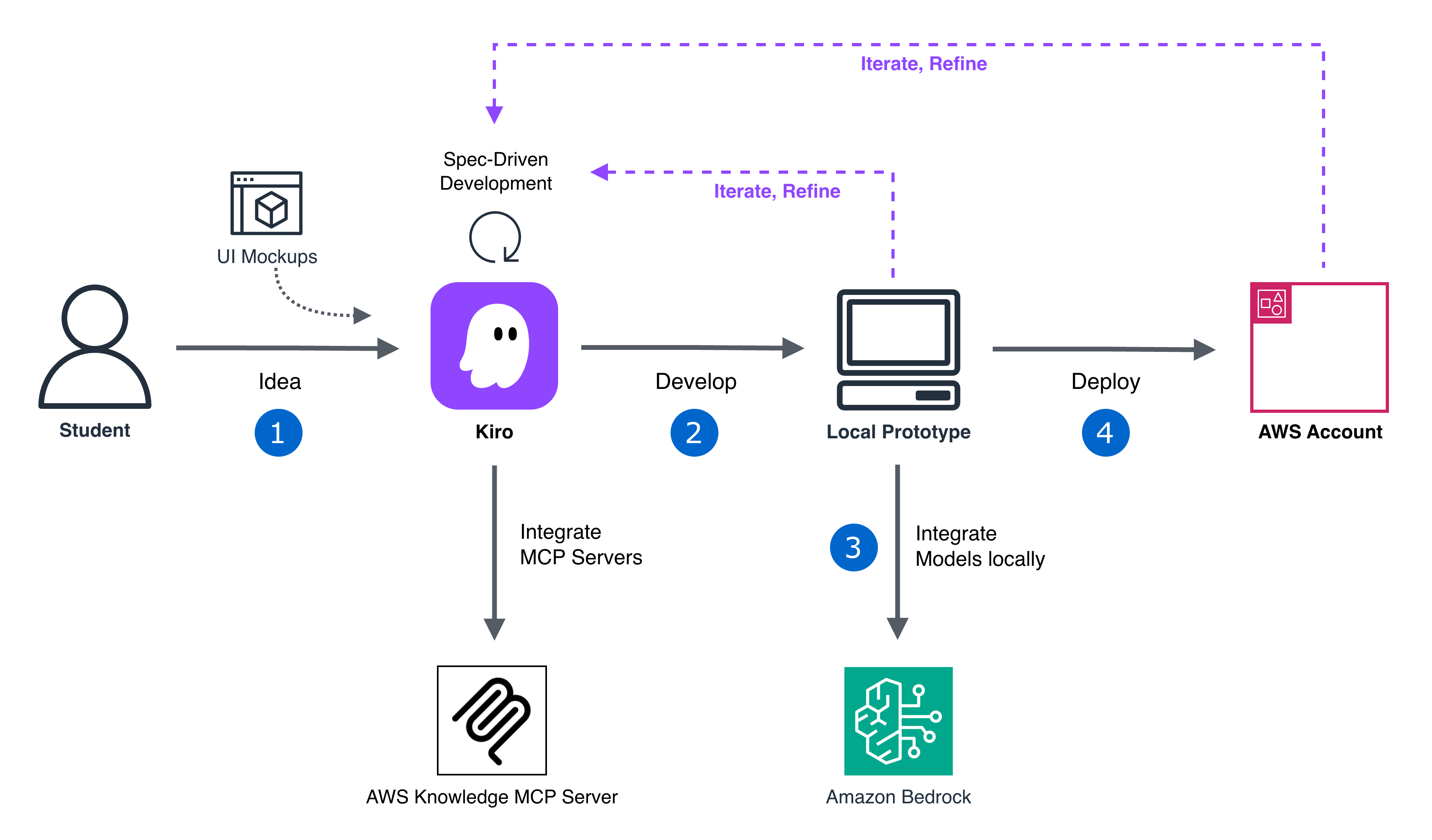
Overview Diagram highlighting the individual steps to go from idea to deployment on AWS with the help of Kiro and MCP servers.
In practice, these three capabilities came together in one workflow. Each team started with an idea (1) and described it to Kiro in plain language, sometimes alongside UI mockups to guide the interface. Kiro used spec-driven development to turn that description into a prototype the team could develop and run locally (2). Teams added the AWS Knowledge MCP Server to Kiro so it could generate code against current AWS APIs and best practices, and they integrated generative AI models on Amazon Bedrock as they developed (3). Once the prototype worked, teams deployed it to an AWS Account provisioned for the workshop (4), iterating with Kiro along the way to refine the specification and the code as they went. For the subject matter experts and non-developers in the room, this made rapid prototyping practical, letting the person who understands the healthcare problem build and deploy a working application while Kiro produced the underlying code.
Outcomes: what was built in eight hours
Five teams built working prototypes during the workshop, each addressing a different healthcare challenge. Here are two examples that illustrate what was possible in a single day.
FEMCARE
The healthcare problem addressed
For patients booking appointments with their gynecologist is often inconvenient and time-consuming, leading some patients to postpone important visits, while consultations can feel rushed and leave concerns insufficiently addressed. On the provider side, gynecologists still manage scheduling and waitlists manually, with limited time to prepare properly for each patient, reducing the quality of care.
What they built
FemCare is an AI-powered platform that streamlines the entire gynecology patient journey end-to-end. The application covers every step from appointment booking and intake to consultation and follow-up to reduce the administrative burden for doctors while improving the patient experience. FemCare automates workflows and improves preparation for patient visits and enables doctors to enter consultations fully prepared to help patients feel heard.
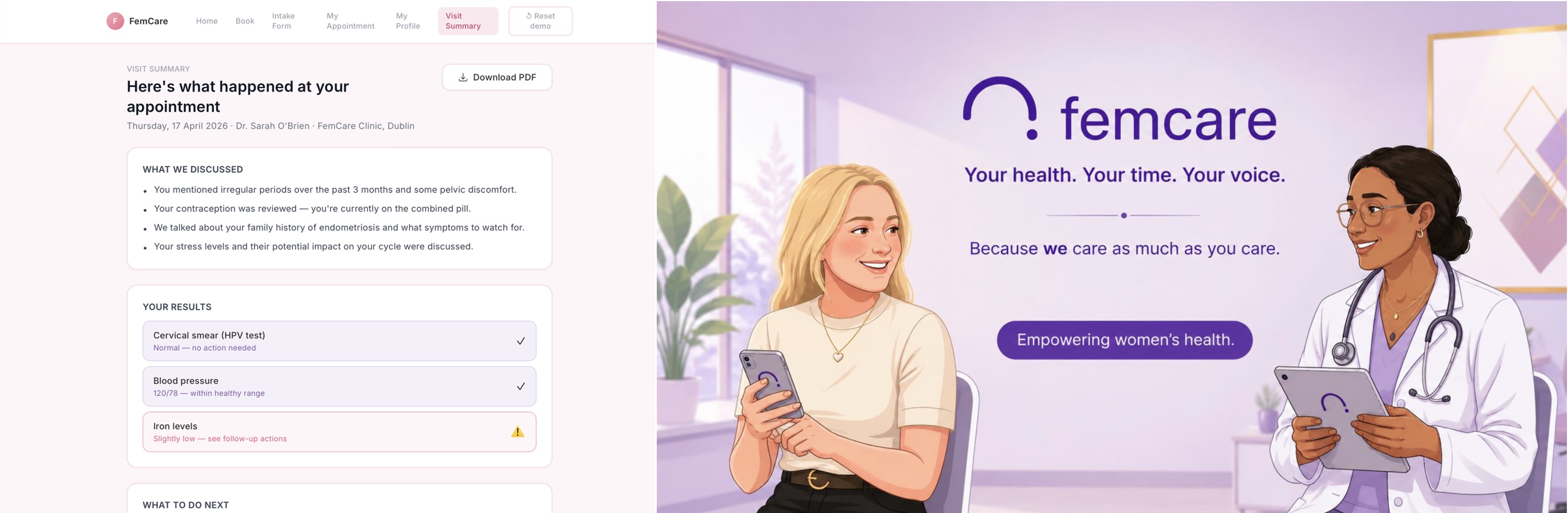
Femcare interface provides appointment scheduling support that considers patient needs and aims to integrate with doctors consultation preparation workflows.
MEALSAFE
The healthcare problem addressed
Hospital food safety systems are often fragmented and heavily dependent on human memory, leading to elevated errors, delayed interventions, and poor coordination across the meal delivery process. Hospitals struggle to consistently monitor food handling, dietary compliance, and real-time issue resolution within existing workflows.
What they built
An AI-powered centralized platform that orchestrates the entire hospital meal journey from meal planning and preparation to delivery and monitoring. The system uses AI-driven controls to improve food safety, reduce human error, enable real-time intervention, and create integrated coordination across hospital food operations.
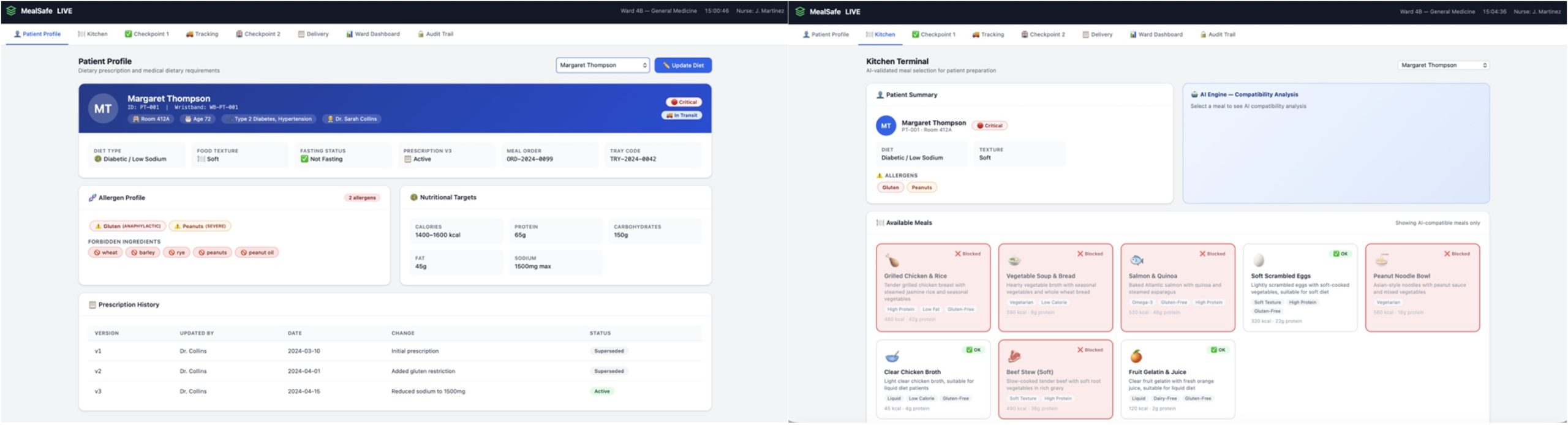
The MealSafe interface combines a patient profile dashboard with real-time allergy alerts and a kitchen terminal where AI-driven compatibility checks prevent unsafe meals from reaching patients with specific dietary restrictions.
Results and benefits
The workshop demonstrated that agentic AI development tools can fundamentally change how healthcare innovation is taught and practiced:
- Five working prototypes built in a single day by teams without professional software engineering backgrounds
- Reduced time-to-validation of ideas that would previously require weeks of engineering effort, validated in hours, allowing faster iteration to validate the clinical value proposition
- Accessible to domain experts participants with healthcare, business, and research backgrounds can drive the development process, with Kiro handling the engineering complexity
Lessons learned
If you plan to run a similar workshop with your students, our experience points to three factors that made the biggest difference.
Tool access turned out to be the single largest source of friction we could eliminate in advance. We recommend checking whether your university is already eligible for the Kiro for Students program so that every participant can start building on day one without worrying about setup or licensing.
Equally important is arriving at the workshop with a clear problem statement already in hand. In our case, teams that had defined their healthcare use case, identified a target user, and outlined a core workflow before the event spent their eight hours building and iterating rather than debating scope. Pre-workshop preparation effectively doubled the productive time available.
Finally, the strongest prototypes came from teams that committed to a single, well-defined user journey rather than trying to cover multiple workflows at once. Kiro’s spec-driven approach rewards clarity of intent: a focused requirement document produces more coherent code, while a sprawling wishlist leads to half-finished features. Keeping scope tight, combined with straightforward tool access and pre-defined scenarios, lowered the barrier to entry for healthcare builders without engineering backgrounds and let domain expertise take center stage.
Student Voices on Kiro:
«Especially about Kiro I liked the way you can approach a project. It is not just blind prompting. You can really see the different layers of how the app is built. It is very intuitive to use. It makes the process way more efficient.» – Christian (Business student)
«I really liked it. I was introduced to a new product. I liked the different features that Kiro included. It could plan different features of the development process. It was a very practical workshop where you could actually work on a real prototype.» – Ismael (Computer Science student)
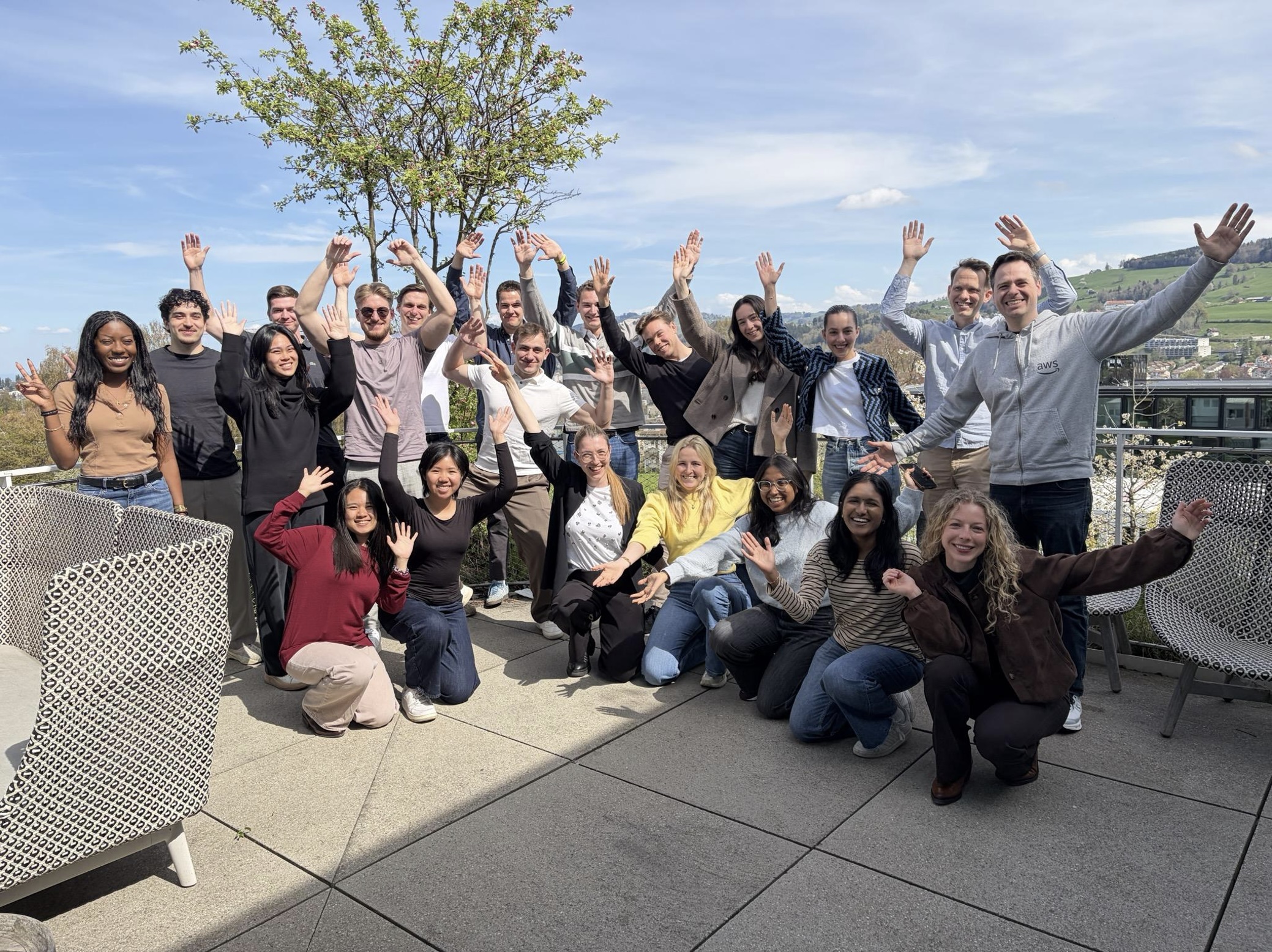
The team at HSG after completing their development and presentations.
How to Get Started
The format, combining domain expertise, bright minds and agentic AI tools, is designed to be repeatable and adaptable for other healthcare organizations, research institutions, and educational programs looking to accelerate innovation.
If you’re interested in running a similar workshop or exploring how Kiro can accelerate healthcare application development, here are your next steps:
Try Kiro yourself: Get started with Kiro
Read more about Kiro for healthcare: From Prompt to Pipeline: AI-Powered Bioinformatics Workflow Development with Kiro and AWS HealthOmics
Run your own Kiro workshop:
- Kiro Express: Learn the fundamentals of Kiro, Amazon’s AI-powered development platform, by building a complete arcade game from scratch.
- From Research to Radiology App: Train and Deploy Vision-Language Models on Amazon SageMaker with Kiro.
Connect with us: Reach out to the AWS for Healthcare team