AWS for SAP
Accelerate your SAP Clean Core journey with Kiro agents
If you’re running SAP systems, you likely face the challenge of identifying and remediating custom code that creates upgrade blockers. SAP Clean core assessment and remediation tasks can consume weeks of manual effort, preventing you from accelerating your modernization timeline.
Kiro Agents can transform how you approach SAP Clean Core strategy. A clean core journey typically unfolds in three phases — assess your custom code, remediate the violations, and operate in a clean core manner going forward — and Kiro Agents can accelerate every one of them. These open-source agents, released on GitHub, automate the classification of ABAP code violations and provide detailed remediation guidance. Instead of manually reviewing thousands of ABAP objects, you can now complete comprehensive assessments in hours rather than weeks.
In this post, you’ll discover how to use Kiro agents to automate your SAP Clean Core assessment, understand the cost considerations for large-scale implementations, and follow step-by-step instructions to get started with your first automated assessment.
Understanding SAP Clean Core
Keeping your SAP core clean means minimizing direct modifications to the standard software and building new capabilities as extensions using released APIs. This keeps your S/4HANA system upgrade-safe, cloud-ready, and able to adopt SAP innovations as they’re delivered.
Custom code that depends on internal SAP objects creates upgrade risk. Clean Core governance quantifies and reduces that risk through ABAP Cloud development model, keeping the system maintainable as SAP evolves. In August 2025, SAP released the new maturity model, as the graphic below shows, which classifies custom development across Levels A – D instead of binary designation of clean vs not clean. Whether you’re already on the journey or just getting started, following are the primary things you should focus on:
- Eliminating unused custom code
- Classifying custom code levels
- Moving away from level D
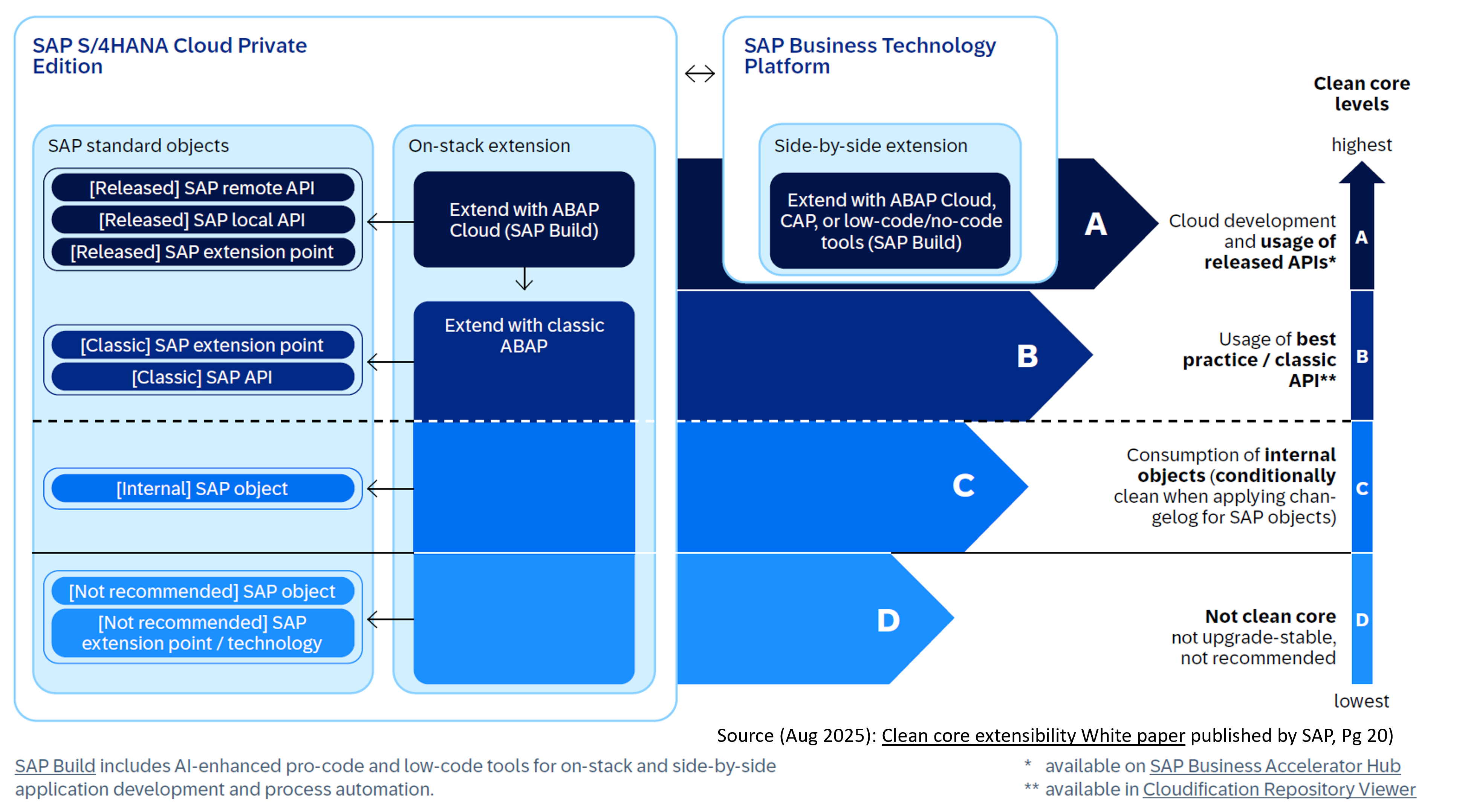
SAP Clean Core level classification for custom code
Eliminate unused custom code
Working with SAP customers, our observation is that a typical organization doesn’t use 50% – 60% of their custom code – so you’re probably maintaining more than half of the custom codebase without any business benefit. Eliminating it should be high in the priority list of clean core and allows simplifying future projects.
Classify custom code levels
SAP provides not only the classification guidelines, but also ABAP Test Cockpit (ATC) check categories – use the ATC checks to get an idea of where you stand. Clean Core distribution by levels is a helpful metric to track progress.
Moving towards clean core readiness
While Level A represents the north star for long-term cloud readiness, eliminating Level D code delivers the highest return on investment for most organizations. Level D code—including modifications, implicit/explicit enhancements, direct writes to SAP tables, and use of unreleased APIs—blocks upgrades and creates critical transport errors. Moving from Level D to Level C or B immediately removes upgrade blockers and reduces technical debt without requiring full ABAP code refactoring. This pragmatic approach lets you prioritize remediation by removing the code that actively prevents your S/4HANA system from staying current.
Kiro agents to the rescue
You can now automate your SAP Clean Core assessment using Kiro agents, open-source tools released on GitHub that streamline the identification and remediation of code violations. These agents analyze your ABAP codebase and provide detailed reports on Level D code that could block your S/4HANA upgrade. The repository provides detailed setup instructions, workflow overviews, security considerations and examples to get started quickly.
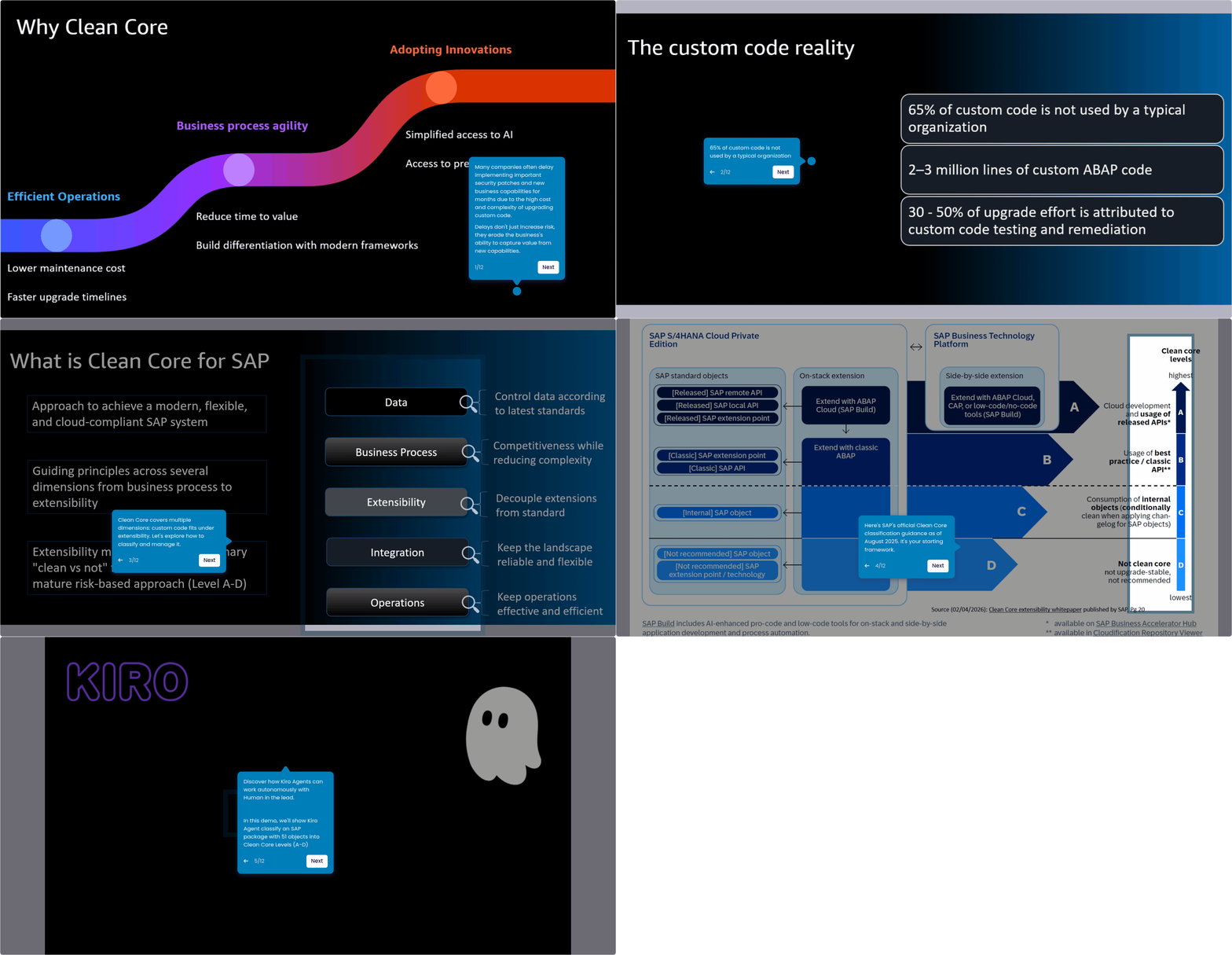
The following video gives an overview of the clean core framework. Kiro agents integrate with your existing ABAP Test Cockpit (ATC) workflows and use foundation AI models available through Amazon Bedrock to classify and prioritize remediation tasks. The agents build on top of the ABAP Accelerator MCP Server to provide a complete workflow from initial code scan to final assessment report.
Cost considerations
Kiro agents use AI models hosted on Amazon Bedrock to analyze your custom code, and costs scale with the number of objects assessed. Based on testing with Anthropic Claude Opus 4.5, assessing 1,000 ABAP objects requires approximately 700-750 credits and completes in under 4 hours.
With the Kiro Pro plan ($20/month, 1,000 credits included), this assessment fits entirely within your monthly allocation at approximately $0.02 per object.
You can optimize costs by configuring different models for different tasks. Use Anthropic Claude Opus for documentation and complex analysis where quality matters most, and Anthropic Claude Sonnet (40% cheaper compared to Anthropic Claude Opus) or Anthropic Claude Haiku (80% cheaper compared to Anthropic Claude Opus) for routine ATC classification checks. This hybrid approach can reduce assessment costs by 40-50% while maintaining high-quality results.
For large codebases with thousands of objects, the Kiro Power plan ($200/month, 10,000 credits) provides the most cost-effective option. For detailed information, visit the Kiro pricing page.
Getting started
In this post, you learned how Kiro agents automate SAP Clean Core assessment by eliminating unused custom code, classifying code maturity levels, and prioritizing remediation efforts.
Ready to automate your SAP Clean Core assessment? Follow these steps to begin using Kiro agents:
- Access the tools: Visit the Kiro agents GitHub repository to download the latest release and review the documentation
- Set up your environment: Configure the ABAP Accelerator MCP Server in your development environment and verify connectivity to your SAP systems
- Run your first assessment: Start with a small subset of your ABAP objects to familiarize yourself with the workflow and output formats
- Scale your implementation: Once comfortable with the process, expand to assess your complete codebase and integrate the results into your upgrade planning
For additional guidance on SAP Clean Core best practices, review the ABAP Extensibility Guide – Clean Core and the ATC Cloud Readiness Check Variants available on GitHub.
Build open source with us
We invite you to not only use the clean core tool to accelerate your journey but also extend and build new capabilities with the Kiro custom agents.
We’d like to hear about your experience. Share your feedback in the comments section or reach out to us on Linkedin: Ravi Kashyap, Stephan Kremer, Adam Hill