AWS Business Intelligence Blog
Transforming healthcare analytics: Arcadia’s journey with Amazon Quick Sight
This is a guest post by Mike Cook from Arcadia.
As Arcadia’s data analytics team, we’ve witnessed firsthand the challenges healthcare organizations face in making sense of their vast data landscapes. Nursing shortages, physician burnout, complex care delivery demands, and the lasting impacts of the COVID-19 pandemic underscore the need for agile, data-driven solutions to provide high-quality patient care, promote staff well-being, and optimize operational efficiency. Arcadia’s platform aggregates data from various sources, including electronic health records (EHRs), claims data, clinical data, and third-party data, to provide a comprehensive view of healthcare operations and patient care needs. The tools use advanced analytics to support predictive insights, streamline resource allocation, and drive data-driven decisions that enhance operational efficiency and improve care delivery outcomes.
In this post, discover how Arcadia’s dashboard development suite, which is part of Arcadia SummitTM health data platform, harnesses the power of Amazon Quick Sight to drastically improve healthcare analytics. Through innovative tools enhanced by advanced analytics and machine learning capabilities, Arcadia, a leading healthcare data platform and software company, is tackling important industry challenges and spearheading meaningful transformation in healthcare delivery and management.
The need for actionable data in healthcare and our Quick Sight solution
Every day, we watched our healthcare partners struggle with rigid reporting systems that couldn’t keep pace with their needs. Organizations would spend weeks generating basic performance reports, while valuable insights remained buried in siloed data systems. As our Chief Data Officer, Jacob Hochberg, often reminded us, “We’re sitting on a goldmine of information, but we need to make it accessible and actionable.” Data-driven decision-making is crucial for effective care management in healthcare organizations. It helps optimize performance, allocate resources efficiently, manage costs, enhance employee satisfaction, improve care quality, and streamline regulatory compliance.
After evaluating numerous visualization platforms, we chose to build our dashboard development product suite on Quick Sight. The decision wasn’t just about technology, it was about finding a partner that could match our vision for healthcare analytics. Quick Sight offered seamless integration with our existing AWS infrastructure, making it the natural choice for delivering scalable, cost-effective insights to our clients.
We began by developing a core library of dashboards, focusing on the metrics that matter most to healthcare organizations. Today, that library has grown to over 50 productized dashboards, each refined through continuous feedback from our users. What makes us particularly proud is how we’ve managed to balance standardization with flexibility: although our dashboards provide immediate value out of the box, we’ve built them to be customizable for each organization’s unique needs. For customers who prefer a self-service approach, we help customers quickly build and share their own reports, leveraging Arcadia’s data structures and the security and scalability of Quick Sight to support demanding enterprise-level use cases. Healthcare providers, business users, and executives can now access data on utilization metrics, quality performance, risk gaps, and contract analytics, giving them actionable insights to drive better quality of care and financial performance.
Technical implementation
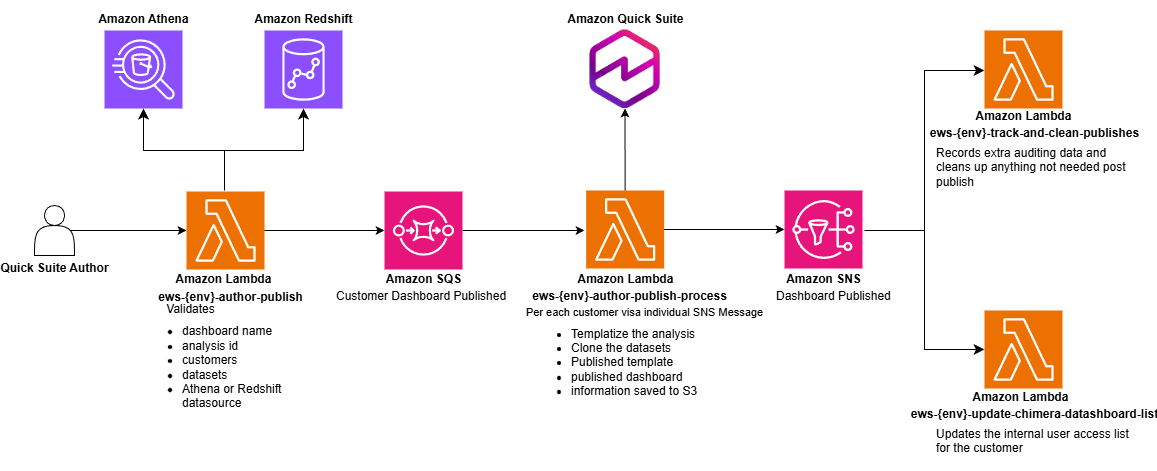
Our engineering team took on the challenge of integrating diverse data sources into a unified analytics platform. We built our solution on top of our Amazon Redshift based Foundry database, implementing sophisticated extract, transform, and load (ETL) processes to transform raw healthcare data into meaningful insights. One of our favorite examples is how we handled the complexity of medical claims data: we developed a Medical Economics engine that consolidates multiple claim lines into single care events, making analysis substantially more intuitive for our users.
The security implementation was particularly crucial for us. Working in healthcare means managing some of the most sensitive data out there. We implemented row-level security and robust encryption while making sure authorized users could still access insights quickly and easily. It’s a balance we’re particularly proud of achieving. The following diagram illustrates our solution architecture.
Real impact on healthcare delivery
The most rewarding part of our work has been seeing how healthcare organizations use our platform to drive real change. One of our partner organizations reduced their reporting time from 3 weeks to just minutes, helping their care management team identify and address care gaps almost immediately. Another client used our population health dashboards to identify at-risk patients proactively, leading to earlier interventions and better outcomes.
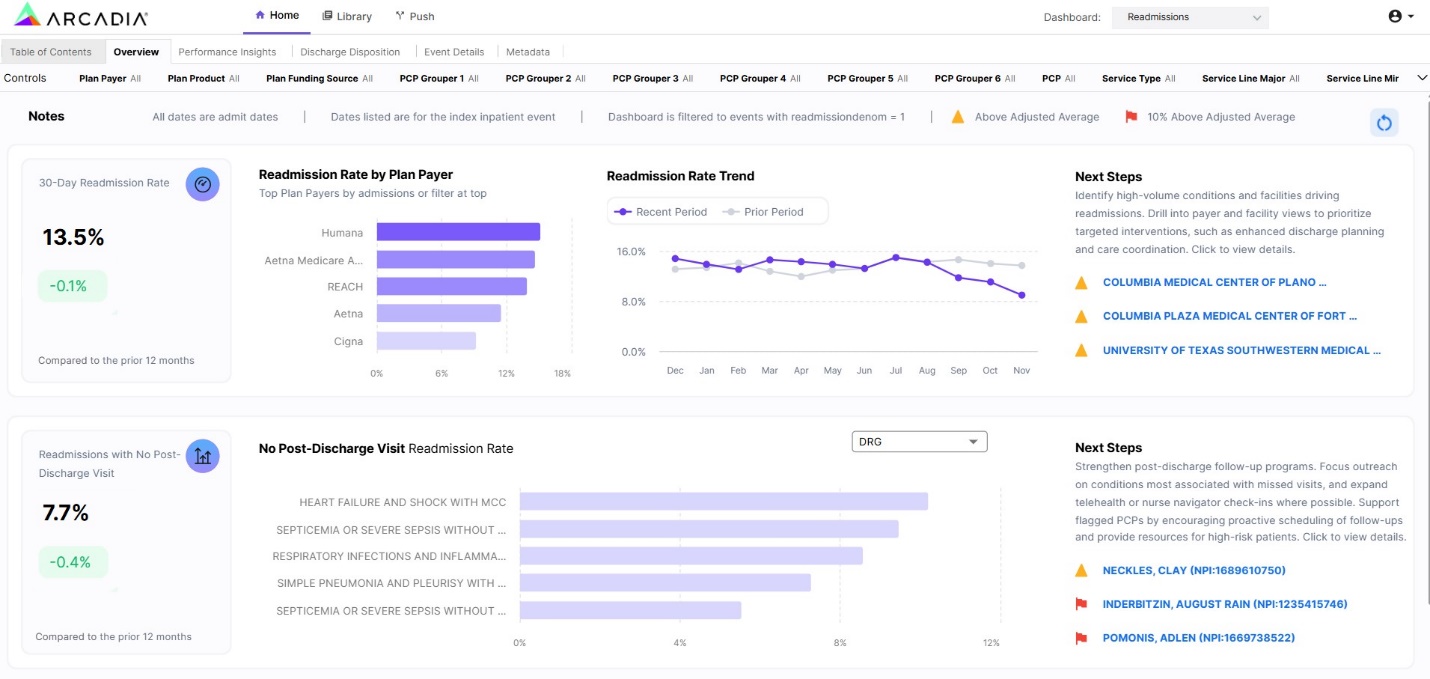
Our Readmission dashboard (see the following screenshot) gives insight into hospital readmissions following an inpatient stay. Readmissions are a costly, and sometimes avoidable, type of healthcare utilization, which can be impacted through better post-discharge planning and coordination. This dashboard helps our customers identify trends in readmission rate performance (by inpatient hospital, by rendering provider, or by PCP) and recommends actionable next steps in the Arcadia platform to drive improvement and better patient outcomes.
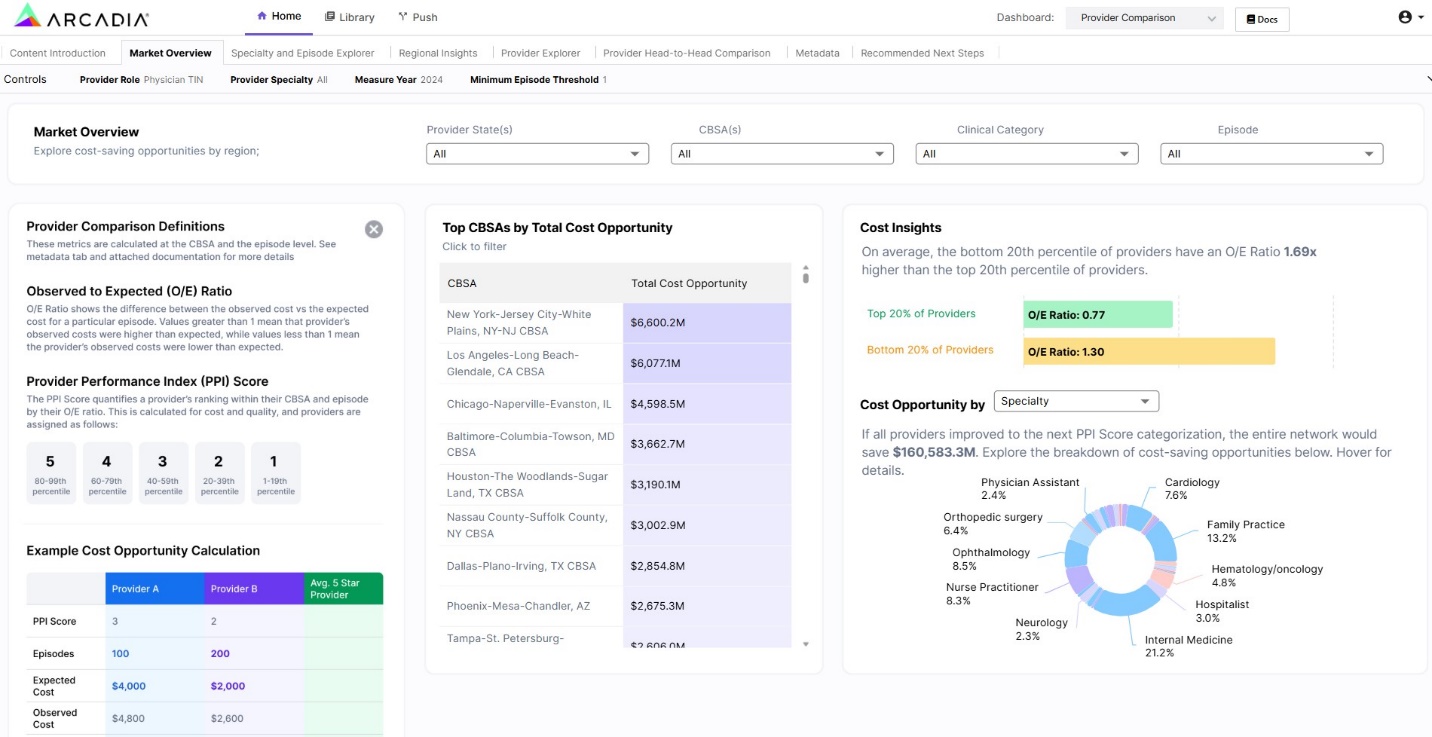
The Provider Comparison dashboard (see the following screenshot) uses our third-party benchmark data asset and scoring algorithm to rate providers on cost and quality outcomes, comparing each to similar providers in their market. This tool helps our customers optimize care in their network for lower costs and better patient outcomes.
Baptist Health Arkansas demonstrates the benefits of Arcadia’s dashboard development suite by significantly reducing their development cycles and labor costs. The tool helps their analysts respond to requests more efficiently while building deeper data expertise. Additionally, by automating the distribution of monthly provider scorecards, they avoided the manual process of creating and emailing 100–200 individual dashboard links, saving several hours of work each month.
Comprehensive analytics enable data-driven decision-making, providing leaders with actionable insights that enable more informed decisions. By making sure healthcare professionals have the right data at the right time, health systems can deliver better patient outcomes and improve patient care quality.
Looking ahead
As we continue to evolve our platform, we’re excited about several new developments. We’re currently working on enhancing our visualization capabilities through Highcharts integration, and we’re developing more sophisticated data modeling approaches to handle increasingly complex healthcare scenarios. Our team is particularly excited about expanding our predictive analytics capabilities, using Quick Sight ML Insights to help healthcare organizations become more proactive in their decision-making.
The healthcare analytics landscape is constantly changing, and we’re committed to staying ahead of the curve. We’re working closely with our AWS partners to explore new capabilities and with our healthcare clients to understand their evolving needs. Our goal remains constant: to make healthcare data not just accessible, but truly actionable.
Join us on this journey
Ready to learn more about how Quick Sight can transform your healthcare analytics? Visit Amazon Quick Sight to explore features, access demos, and start your analytics journey today. We’re always eager to share our experiences and learn from others in the healthcare analytics community. Whether you’re a healthcare provider looking to enhance your analytics capabilities or a fellow technologist interested in our approach, we’d love to connect. Reach out to our team to learn more about our journey with Quick Sight and how we’re helping to transform healthcare analytics.
About the authors
 Mike Cook is a Director, Analytics at Arcadia. He leads a team of productized analytics builders at Arcadia, creating business intelligence content to derive actionable insights from complex healthcare data. Prior to leading this team, Mike built many of the core dashboards within Arcadia’s development suite, utilizing Amazon Quick Sight for data modeling and visualization.