AWS Contact Center
How Amazon Connect Customer and CLEAR are reducing fraud and cutting call wait times
Every day, millions of Americans call government agencies to access critical services: benefits, healthcare coverage, tax questions, assistance programs and more. And every day, those callers face the same frustrating gauntlet of identifying questions: “What’s your date of birth? Last four of your Social Security number? Mother’s maiden name?”
This knowledge-based authentication (KBA) process was designed to protect citizens, but it has become one of the weakest points in the system. The answers to security questions are static and often available to bad actors through data breaches, social media, or public records. Fraudsters can impersonate legitimate callers, social engineer agents into bypassing checks, and take over accounts to redirect benefits or change payment details. KBA also slows every interaction, adding time at each handoff in the process. For public sector agencies managing massive call volumes with constrained staffing, the impact is real: greater exposure to fraud and impersonation, longer handle times, higher abandonment rates, and a degraded citizen experience.
We’re excited to share that AWS and CLEAR have collaborated on integrating the CLEAR1 identity verification platform with Amazon Connect Customer to fundamentally reimagine how customer experience teams verify caller identities. Public sector has been one of the first industries to see significant results.
The Public Sector Verification Challenge
- Public sector contact centers operate under unique pressures that make the identity verification problem especially acute:
- Massive scale with limited resources. At-scale federal and state agencies handle tens of millions of calls annually. Staffing hasn’t kept pace with demand, making every second of agent time precious.
- High-value, high-risk interactions. Public sector calls frequently involve sensitive personally identifiable information (PII), benefits determinations, and financial transactions. The stakes of getting identity wrong are enormous, whether through fraud or by denying access to a legitimate citizen.
- Outdated authentication methods. Knowledge-based authentication is both the slowest and weakest link. Agents spend 30 to 90 seconds per call asking security questions that sophisticated, bad actors can easily answer using breached personal data. Meanwhile, legitimate callers, especially elderly beneficiaries or disabled individuals, can struggle to remember answers, creating access barriers to the very services they need.
- Regulatory and compliance demands. Agencies must comply with NIST identity assurance guidelines, HIPAA requirements for healthcare-related calls, and evolving federal mandates for stronger identity proofing, all while maintaining equitable access.
The result? A system that can frustrate honest citizens, fail to stop determined fraudsters, and consume agent capacity that could be spent actually solving problems.
A New Approach: Verify Before the Conversation, Not During It
The CLEAR integration with Amazon Connect Customer introduces a fundamentally different model: identity verification moves from the agent’s desk to the caller’s phone, and it happens before the conversation begins.
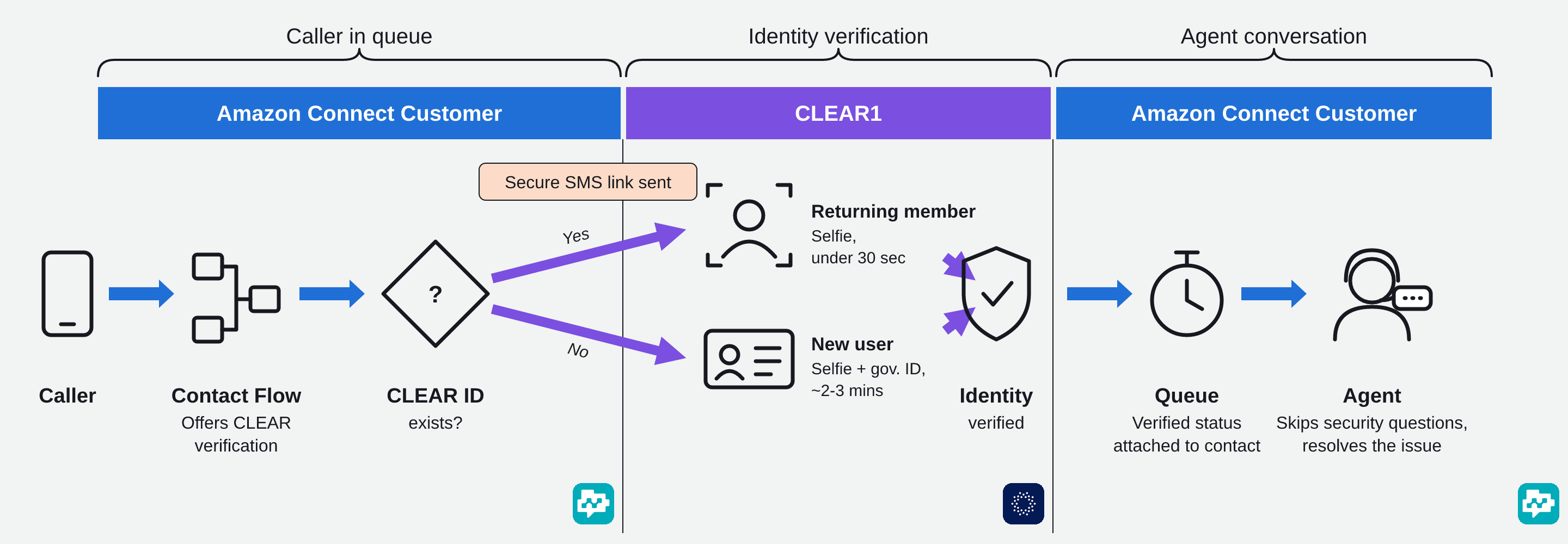
Here’s how it works from the caller’s perspective:
- When a citizen calls the agency and is placed in a queue, they’re offered the option to verify their identity through CLEAR.
- If they opt in, they receive a secure SMS link on their phone.
- They complete verification: a selfie plus a government ID scan for first-time users, or just a selfie for returning users.
- By the time an agent picks up, the caller’s identity has already been verified by analyzing hundreds of real-time signals across biometrics, government-issued IDs, devices, and authoritative data sources. The agent sees the verification status on their screen and can immediately focus on resolving the citizen’s issue.
For returning callers, which represent the majority of interactions at most agencies, the entire verification process takes under 30 seconds. First-time enrollment completes in just a few minutes, and the verified, reusable identity is stored for any future reverifications.
Measurable Outcomes for Agencies
The impact of shifting verification upstream is measurable across every dimension agencies care about:
- Faster service delivery. Eliminating 30 to 90 seconds of security questioning per call translates directly to shorter handle times and shorter queue waits. For a government agency handling millions of calls per year, this represents thousands of recovered agent hours.
- Stronger security posture. Person-based verification tied to biometrics and government-issued documents is orders of magnitude more resistant to fraud than knowledge-based authentication, which relies only on credentials. Agencies achieve higher identity assurance with lower effort.
- Improved citizen satisfaction. Citizens reach a live agent faster, skip repetitive questions, and feel the interaction was designed for them—not for a compliance checklist. This is especially meaningful for elderly or disabled callers who find KBA questions burdensome.
- Compliance alignment. CLEAR is SOC 2 Type II certified, and the integration supports architectures aligned with HIPAA, PCI, and federal identity assurance standards when deployed appropriately. Agencies can strengthen their compliance posture while improving the experience.
The CLEAR Advantage: A Trusted Identity Network
What makes this integration uniquely powerful is CLEAR’s established trust network. With over 43 million members who have already completed identity verification for airports, stadiums, and healthcare facilities, many callers won’t need to enroll at all. They’ve already verified with CLEAR, and that reusable identity travels with them into customer experience channels.
This portability of trust is a game-changer for public sector. A citizen who verified through CLEAR at the airport can reuse that same verified identity when calling their Medicare helpline. No duplicate enrollment. No starting from scratch. Just a quick selfie and they’re verified.
“We’re proud to partner with Amazon Web Services to bring our secure identity platform to contact centers at scale,” said Brett Romanoff, Executive Vice President, CLEAR1. “By integrating CLEAR1 into Amazon Connect Customer, organizations can strengthen protection against fraud while creating a more seamless experience for both agents and customers.”
“Customers expect fast, easy support the moment they call in,” said Amy Belcher, Director, Global ISV Partners, AWS. “With CLEAR1 and Amazon Connect Customer, organizations can verify callers in seconds, eliminate repetitive security questions, and let agents focus on what matters most: solving customer problems.”
Looking Ahead
This announcement marks the beginning of a broader vision. While we’ve focused on public sector, where the need is most urgent and the impact most measurable, the CLEAR and Amazon Connect Customer integration is equally relevant for financial services, travel and hospitality, and any industry where verified identity is foundational to the customer interaction.
The integration is available today through AWS Marketplace, deployable within existing Amazon Connect Customer contact flows with no rip-and-replace required.
Get Started
- Explore the integration on AWS Marketplace to learn more and request a demo.
- See how to build it: the AWS Builder Center deep dive covers the reference architecture and implementation patterns for self-service, representative-assisted, and hybrid verification.
- Contact your AWS account team to discuss how CLEAR1 and Amazon Connect Customer can be deployed in your contact center environment.
- Learn more about Amazon Connect Customer’s identity verification capabilities and third-party integration options.
Identity verification shouldn’t be a barrier between citizens and the services they need. With CLEAR and Amazon Connect Customer, it becomes a bridge—one that’s faster, more secure, and built for the scale of public sector.
 Lewis Brown is a Senior Solutions Architect on the AI Velocity team at AWS. He believes digital experiences for customers and citizens should be as good as in-person ones, and he helps organizations use AI to get there. When he’s not working, Lewis is playing or watching basketball, or at the beach and theme parks with his family.
 Ritesh is a specialist solutions architect for Amazon Connect at AWS, focusing on public sector organizations. He helps government agencies and public institutions modernize citizen engagement through cloud-based contact center solutions, enabling them to deliver accessible, efficient, and secure services to the communities they serve.
 Cole Martin is a Product Marketing Manager for Amazon Connect Customer at AWS. He helps shape how the market understands Connect Customer’s AI-powered capabilities: from agentic self-service to end-to-end automation. He works closely with global enterprises to champion their success stories, bringing AI-powered customer experience transformation to the spotlight.