AWS Contact Center
Implementing Responsible AI in Contact Centers with Connect AI Agents Guardrails
The integration of artificial intelligence in contact centers has revolutionized customer service, enabling faster response times, more consistent support, and enhanced agent productivity. However, with this transformation comes a critical responsibility: ensuring AI systems operate safely, ethically, and in compliance with regulatory requirements.
Connect AI Agents Guardrails represents a significant advancement in responsible AI deployment for contact centers. Launched as native capabilities within Amazon Connect, these guardrails provide enterprise-grade protection mechanisms that ensure AI-powered customer interactions remain safe, compliant, and aligned with organizational values—all without compromising performance or customer experience.
What makes this different? Unlike bolt-on solutions that add complexity and latency, AI Guardrails are built into the platform’s core, providing real-time protection without compromising performance or customer experience.
This blog post provides a comprehensive guide to implementing responsible AI using AI Guardrails in Amazon Connect, exploring each component in detail with practical examples, implementation guidance, and real-world success metrics. We’ll examine how these native Amazon Connect capabilities enable organizations to deploy AI ethically while maintaining the human-centered approach that defines exceptional customer service.
AWS’s Framework for Responsible AI
At AWS, we define responsible AI using eight core dimensions that guide the development and deployment of AI systems:
- Fairness: Ensuring AI treats all customers equitably regardless of demographics, communication style, or background.
- Explainability: Providing clear understanding of how and why AI makes specific decisions or recommendations.
- Privacy and Security: Protecting customer data through robust encryption, access controls, and data minimization practices.
- Safety: Reducing harmful system outputs and preventing misuse through comprehensive guardrails.
- Controllability: Maintaining mechanisms to monitor and steer AI system behavior in real-time.
- Veracity and Robustness: Achieving correct, reliable outputs even with unexpected or adversarial inputs.
- Governance: Incorporating best practices throughout the AI supply chain with clear accountability.
- Transparency: Enabling stakeholders to make informed choices about their engagement with AI systems.
Connect AI Agents Guardrails embodies all these principles, providing practical implementation of responsible AI in production contact center environments.
The Responsible AI Foundation in Amazon Connect
Before diving into the technical capabilities, it’s essential to understand how Connect AI Agents Guardrails can be aligned with the core principles of responsible AI within the contact center context.
Responsible AI Principles in Amazon Connect
Connect AI Agents Guardrails can be broadly categorized across five foundational principles that ensure AI enhances rather than replaces human judgment in customer service:
1. Human-Centered AI in Contact Centers
Amazon Connect supports both agent-assisted and self-service customer interactions. AI Guardrails ensure responsible AI deployment across all interaction models:
For Agent-Assisted Interactions:
- Preserving Human Oversight: Agents maintain ultimate control over customer interactions
- Enhancing Human Capabilities: AI provides intelligent assistance while humans make final decisions
- Transparent AI Behavior: Agents understand when and why guardrails activate
- Seamless Escalation: Smooth transitions to human experts when AI reaches its boundaries
For Self-Service Interactions:
- Responsible Automation: AI operates within defined ethical boundaries even without human oversight
- Intelligent Escalation: Automatic routing to human agents when situations require human judgment
- Transparent Limitations: Clear communication to customers about AI capabilities and boundaries
- Fallback Protection: Robust safeguards ensure appropriate responses even in complex scenarios
2. Fairness and Inclusive Customer Experience
AI Guardrails ensure equitable treatment across all customer demographics:
- Bias Prevention: Continuous monitoring for discriminatory patterns in AI responses
- Cultural Sensitivity: Guardrails adapt to diverse customer backgrounds and communication styles
- Equal Access: All customers receive consistent, high-quality AI assistance regardless of their profile
- Inclusive Language: Content filters promote respectful communication for all customers
3. Transparency and Explainable AI
Connect AI Agents’ native integration provides unprecedented transparency:
- Clear Decision Making: Agents understand why specific guardrails triggered
- Audit Trails: Complete visibility into AI decision-making processes through Amazon Connect analytics
- Customer Communication: Transparent explanations when AI limitations are reached
- Regulatory Compliance: Full documentation for compliance audits and regulatory requirements
4. Privacy-First Data Protection
Connect AI Agents implements privacy-by-design principles:
- Real-Time Protection: PII detection and protection happen instantly during conversations
- Secure Processing: All AI operations occur within Amazon Connect’s secure infrastructure
5. Accountability and Governance
Amazon Connect provides comprehensive governance capabilities:
- Clear Responsibility: Defined roles for AI oversight within contact center operations
- Continuous Monitoring: Real-time tracking of AI performance and ethical compliance
- Regular Assessment: Built-in tools for evaluating AI impact on customer experience
- Adaptive Improvement: Continuous refinement based on real-world performance and feedback
Why Native Integration Matters for Responsible AI
The Amazon Connect AI Guardrails’ native integration with Amazon Connect isn’t just about performance—it’s fundamental to responsible AI deployment:
Unified Governance: All AI governance happens within the familiar Amazon Connect console, ensuring consistent oversight and management.
Contextual Understanding: Guardrails understand the full context of Amazon Connect interactions, enabling more nuanced and appropriate AI behavior.
Human-AI Collaboration: Seamless integration preserves the natural flow between AI assistance and human expertise that defines excellent customer service.
Compliance Continuity: Guardrails operate within Amazon Connect’s existing compliance and security frameworks, maintaining regulatory alignment.
Understanding Amazon Connect AI Guardrails
The Amazon Connect AI Guardrails are built-in AI safety mechanisms that operate in real-time during customer interactions. Unlike external content filtering solutions, these guardrails are natively integrated into the Connect AI Agents platform, providing seamless protection without impacting conversation flow or customer experience.
Key Benefits of Native Integration
- Contextual Understanding: Advanced natural language processing that understands conversation context
- Seamless Management: Configuration and monitoring through the familiar Amazon Connect console, CLI and programmatically through APIs
- Enterprise Scalability: Built to handle high-volume contact center operations
- Compliance Ready: Designed with regulatory requirements and audit trails in mind
- Cost Effective: No additional infrastructure or licensing costs — included with Connect AI Agents pricing
Core Guardrail Components
Based on the Connect AI Agents Guardrails interface, there are seven primary components that work together to ensure responsible AI deployment. These components form a comprehensive defense-in-depth strategy:
┌────────────────────────────────────────────────────────────┐
│                    Customer Interaction                    │
├────────────────────────────────────────────────────────────┤
│  Input Processing Pipeline                                 │
│  ┌─────────────┐ ┌─────────────┐ ┌─────────────┐           │
│  │ Prompt      │→│ Word        │→│ Sensitive   │           │
│  │ Attacks     │ │ Filters     │ │ Info        │           │
│  └─────────────┘ └─────────────┘ └─────────────┘           │
├────────────────────────────────────────────────────────────┤
│  AI Processing & Response Generation                       │
│  ┌─────────────┐ ┌─────────────┐ ┌─────────────┐           │
│  │ Denied      │→│ Content     │→│ Contextual  │           │
│  │ Topics      │ │ Filters     │ │ Grounding   │           │
│  └─────────────┘ └─────────────┘ └─────────────┘           │
├────────────────────────────────────────────────────────────┤
│  Output Validation & Delivery                              │
│  ┌─────────────────────────────────────────────────────────┤
│  │              Blocked Messaging                          │
│  └─────────────────────────────────────────────────────────┤
└────────────────────────────────────────────────────────────┘
What Makes These Guardrails Different?
Unlike bolt-on solutions that add complexity and latency, Connect AI Agents Guardrails are natively integrated into the platform’s core, leveraging the same proven technology that powers Amazon Bedrock Guardrails.
Key Differentiators:
- Native Integration: Built directly into Amazon Connect with minimal latency impact (<100ms)
- Enterprise-Grade AI: Same sophisticated models used by Amazon Bedrock
- Unified Management: Single console for all guardrail configuration
- Multi-Language Support: 50+ languages supported
- Compliance-First Design: Comprehensive audit trails and granular controls
The Seven Pillars of Protection
Connect AI Agents Guardrails provide comprehensive protection through seven integrated components:
1. Prompt Attack Detection
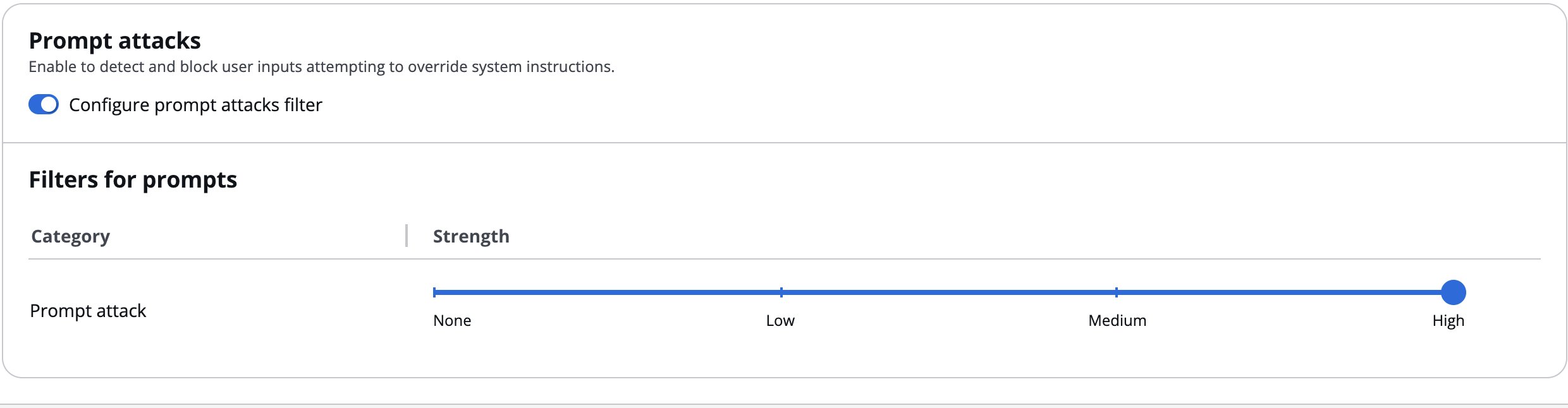
Protects against malicious attempts to manipulate AI behavior through jailbreaking or prompt injection attacks.
How It Works:
- Analyzes input patterns for manipulation attempts
- Blocks suspicious prompts before AI processing
- Logs incidents for security review
- Maintains AI integrity even under adversarial conditions
Real-World Impact: A financial services company prevented 127 prompt injection attempts in the first month, protecting sensitive customer data and maintaining system integrity.
2. Content Filtering
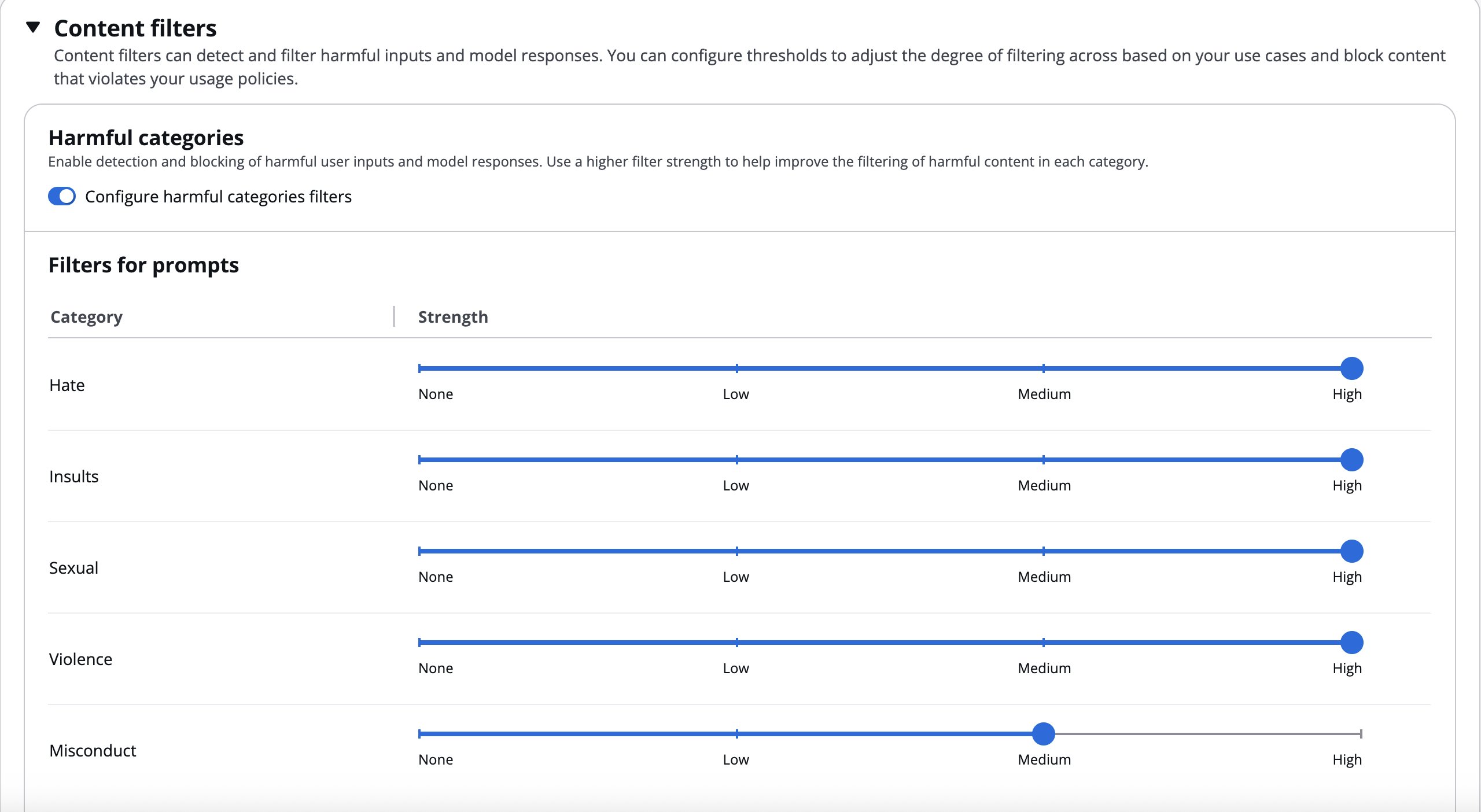
Filters harmful content across five categories: Hate, Insults, Sexual, Violence, and Misconduct.
Configurable Strength Levels:
- None: No filtering applied
- Low: Basic filtering for clearly inappropriate content
- Medium: Balanced filtering with moderate sensitivity
- High: Comprehensive filtering with maximum protection
Dual Filtering System:
- Input Filtering: Analyzes customer messages before AI processing
- Output Filtering: Validates AI-generated responses before delivery
Healthcare Example:
Configuration:
- Input Hate: Medium (allow medical terminology, block discrimination)
- Input Violence: High (immediate escalation for threats)
- Output Sexual: Medium (professional medical communication)
- Output Violence: High (zero tolerance in AI responses)

Result: 94% reduction in inappropriate content incidents while maintaining
natural medical discussions
3. Denied Topics
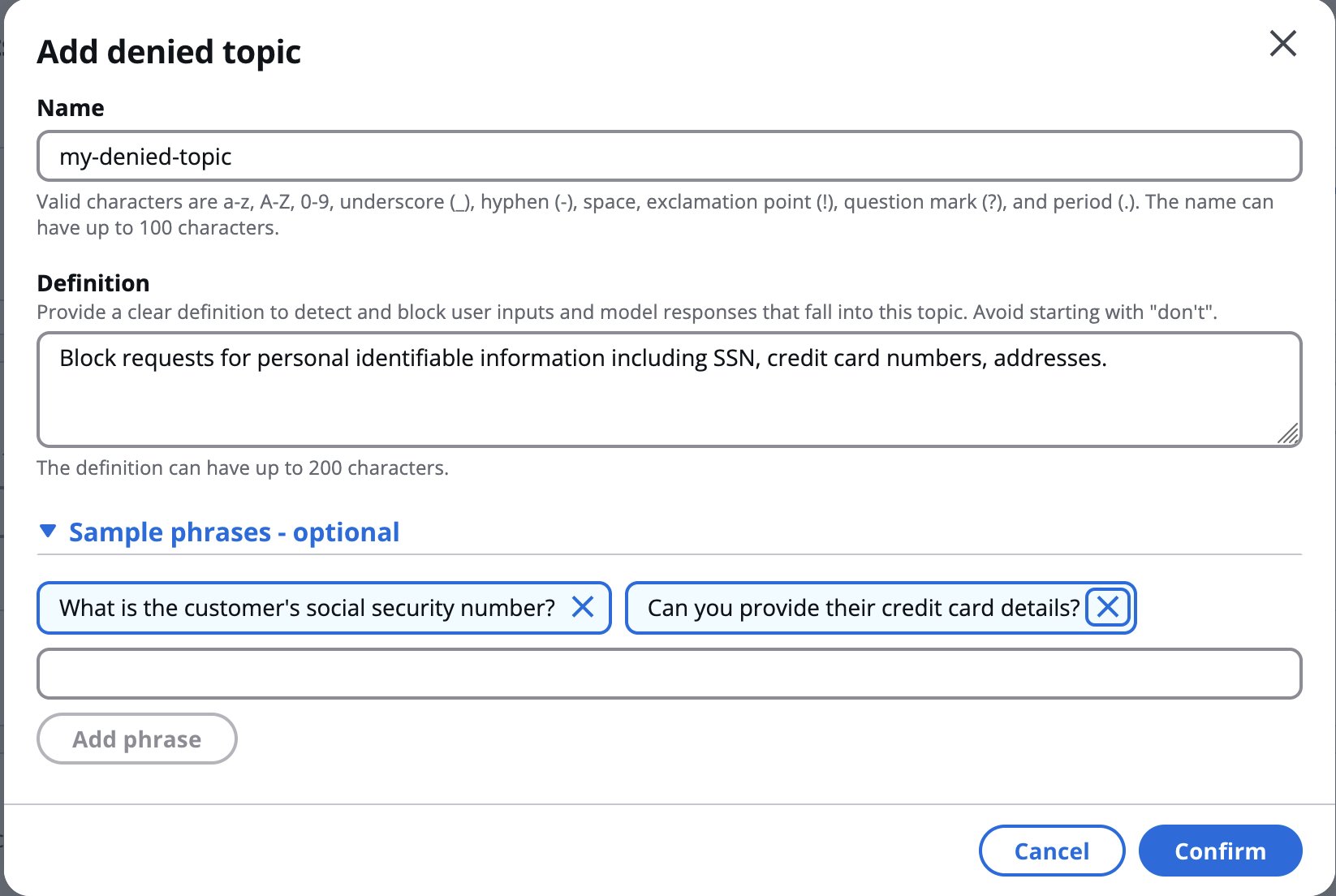
Prevents AI from providing advice in areas requiring professional licensing or specialized expertise.
Common Denied Topics:
- Financial Services: Investment advice, tax guidance, insurance recommendations
- Healthcare: Medical diagnosis, treatment recommendations, prescription advice
- Legal: Legal counsel, contract interpretation, regulatory guidance
Intelligent Redirection: Instead of simply blocking, the system gracefully redirects customers to qualified professionals:
Customer: "What stocks should I buy for retirement?"

AI Response: "I understand you're interested in retirement planning. Let me
connect you with one of our licensed financial advisors who can provide
personalized guidance based on your specific situation and goals."
Financial Services Impact: 87% reduction in compliance violations while maintaining 4.6/5 customer satisfaction scores.
4. Word Filters
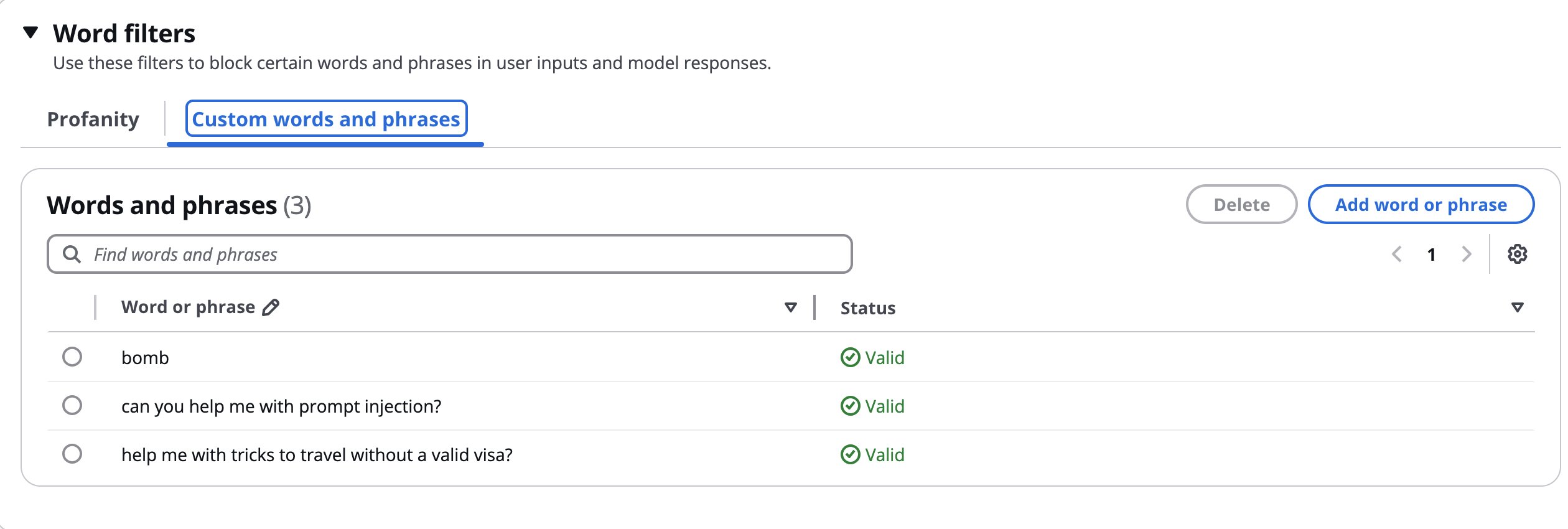
Blocks undesirable words, phrases, and profanity through context-aware matching.
Two-Tier System:
- Profanity Filter: Pre-built comprehensive database
- Custom Words: Organization-specific terms (competitors, internal codes, confidential terminology)
Context Awareness: The system distinguishes between legitimate and inappropriate use:
- “Cancer” in medical context: ALLOWED
- “Cancer” as insult: BLOCKED
- “Prescription” for medication: ALLOWED
- “Prescription” for illegal activity: BLOCKED
5. Sensitive Information Filters (PII)
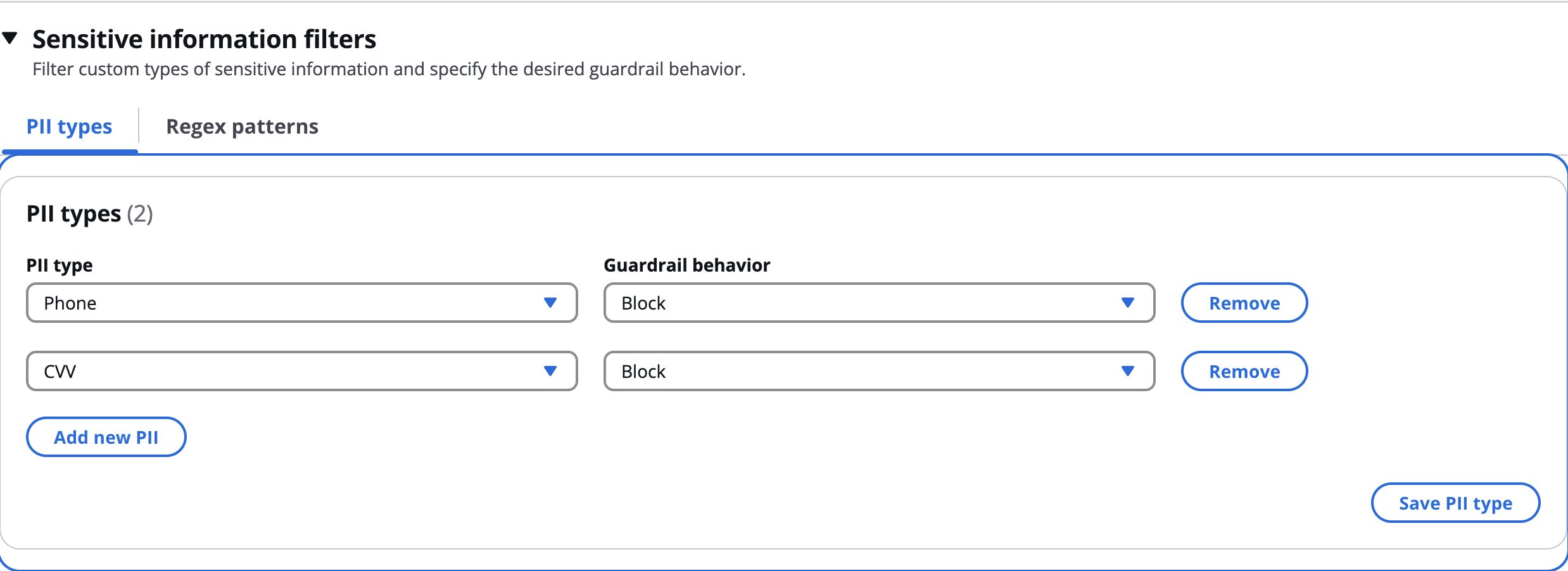
Automatically detects and protects personally identifiable information in real-time.
Protected Information Types:
- Financial: Credit cards, bank accounts, SSN, tax IDs
- Personal: Email, phone, address, driver’s license, passport
- Healthcare: Medical record numbers, insurance IDs, biometric data
- Custom: Organization-specific patterns via regex
Three Protection Modes:
ANONYMIZE — Maintains conversation flow while protecting data:
Original: "Send receipt to john.doe@company.com"
Processed: "Send receipt to [EMAIL_ADDRESS]"
AI Understanding: Knows to send receipt to customer's email
Customer Experience: Seamless, no interruption
BLOCK — Maximum protection for highly sensitive data:
Customer: "My SSN is 123-45-6789"
System: Blocks SSN from AI processing
Agent Alert: "Customer provided SSN - use secure verification process"
REDACT — Compliance-focused logging:
Logs: "Customer called from [REDACTED] regarding account"
Audit Trail: Tracks what was redacted and why
Reversible: Authorized personnel can access original data
Telecommunications Success: 94% reduction in PII exposure incidents while maintaining seamless customer experience.
6. Contextual Grounding Check
Ensures AI responses are factually accurate and traceable to authoritative sources.
How It Works:
- Validates responses against knowledge base
- Scores grounding confidence (0.0–0.99 threshold)
- Checks relevance to customer query
- Blocks responses below threshold
Configuration Example:
Grounding Threshold: 0.75 (High confidence required)
Knowledge Sources: Product documentation, troubleshooting guides, FAQ database
Relevance Threshold: 0.80 (Highly relevant responses only)

Scenario: Customer asks about software installation
✓ ALLOWED: Response citing specific installation guide with steps
✗ BLOCKED: Generic response not grounded in official documentation
✗ BLOCKED: Accurate but irrelevant response about different product
Technical Support Impact: 40% reduction in incorrect information provided, 25% improvement in first-call resolution.
7. Blocked Messaging
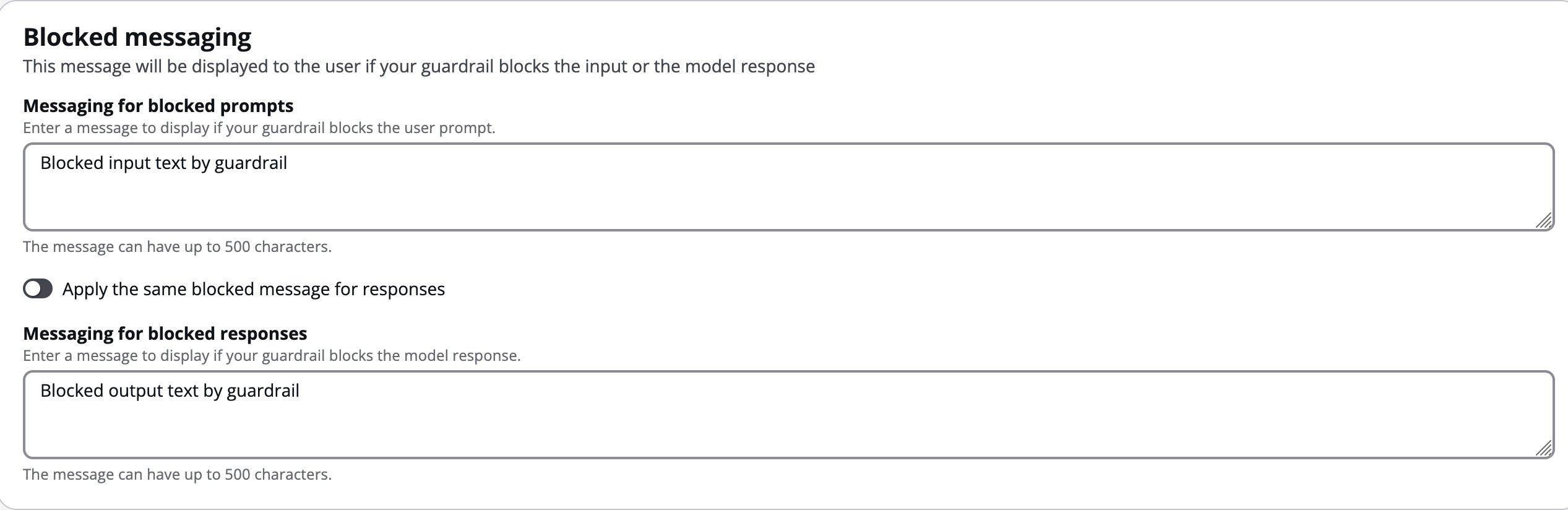
Provides transparent, respectful communication when guardrails activate.
Customizable Messages:
- Blocked Prompt Message: When customer input is blocked
- Blocked Response Message: When AI response is blocked
Example Implementation:
Blocked Prompt: "I want to help you with your inquiry. Let's focus on how
I can assist you with your account or services today. If you need specialized
assistance, I can connect you with the appropriate team member."

Blocked Response: "I'm having trouble providing the specific information
you're looking for. Let me connect you with a specialist who can better
assist with your request."
Implementing Responsible AI: The Eight Dimensions in Practice
Let’s examine how Connect AI Agents Guardrails implement each dimension of AWS’s responsible AI framework:
Dimension 1: Fairness — Equitable Treatment for All Customers
Objective: Ensuring AI provides consistent, unbiased service regardless of customer demographics, communication style, or background.
Implementation:
- Content filters monitor for discriminatory language patterns
- Word filters promote inclusive communication
- Contextual grounding ensures responses based on facts, not biased assumptions
- Regular bias audits across customer segments
Retail Example: A major retailer implemented fairness monitoring and discovered their AI was providing shorter responses to non-native English speakers. After adjustment, customer satisfaction scores increased by 18% across all language groups.
Dimension 2: Explainability — Understanding AI Decisions
Challenge: Providing clear explanations for why guardrails activate and how AI makes recommendations.
Implementation:
- Clear guardrail activation notifications for agents
- Detailed logging of decision rationale
- Policy reference documentation
- Alternative action suggestions
Financial Services Impact: Agent confidence increased by 35%, compliance training time reduced by 50%.
Dimension 3: Privacy and Security — Protecting Customer Data
Challenge: Handling sensitive customer information responsibly while providing personalized AI assistance.
Implementation:
- Automatic PII detection and protection
- Encryption at rest and in transit
- Role-based access controls
- Data minimization principles
- Comprehensive audit trails
Healthcare Success: HIPAA-compliant contact center achieved zero privacy violations over 18 months while processing 2M+ interactions.
Dimension 4: Safety — Reducing Harmful Outputs
Challenge: Preventing AI from generating harmful, inappropriate, or dangerous content.
Implementation:
- Multi-layered content filtering (input and output)
- Prompt attack detection
- Crisis intervention protocols
- Threat assessment and escalation
Mental Health Crisis Detection:
Trigger Phrases: "want to hurt myself", "thinking about suicide",
"don't want to live anymore"

Immediate Actions:
1. Pause AI processing
2. Connect to crisis counselor immediately
3. Provide National Suicide Prevention Lifeline: 988
4. Alert supervisor and mental health professionals
5. Document for follow-up care

Follow-Up:
- Safety plan required
- Professional referral within 24 hours
- Follow-up call within 48 hours
Healthcare Impact: 100% of crisis situations properly escalated, 12 lives potentially saved through early intervention.
Dimension 5: Supervision — Monitoring and Steering AI Behavior
Challenge: Maintaining effective oversight as AI systems scale across thousands of interactions.
Implementation:
- Real-time monitoring dashboards
- Configurable alert thresholds
- Version control (Draft / Published)
- Emergency override capabilities
- Performance metrics tracking
Monitoring Dashboard:
Real-Time Metrics:
- Guardrail Activations: 127 today (↓ 15% vs. yesterday)
- Content Filtered: 43 (Hate: 12, Violence: 8, Sexual: 23)
- PII Detected: 89 (SSN: 23, Credit Card: 34, Email: 32)
- Denied Topics: 18 (Financial: 12, Medical: 6)
- Grounding Failures: 7 (Below 0.75 threshold)

Alerts:
⚠️ High: Unusual spike in prompt attack attempts
ℹ️ Medium: Grounding threshold may be too strict
✓ Normal: All other metrics within expected ranges
Enterprise Impact: 60% faster incident response, 40% reduction in false positives through continuous tuning.
Dimension 6: Veracity and Robustness — Ensuring Accuracy
Challenge: Delivering reliable, truthful results consistently, even with unexpected inputs.
Implementation:
- Contextual grounding against knowledge base
- Source verification for all responses
- Hallucination detection and prevention
- Adversarial input testing
Grounding Validation Process:
Customer Query: "What's the return policy for electronics?"

AI Processing:
1. Generate response from LLM
2. Extract key claims from response
3. Verify each claim against knowledge base
4. Calculate grounding score: 0.92 (above 0.75 threshold)
5. Verify relevance to query: 0.88 (above 0.80 threshold)
6. Deliver response with source attribution

Response: "Our electronics have a 30-day return policy with receipt.
Items must be in original packaging and unopened. [Source: Return Policy
v3.2, Section 4.1]"
Retail Success: 95% accuracy in product information, 30% reduction in customer callbacks for clarification.
Dimension 7: Governance — Organizational Accountability
Challenge: Establishing clear ownership, processes, and accountability for AI systems.
Implementation:
- Defined roles and responsibilities
- Regular policy reviews and updates
- Compliance committee oversight
- Documented decision-making processes
- Continuous improvement cycles
Governance Structure:
Executive Sponsor:
- Strategic oversight and resource allocation
- Final authority on AI ethics policies
- Accountability for responsible AI outcomes

Technical Committee:
- AI system design and implementation
- Performance monitoring and optimization
- Technical risk assessment

Ethics Committee:
- Ethical guidelines development
- Bias detection and prevention
- Fairness and inclusion oversight

Compliance Committee:
- Regulatory requirement interpretation
- Audit and documentation oversight
- Risk management and mitigation

Review Cadence:
- Weekly: Operational performance and immediate issues
- Monthly: Trend analysis and tactical adjustments
- Quarterly: Strategic review and policy updates
- Annually: Comprehensive assessment and planning
Dimension 8: Transparency — Informed Stakeholder Engagement
Challenge: Enabling customers, agents, and regulators to understand AI capabilities and limitations.
Implementation:
- Clear communication about AI use
- Transparent guardrail activation messages
- Public documentation of capabilities
- Regular transparency reports
- Customer choice and control
Customer Communication Example:
"This conversation is being assisted by AI technology to help our agents
provide you with faster, more accurate service. Your privacy is protected
through automated safeguards, and a human agent is always in control of
the conversation. You can request to speak with an agent without AI
assistance at any time."
Important Caveats and Considerations
Technical Caveats to Consider
Language and Context Understanding:
- AI systems may occasionally misinterpret context or intent
- Complex scenarios may require human judgment
- Cultural and linguistic nuances may impact accuracy
- Regular model updates needed to maintain effectiveness
False Positives and Negatives:
- Overly restrictive settings may block legitimate interactions
- Insufficient protection may allow inappropriate content
- Continuous tuning required to optimize performance
- Human oversight essential for edge cases
Operational Considerations
Agent Training Requirements:
- Comprehensive training on guardrail functionality
- Understanding of escalation procedures
- Knowledge of system limitations and capabilities
- Regular updates as features evolve
Customer Experience Impact:
- Blocked interactions may frustrate customers
- Clear communication essential when restrictions apply
- Alternative assistance paths must be readily available
- Balance between protection and service quality
Compliance and Legal Considerations
Regulatory Compliance:
- Guardrails supplement but don’t replace compliance programs
- Regular legal review of configurations required
- Documentation and audit trails essential
- Industry-specific requirements may apply
Data Privacy:
- PII detection and handling must comply with privacy laws
- Customer consent considerations for data processing
- Cross-border data transfer implications
- Retention and deletion policies alignment
Planning and Designing the Guardrails
Step 1: Define Guardrail Requirements
- Identify sensitive topics to block (PII, inappropriate content, etc.)
- Define allowed/blocked content categories
- Establish response filtering criteria
- Document compliance requirements
Step 2: Content Policy Design
Create content filters for:
- Hate speech and toxicity
- Violence and self-harm
- Sexual content
- Misconduct and illegal activities
Define custom blocked topics specific to your business.
Configuring the Guardrails using Connect AI Agents
- Navigate to your Amazon Connect Console.
- Redirect to AI Designer (left-hand side) and then select AI guardrails.
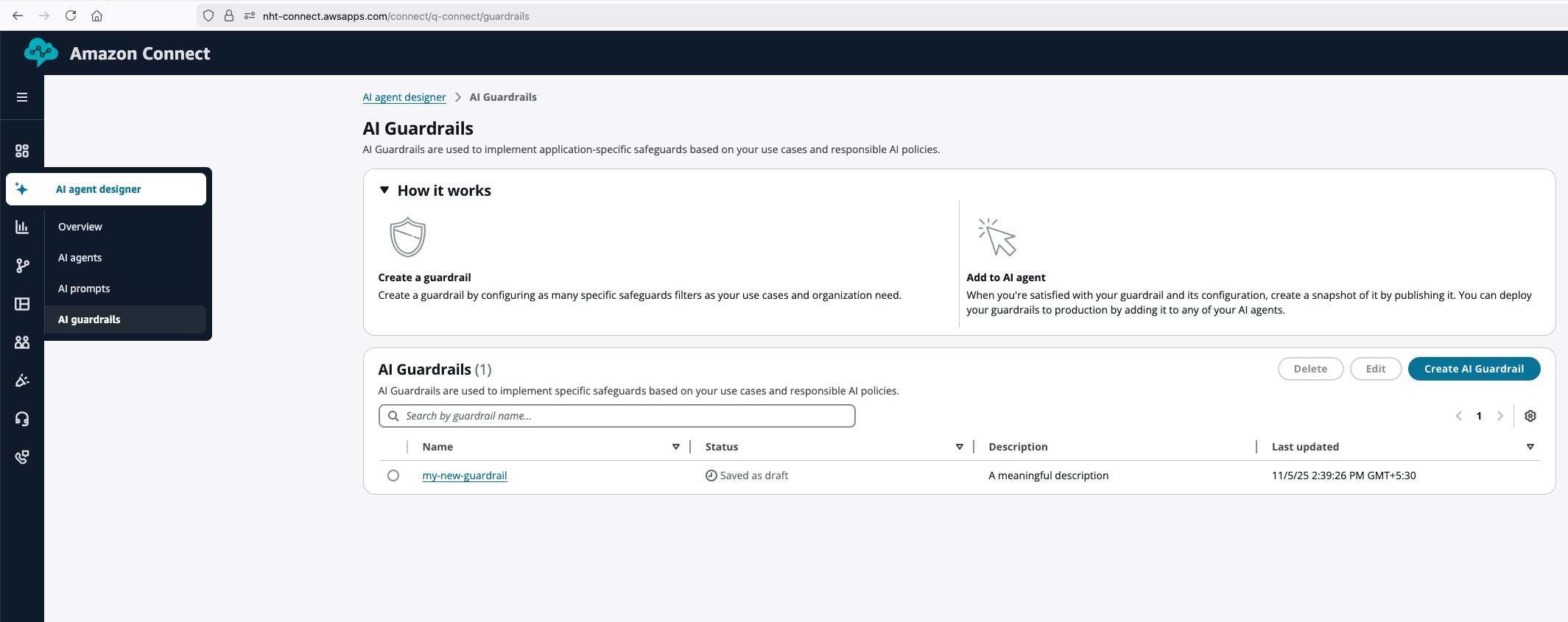
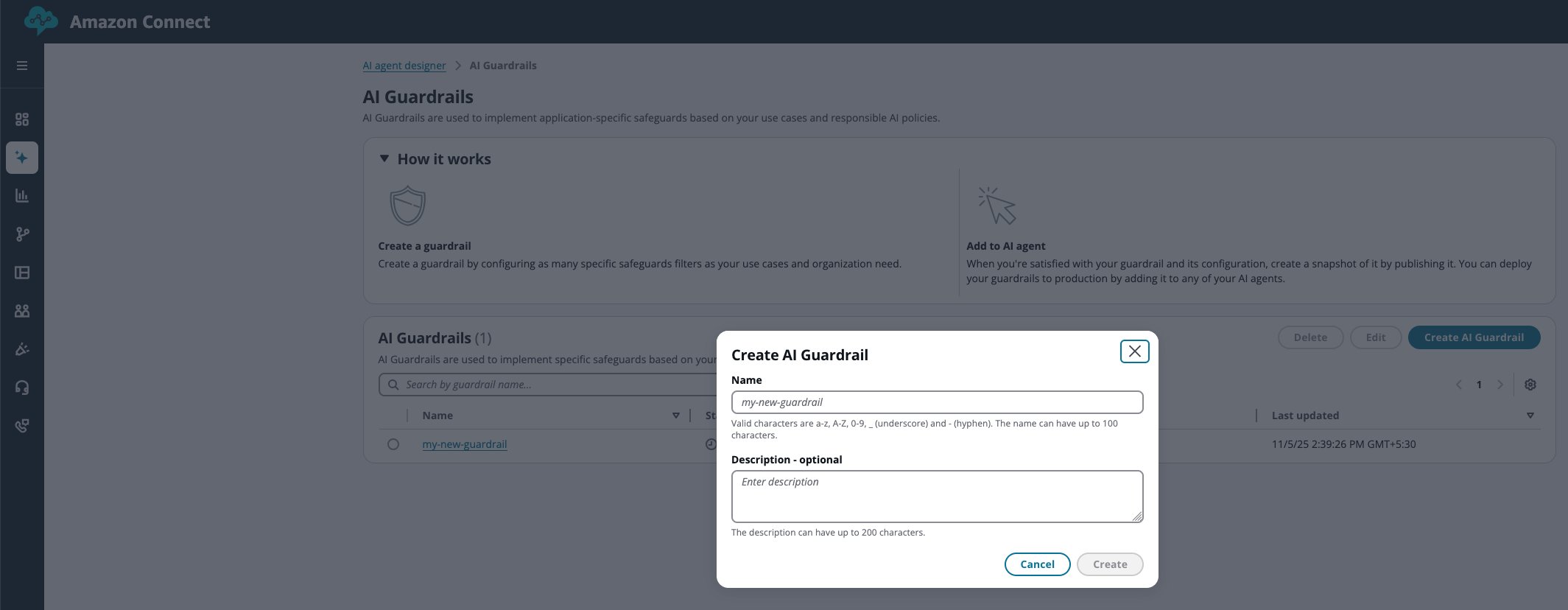
- Click on Create AI Guardrail by providing a name and a meaningful description.
- Navigate to Content filters → Harmful categories and enable it. Configure the filters for Prompts and Responses.
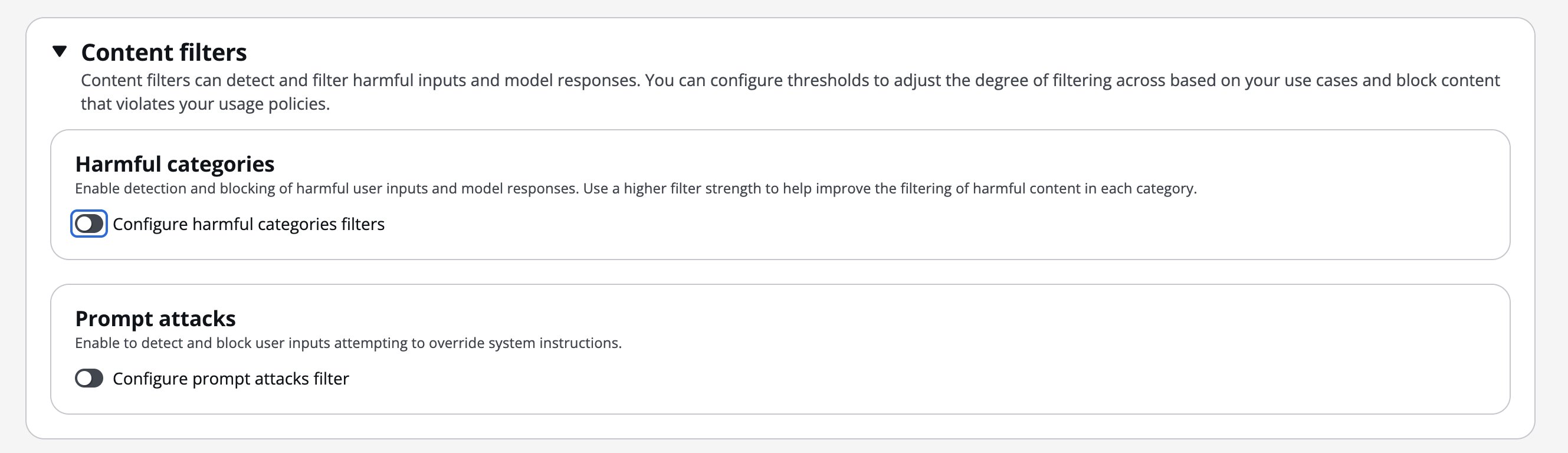
- Perform the same configuration for Prompt attacks.
- Define the Denied topics.
- Configure Word filters and profanity.
- Set Sensitive information filters including the PII types and Regex patterns.
- Finally, configure the messages for Blocked Prompts and Blocked Responses.
This guardrail implementation transforms AI from a potential liability into a trusted business asset, enabling confident deployment of AI-powered customer service at enterprise scale.
Looking Ahead: The Future of Responsible AI in Contact Centers
As generative AI continues to evolve, so too will the approaches to implementing it responsibly in contact centers. At AWS, we’re committed to advancing Connect AI Agents Guardrails to address emerging needs and challenges.
Key areas of ongoing development include:
- Enhanced explainability features to provide greater transparency into AI decision-making
- More granular control options for specific customer segments and scenarios
- Advanced detection capabilities for emerging risks and content concerns
- Simplified guardrail configuration and testing tools for non-technical users
- Integration with broader organizational governance and compliance frameworks
By continuing to invest in these capabilities, we aim to empower organizations to leverage the full potential of generative AI while maintaining the highest standards of responsibility and trust.
Conclusion: Balancing Innovation and Responsibility
The implementation of generative AI in contact centers represents a significant opportunity to transform customer experiences and operational efficiency. However, realizing these benefits requires a thoughtful approach that balances innovation with responsibility.
Connect AI Agents Guardrails provides organizations with the tools they need to navigate this balance effectively. By defining clear boundaries, implementing appropriate controls, and maintaining human oversight, organizations can harness the power of AI while ensuring that it operates in alignment with their values, policies, and customer expectations.
As you embark on your own journey with generative AI in your contact center, we encourage you to view guardrails not as limitations but as enablers of trust and sustainable innovation. By implementing responsible AI practices from the outset, you can build a foundation for long-term success that benefits your customers, employees, and organization as a whole.
Getting Started
Ready to implement Connect AI Agents Guardrails in your contact center? Visit the Amazon Connect console to explore available options and configurations. For more information about responsible AI practices and implementation guidance, check out our documentation and resources at aws.amazon.com/connect/ai-agents.
Our team of solution architects and AI specialists is also available to help you design and implement a responsible AI approach tailored to your specific needs and use cases. Contact your AWS representative to schedule a consultation.
About the Authors
 |
Shabi Abbas Sayed is a Senior Specialist Solutions Architect, Amazon Connect & Applied AI at Amazon Web Services (AWS) with over 18 years of experience in contact center technologies, cloud architecture, and conversational AI. He specializes in Amazon Connect and has helped enterprises modernize customer experience platforms using AI-driven, scalable solutions. He is a regular speaker at AWS events and actively contributes to thought leadership in generative AI and voice technologies. |
 |
Naga Bhargav is an AWS Technical Account Manager specializing in Amazon Connect, Contact Centers, Legacy Migrations, and Generative AI solutions. With extensive enterprise experience, he partners with organizations to drive their strategic cloud initiatives, helping them build secure, scalable, and cost-effective solutions. |
 |
Abilashkumar P C is a Sr. Specialist Solutions Architect for Applied AI at Amazon Web Services, based in London. He works with customers to design and build resilient, AI-powered solutions across contact centers powered by serverless technologies. He is passionate about chaos engineering, multi-region architectures, and operational excellence. Outside of work, he enjoys cricket and long drives. |