AWS Database Blog

Author: Lee Hannigan

Run DuckDB analytics on your Amazon DynamoDB data with zero-ETL
Run ad hoc SQL analytics on your Amazon DynamoDB data with DuckDB. A zero-ETL integration replicates your table into Apache Iceberg tables on Amazon S3 Tables, and an AWS Lambda function running DuckDB serves SQL queries through an IAM-authorized function URL.
Introducing strands-dynamodb-storage: Durable agent storage for the Strands Agents SDK
Announcing strands-dynamodb-storage, an open source Amazon DynamoDB storage backend for the Strands Agents SDK. Back a Strands agent’s session state, long-term memories, and transcripts with one DynamoDB table in your own account, and give the agent semantic recall with a vector index on that same table.
Best practices for Amazon DynamoDB Global Tables – Part 3: Validating regional resilience with AWS Fault Injection Service
In this post, we show you how to use AWS Fault Injection Service (AWS FIS) to validate that your application handles regional disruptions the way you expect, by running controlled experiments against your DynamoDB global tables. We cover both multi-Region strong consistency (MRSC) and multi-Region eventually consistent (MREC) global tables, because AWS FIS works differently with each.
Best practices for Amazon DynamoDB Global Tables – Part 2: Failover strategies
In this post we cover the two primary failover strategies for DynamoDB global tables, the tradeoffs between them, and the operational considerations that you must be aware of during and after a failover.
Best practices for Amazon DynamoDB Global Tables – Part 1: Operational readiness
This is Part 1 of a series on best practices for DynamoDB global tables. In this post, we focus on preparation: understanding how replication works, what your resilience posture looks like, and the operational groundwork that separates a controlled failover from a scramble.
Introducing ExtendDB: An open source DynamoDB-compatible adapter with pluggable storage backends
Today, we are announcing ExtendDB, an open source Amazon DynamoDB-compatible adapter with pluggable storage backends, released under the Apache 2.0 License. ExtendDB implements the DynamoDB wire protocol and ships with PostgreSQL as its first backend, so any AWS SDK, CLI, or tool that works with DynamoDB works with ExtendDB unchanged. In this post, we introduce ExtendDB, walk through getting started, and explain the architecture. This is a v0.1 release for development, testing, and experimentation.
Zero-downtime DynamoDB construct migration: from Table to TableV2 with cdk orphan
In this post, we show you how to use the new cdk orphan command to safely migrate a DynamoDB table from the Table construct to TableV2 with zero downtime. Your data stays intact, streams keep flowing, and your application remains available throughout the process.
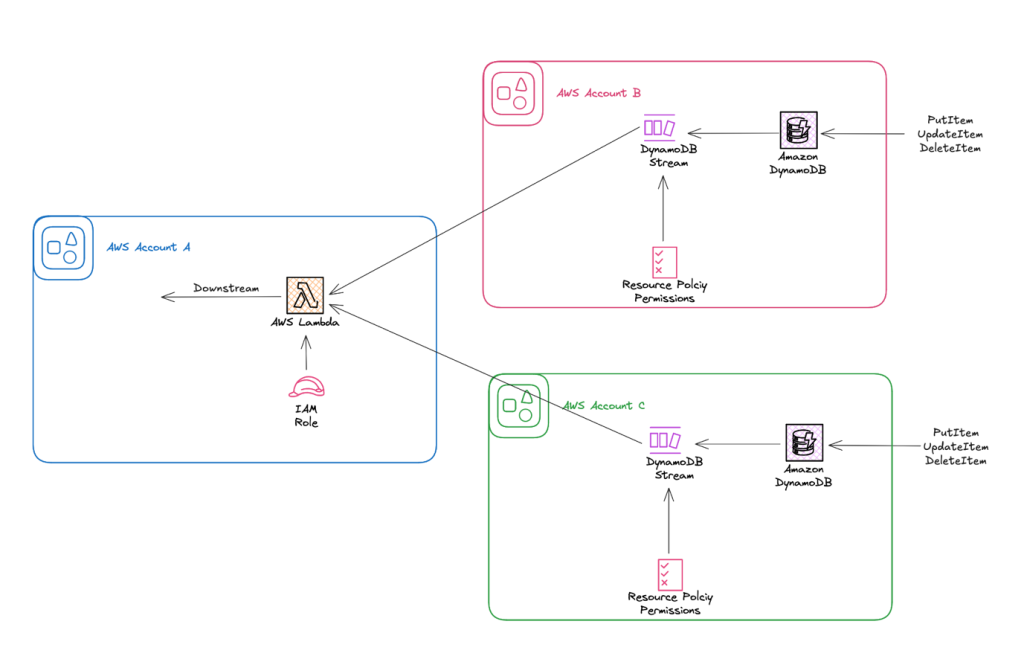
Simplify cross-account stream processing with AWS Lambda and Amazon DynamoDB
In this post, we explore how to use resource-based policies with DynamoDB Streams to enable cross-account Lambda consumption. We focus on a common pattern where application workloads live in isolated accounts, and stream processing happens in a centralized or analytics account.
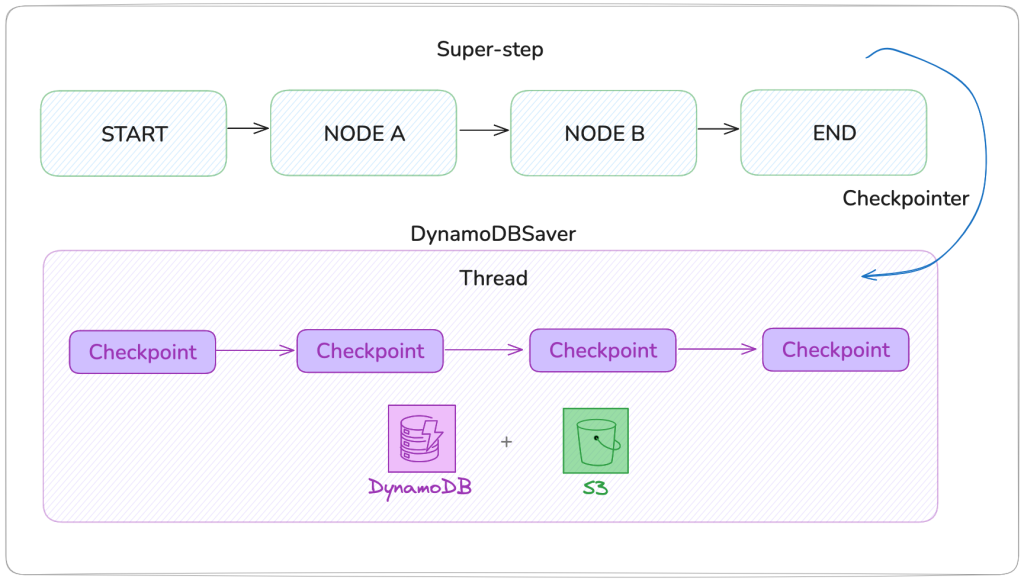
Build durable AI agents with LangGraph and Amazon DynamoDB
In this post we show you how to build production-ready AI agents with durable state management using Amazon DynamoDB and LangGraph with the new DynamoDBSaver connector, a LangGraph checkpoint library maintained by AWS for Amazon DynamoDB.
Accelerating data modeling accuracy with the Amazon DynamoDB Data Model Validation Tool
Today, we’re introducing the Amazon DynamoDB Data Model Validation Tool, a new component of the MCP server that closes the loop between generation, evaluation, and execution. The validation tool automatically tests generated data models against Amazon DynamoDB local, refining them iteratively until every access pattern behaves as intended.