AWS Developer Tools Blog
AWS SDK for JavaScript aligns with Node.js release schedule
This post is about AWS SDK for JavaScript v3 announcing end of support for Node.js versions based on Node.js release schedule, and it is not about AWS Lambda. For the latter, refer to the Lambda runtime deprecation policy.
In the second week of January 2026, the AWS SDK for JavaScript v3 (JS SDK) will start following the Node.js release schedule for ending support for Node.js and ECMAScript versions. The JS SDK versions will be tested on all Long-Term Support (LTS) versions of Node.js, with an additional 8 months of support for the most recent end-of-life (EOL) version. When we drop support for specific Node.js EOL version, we will also drop support for equivalent ECMAScript version in browsers.
The Node.js release schedule states that LTS versions reach EOL in April, and there are three LTS versions supported at any point in time. For example, Node.js 18.x was supported until April 2025 (until Node.js 24.x was published), and Node.js 20.x will be supported until April 2026 (until the next LTS version of Node.js will be published). In accordance with the AWS SDKs and Tools maintenance policy for language runtimes, the JS SDK will support each Node.js major version for an additional 8 months past the Node.js EOL date. (AWS reserves the right to drop support for unsupported Node.js versions earlier to address critical security issues.)
Along with dropping support for the Node.js EOL version, the JS SDK will also drop support for the equivalent ECMAScript version in browsers. The following table summarizes the upcoming dates.
| Node.js Version | Release Date | Node.js End of Life | JS SDK End of Support |
|---|---|---|---|
| 18.x | April 2022 | April 2025 | January 2026: Migrate to 20.x+ and ES2023+ |
| 20.x | April 2023 | April 2026* | January 2027*: Migrate to 22.x+ and ES2024+ |
| 22.x | April 2024 | April 2027* | January 2028*: Migrate to 24.x+ and ES2025+ |
| 24.x | April 2025 | April 2028* | January 2029*: Migrate to 26.x+ and ES2026+ |
* These dates are speculative based on Node.js release schedule.
Benefits of upgrading Node.js versions
Your applications’ security depends on staying current with the JavaScript ecosystem. When Node.js versions reach EOL, they no longer receive security patches or bug fixes, exposing your applications to vulnerabilities.
By aligning with the Node.js release schedule, you can make sure you have access to the following:
- A secure, up-to-date runtime that protects your applications from known vulnerabilities.
- Ongoing performance improvements that keep your applications running optimally.
- Predictable support timelines to plan future upgrades without disruption.
We strongly recommend upgrading to a supported Node.js version—preferably the latest LTS.
What to expect
If you’re using the latest JS SDK version with the Node.js LTS version that is EOL, the following message will be shown when you create an instance of any client:
// test.mjs or test.js with type:module
import { DynamoDB } from "@aws-sdk/client-dynamodb";

const client = new DynamoDB({});
$ node test.mjs
...
NodeDeprecationWarning: The AWS SDK for JavaScript (v3) will
no longer support Node.js v18.20.8 in January 2026.
To continue receiving updates to AWS services, bug fixes, and security
updates please upgrade to supported version of Node.js.
More information can be found at: https://a.co/c895JFp
...
In the second week of January, the GitHub and npm releases for the JS SDK will contain release notes stating the end of support for the Node.js EOL version. The exact SDK version will be included in the same release notes.
If you are using the Node.js EOL version, installing the later versions of the SDK will cause an engine deprecation warning to appear. If you have set engine-strict=true, an npm installation error with code ENOTSUP will occur as follows:
$ node --version
v18.20.8

$ npm install @aws-sdk/client-s3
...
npm ERR! code ENOTSUPnpm ERR! notsup Unsupported engine for @aws-sdk/client-s3@<version>: wanted: {"node":">=20.0.0"} (current: {"node":"18.20.8","npm":"10.8.2"})
...
The JS SDK versions released in the second week of January may continue to work on the Node.js EOL version. This does not imply a continuation of support. You can continue to use older versions of the JS SDK released before the second week of January with the Node.js EOL version.
Along with dropping support for the Node.js EOL version, we will also drop support for the equivalent ECMAScript version in browsers. This doesn’t impact most applications because new versions of browsers are released at a much faster pace (usually every 4–6 weeks), and they are automatically updated. Also, most browser applications use bundlers, where the ECMAScript version is specified in the application bundler configuration and the bundler will transpile all dependencies to that target. For applications that need to support very old browsers, you must provide polyfills.
Maintenance policies
We followed the Node.js release schedule and AWS SDKs and Tools maintenance policy to arrive at the end-of-support cadence for Node.js and equivalent ECMAScript version in browsers.
Node.js Release Schedule
Refer to the Node.js release schedule for a complete list of Node.js versions and their maintenance status.
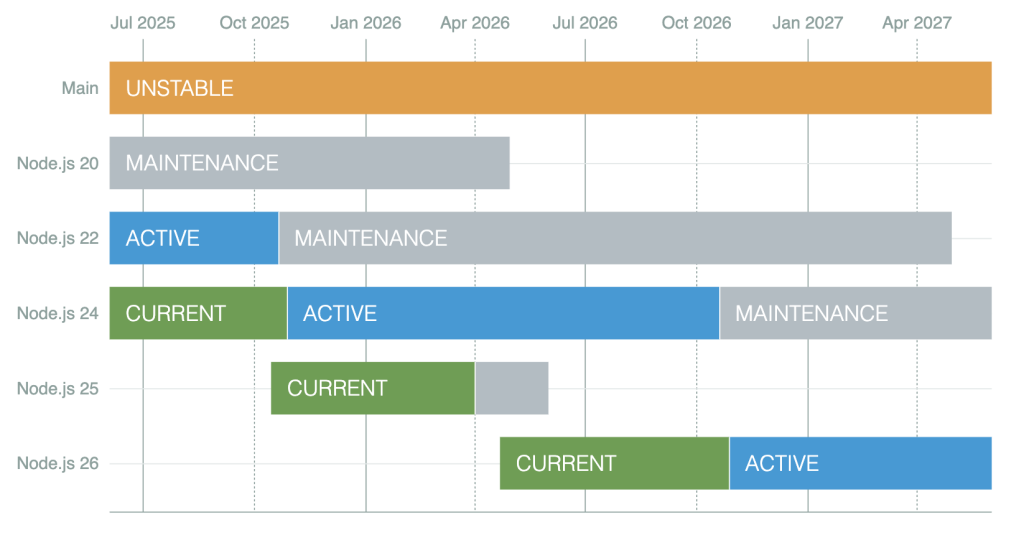
The new even-numbered versions (e.g. v20.x, v22.x, v24.x, and so on) are released in April, whereas odd-numbered versions (e.g. v21.x, v23.x) are released in October. When a new odd-numbered release is available, the previous even-numbered version transitions to LTS.
AWS SDKs and Tools
For more information regarding maintenance and deprecation for AWS SDKs, see the AWS SDKs and Tools maintenance policy. Our policy is to continue supporting SDK dependencies for at least 6 months after the community or vendor ends support for the dependency.
Feedback
Your feedback is greatly appreciated. You can engage with the AWS SDK for JavaScript team directly by opening a discussion or issue on our GitHub repository.