AWS for Industries
Executive Insights from the 2026 AWS Life Sciences Symposium
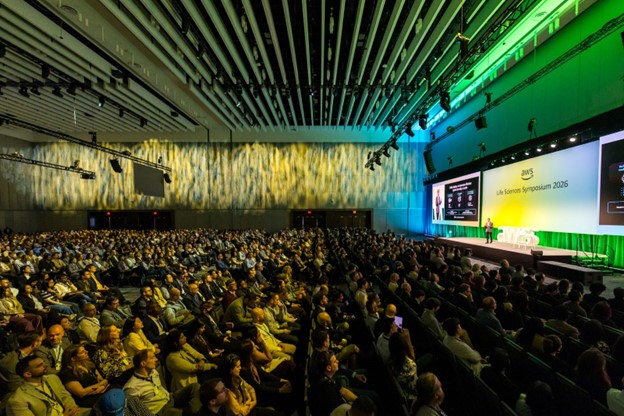
The below blog recaps the keynote delivered at the 2026 AWS Life Sciences Symposium. View the full recording.
There are two contrasting narratives depicting the success of agentic AI across the life sciences.
On one hand, a recent report from Deloitte cited that only 22% of life sciences leaders self-report successfully scaling AI, with only 9% reporting significant returns. On the other hand, companies like Insilico Medicine and Generate:Biomedicines advancing AI-assisted candidates into late-stage clinical trials as soon as Q4 2026.
Generate:Biomedicines advancing AI-assisted candidates into late-stage clinical trials as soon as Q4 2026.
Which version of the story is true – is AI still just hype or are we starting to see real-world value?
The answer is both.
It’s not black and white – the reality is many life sciences organizations are stuck somewhere in the gray area in between. Even within the same organizations, we’re seeing small pockets or successful AI deployments at-scale, while other teams struggle to make it out of proof of concept (PoC).
Over the past several years, Amazon Web Services (AWS) helped hundreds of life sciences organizations innovate with AI across the value chain – from identifying novel drug candidates to localizing marketing collateral. While technology plays a vital role in determining which organizations achieve success at-scale, we’ve learned that it must co-exist with a fundamental mentality shift.
These are the two themes we see:
1/ Building for production from day 1
2/ Adopt a builder mentality
Building for production from day 1
The life sciences organizations that are truly driving AI innovation throughout their organizations have built for production from day one.
Proof of concepts have always been a way to play it safe. We’ve seen time and time again that things break when you scale AI from concept into production when faced with challenges in scalability, governance, security, and performance.
Diogo Rau, Executive Vice President and Chief Information and Digital Officer at Eli Lilly, joined me on stage to share how Lilly prioritizes production at-scale.
Lilly created Cortex – its unified AI platform that standardizes guardrails, shared components, and self-service access to more than 50+ models – to streamline and optimize the development and deployment of AI solutions across its organization.
Lilly knew that to drive success at scale, it needed to make Cortex work for everyone, deploying both pro-code options for hands-on developers and no-code environments for scientists and researchers to experiment, build, and use. Over the past three years, Cortex grew from offering one to now 52 models, includes ~60 enterprise-grade applications, and is used by almost every non-manufacturing employee across the globe.
As Diogo mentioned, and many life sciences organizations have already experienced, AI success isn’t a linear path – it’s a continuous investment and journey that, luckily for our industry, follows the scientific method.
Observe. Question. Hypothesize. Experiment. Test. Show results. Start over.
And that’s why it’s vital that you become a builder.
Adopt a builder mentality
Becoming a builder doesn’t mean that you need to create everything from the ground up. Rather, it’s about developing and empowering a builder mentality across every layer of your organization.
At the enterprise level, this means building a unified data and AI backbone that can function across your enterprise, much as Diogo referenced. And it’s not just about providing access to the right data – you need to prepare your data for both human and agents.
That’s where the semantic data layer comes in. Your teams walk around with a vast amount of knowledge that we may call “common sense” or “domain expertise.” Agents don’t inherently know your industry- and company-specific ontologies, taxonomies, data relationships and so on.
If I ask an agent “which HPCs in Dr. Harper’s referral network are under-targeted relative to their prescribing potential,” the agent cannot give an answer. There’s nothing to help it understand what a referral network or prescribing potential even is, let along the threshold for meeting a target. By providing this context within a semantic data layer, our agent can now understand, connect the dots, and provide an actionable answer.
As I mentioned in my keynote, AI is everyone’s responsibility.
Organizations that are already experiencing success at-scale already know this – they are relentlessly committed to empowering a culture that fails fast, learns quickly, and empowers every researcher scientist, and team member with the right data and AI tools to build.
For instance, many of our life sciences customers including Bristol Myers Squibb, Sanofi, and Pfizer are already leveraging Amazon Bedrock AgentCore to empower their teams to build, deploy, and operate agents efficiently and securely at-scale. And with Amazon Quick, researchers can quickly build and deploy their own agents using text-based prompts.
It’s at the intersection of AI accessibility and human domain expertise that we’re starting to see accelerated advancements across the value chain.
From target identification to clinical trials, Manas AI combines AI and human expertise to accelerate every step of bringing life-saving medicines to patients. During the keynote, Siddhartha Mukherjee, M.D., Ph.D., co-founder and CEO of Manas AI, highlighted how the company is driving biologically informed target identification. Built on AWS, the Manas Pocket Identifier (MPI) can discover novel allosteric pockets, select the most appropriate pockets, and provide a deep characterization of the pocket grounded in best-in-class physics expertise. Additionally, the Manas Medicine Making AI Platform (3MP) can generate a novel compound corresponding to the characteristics of the targeted pocket.
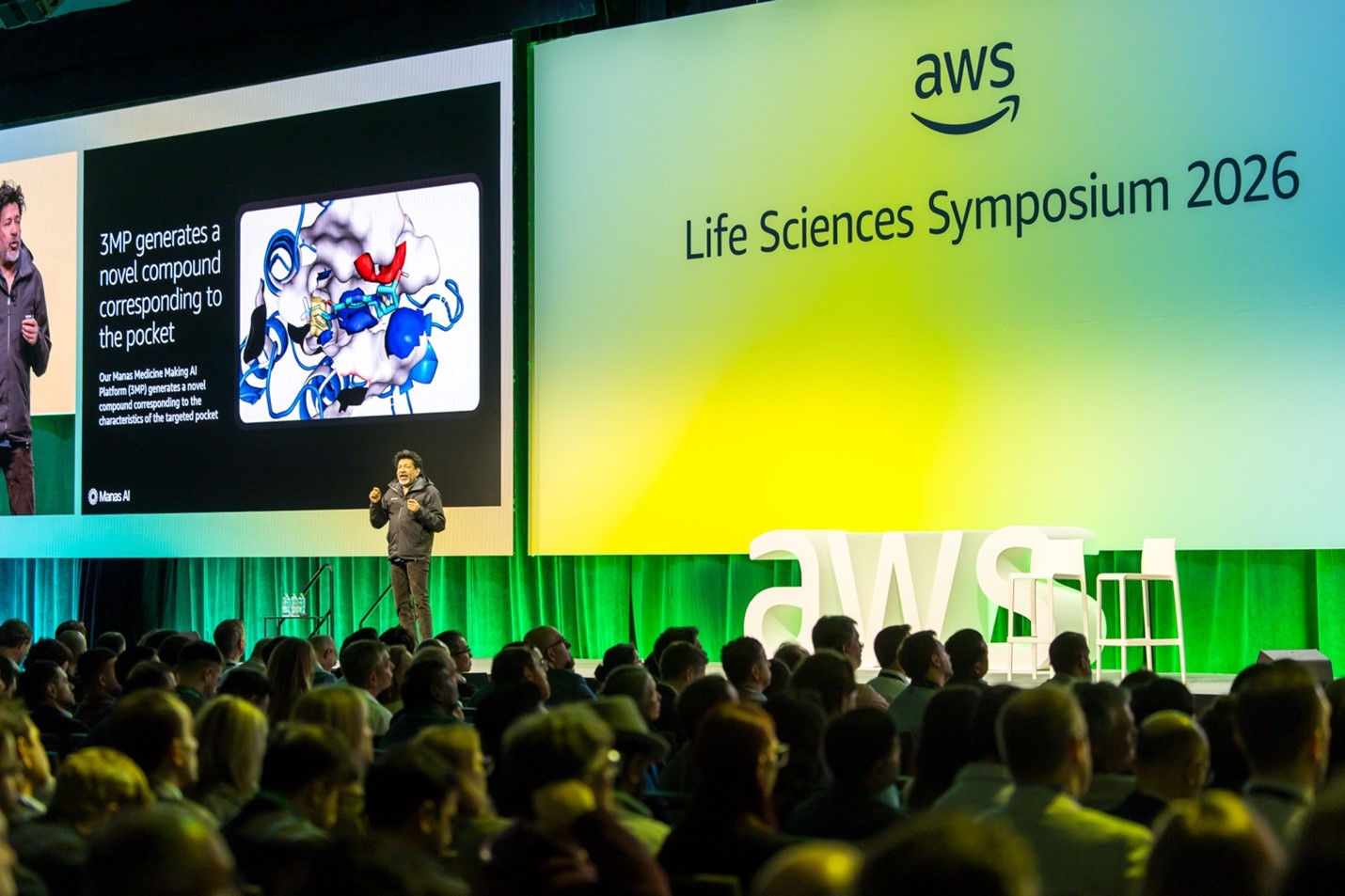
As Aviv Regev, Executive Vice President, Genentech Research and Early Development, said in our fireside chat recording, “But really the most exciting part is it is now in the scientist’s hands. It’s no longer like something done by special people who do AI.”
You don’t have to have it all figured out
As we touched on at the onset of this blog, the life sciences industry is at an inflection point. While we’re seeing many early signals of success, the truth is many organizations are still asking themselves “where do I start.”
If you’re asking yourself this question, you are not alone and you don’t need to start from a blank sheet of paper.
Over the past several years, AWS has deepened its investments in the life sciences industry, building industry-specific AI services, agents, tools, and guidance purpose-built to address common industry challenges.
For example, AWS has developed dozens of customizable agents based on successful customer deployments, ranging from therapeutic target validation to competitive market intelligence. In many cases, AWS’s agents are production ready and only require configuration and customization based on your organizational data and infrastructure.
During our annual symposium, we announced a new addition to our suite of life sciences services – Amazon Bio Discovery. Amazon Bio Discovery is new AI-powered application designed to help scientists design and test novel drugs more quickly and confidently. By bringing computational design and wet-lab validation together in one application, Amazon Bio Discovery automates technical complexities, optimizes decisioning at-scale, and unifies data and learnings.
Dr. Yashodhara Dash, Vice President of Entrepreneurship and Commercialization at Memorial Sloan Kettering Cancer Center, shared initial results from their usage of Amazon Bio Discovery, demonstrating how the organization progressed from target to sending 100,000 de novo designs to the lab within weeks.
Where innovation meets impact
If the keynote asked what it takes to turn AI ambition into real-world impact, Eden Wells, Chief Insights and Decision Science Officer, Novartis US, answered. Her perspective highlighted a core truth in healthcare today: closing the gap between breakthrough science and patient outcomes requires changing how decisions get made — supported by scalable, trusted technology foundations.
Faced with fragmented patient support systems, the work Eden and her teams drove, built on AWS, highlighted a critical insight: data alone isn’t enough. What can change outcomes are decision environments – systems intentionally designed around how people decide under pressure, integrating medical science, behavioral insight, and trusted technology. In practice, that approach delivered tangible improvements: 36% faster workflow for benefits applications and a 10–15% increase in patient conversion rates.
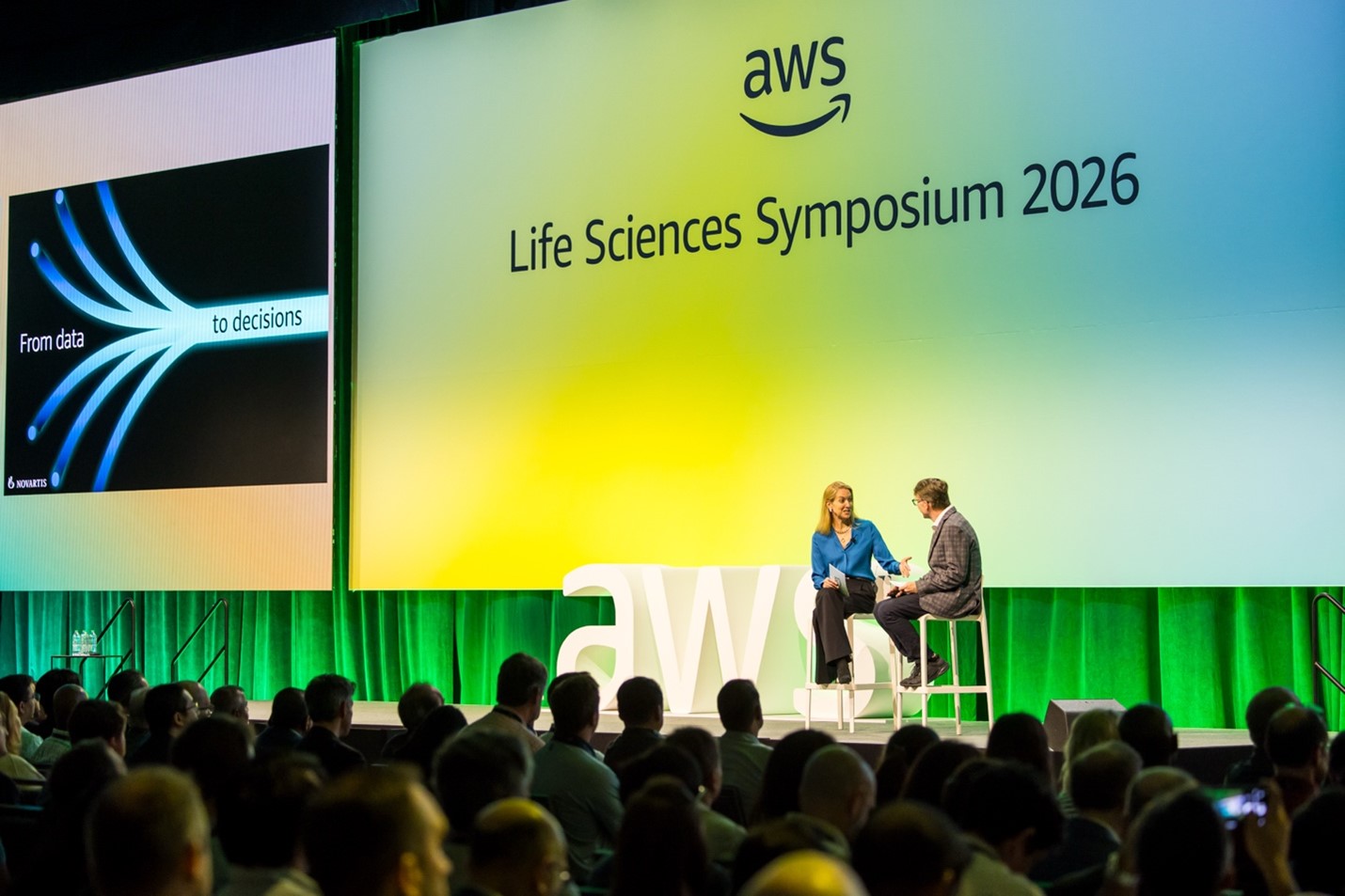
But the deeper lesson is about scale: moving beyond pilots to governed, connected foundations that allowed better decision-making. The ability to consistently repeat the success across the commercial organization has enabled teams to be much more proactive, and translate upstream innovation into real-world outcomes at the speed of human decision-making.
The 2026 AWS Life Sciences Symposium made one thing clear: we are at an inflection point where AI is no longer a future promise — it’s delivering real outcomes today, from accelerating drug discovery to improving patient access. The organizations leading this transformation share a common thread: they build for production from day one, empower every employee to innovate with AI, and leverage technology as a catalyst.
To learn more, watch the full recording.