AWS for Industries
The Evolution of BMW Group’s 3D Streaming Experience
Transforming the Online Car Configuration Experience
BMW Group’s Emotional Virtual Experience (EVE) began as an innovative dealership tool that enables immersive 3D real-time streaming consultations in dealers’ showrooms. This solution allowed them to showcase vehicles in every possible configuration as stunning 3D rendering, helping customers envision their future BMW vehicle with unprecedented fidelity.
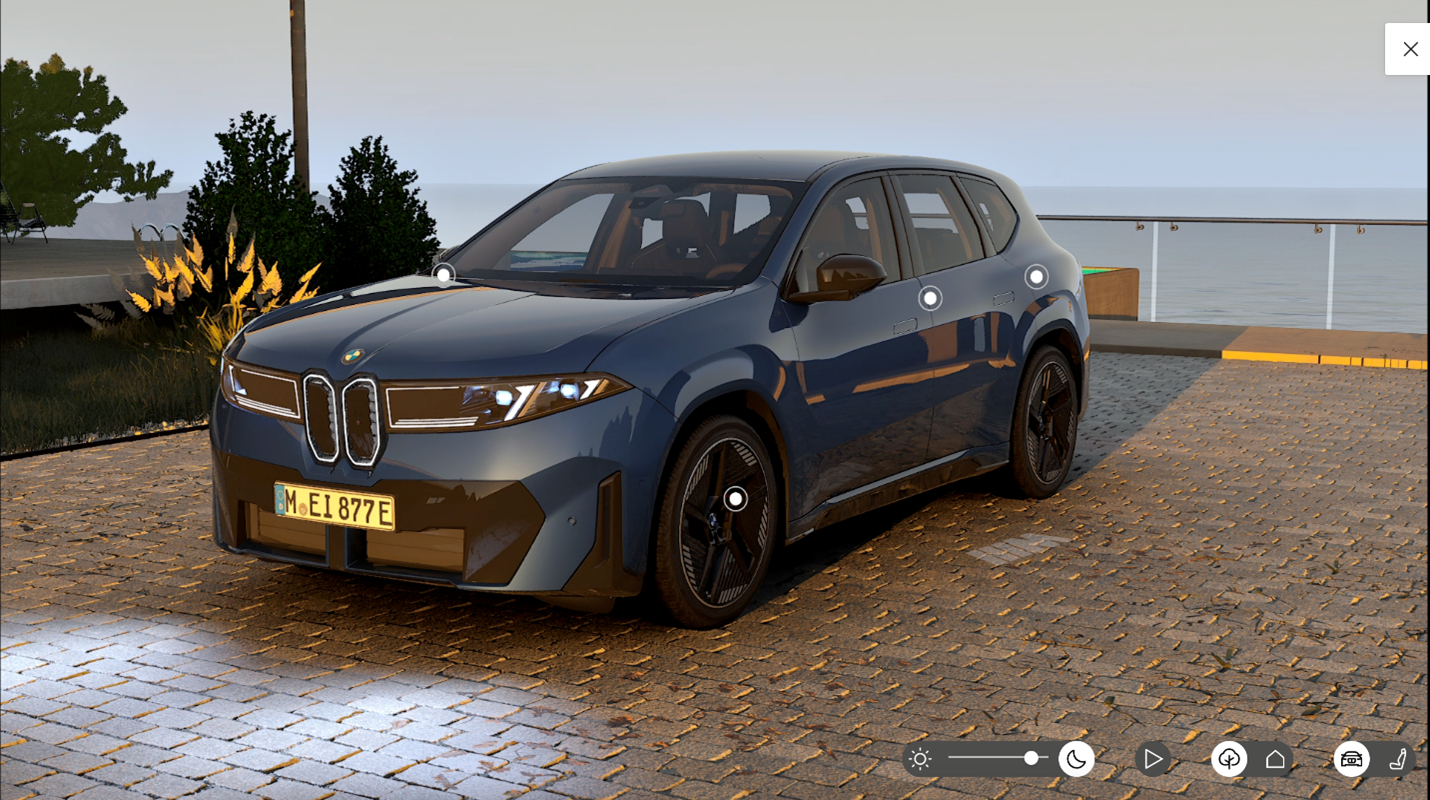
However, the automotive industry’s digital transformation demanded more from BMW Group. With the highly anticipated launch of the Neue Klasse on September 5, 2025, BMW Group faced a pivotal challenge: how to transform this dealership-exclusive technology into a global, internet-scale digital experience that could serve thousands of users simultaneously.
The stakes were enormous. BMW Group needed to deliver one of the automotive industry’s most advanced 3D streaming experiences directly through its online configurator, accessible from any device, anywhere in the world. The original EVE solution, while successful in controlled dealership environments, relied on expensive on-premises Windows GPU servers and was not built to be hosted on cost-efficient Linux instances on AWS.
This challenge pushed BMW Group beyond incremental improvements toward a fundamental reimagination of its 3D streaming architecture. The goal was ambitious yet clear: deliver seamless, real-time 3D vehicle visualization, embedded into BMW Group’s online car configurator. It had to feel natural, responsive, and visually accurate to customers exploring their dream vehicle from their living room, office, or anywhere they choose to configure.
The Neue Klasse launch represented more than just a new vehicle line—it was an opportunity to set a new standard for digital customer engagement in the automotive industry, transforming how customers worldwide discover, explore, and connect with BMW vehicles before ever setting foot in a showroom.
In this blog post, we’ll explain why BMW Group chose Amazon Web Services, Inc. (“AWS”) as its cloud provider to deliver this user experience and dive deep into how the team solved the technical challenges along the way.
Why AWS for Global 3D Streaming?
When BMW Group evaluated deployment options for the 3D streaming platform transformation, several factors made AWS the clear choice.
Global Reach: The Neue Klasse launch demanded worldwide availability from day one. AWS’s global footprint, with regions strategically positioned across continents, provided the foundation for low-latency 3D streaming regardless of customer location.
GPU Infrastructure at Scale: AWS offers a diverse portfolio of GPU-optimized EC2 instances. The g4dn.2xlarge provided the optimal balance of price and performance for the Unreal Engine workload, and AWS’s scale gave BMW Group confidence that demand spikes during launch events could be handled.
Cost-Effective Linux Migration: Moving from Windows-based on-premises infrastructure to Linux instances in the cloud represented significant cost savings through reduced licensing costs and improved resource efficiency.
Collaborative Engineering: AWS teams worked closely with BMW Group’s engineers throughout the architecture design process, helping navigate the complexities of transforming a dealership tool into a globally distributed, customer-facing service.
Technical Challenges to Solve
As BMW Group designed the global architecture, three critical technical requirements emerged that would define their implementation approach:
Capacity Management: Unlike traditional web applications that can run on standard compute instances, Unreal Engine streaming applications require GPUs. Therefore, they had to ensure sufficient availability of optimal GPU instances. They ran benchmarks to identify g4dn.2xlarge as the EC2 instance with the best price-performance and wanted to ensure that they’d always have enough instances of that type for the day of the launch of the “Neue Klasse”, for which they expected substantial demand.
Latency Optimization: Real-time 3D streaming is unforgiving when it comes to network latency. Intelligent routing to map each user to the geographically closest AWS region while maintaining consistent performance standards across the US and EU is necessary.
Resource Isolation: Perhaps most challenging was the fundamental constraint of BMW’s Group’s existing Unreal Engine based streaming architecture: each GPU instance can support only one concurrent user session. This is a common challenge with real-time 3D streaming applications: the GPU continuously renders a personalized, interactive scene for each user, maintaining session state and responding to user inputs in real-time. Unlike traditional web applications where a single server handles thousands of stateless requests, 3D streaming requires dedicated GPU resource per active session and at most a few concurrent users are supported. For BMW’s application, only one user per instance was supported. This meant they had to implement a sophisticated 1-to-1 mapping between users and EC2 instances in the instance pool.
These challenges required BMW Group to leverage AWS services in innovative ways, to create a truly scalable global streaming platform.
Architecture: Building a Global 3D Streaming Platform
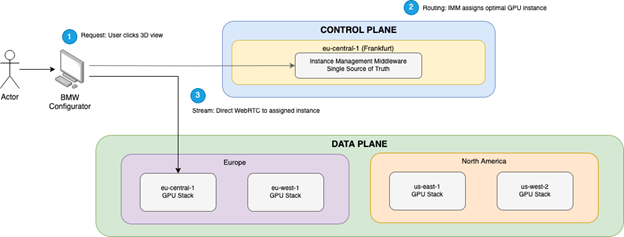
3D Streaming platform’s architecture follows a pattern common in AWS services: separating control plane from data plane. This allows optimizing each component for its specific responsibilities while maintaining clear boundaries between configuration and execution.
Instance Management Middleware (IMM): The control plane handles orchestration – mapping user requests to GPU instances, tracking instance states (available, assigned, provisioning) across all regions, determining optimal regions via IP geolocation, and implementing regional fallback when capacity is constrained. IMM coordinates resources globally but doesn’t execute streaming workloads.
Regional Stacks: The data plane operates as independent stacks deployed across multiple AWS regions. GPU-optimized EC2 instances run Unreal Engine to render photorealistic 3D vehicle visualizations, delivered to browsers via WebRTC. CoTurn servers manage connection establishment, while pre-warmed instance pools ensure rapid session startup.
Deployment Strategy: Centralized Control, Distributed Execution
The data plane spans multiple AWS regions across North America and Europe, with two regions per geography for availability and resilience. The control plane (IMM) runs in a single region: eu-central-1 (Frankfurt).
This centralization is deliberate. IMM must atomically assign GPU instances and mark them unavailable to prevent double-booking. Distributing IMM across regions would introduce consistency challenges – network partitions or replication lag could allow two IMM instances to assign the same GPU to different users. A single region eliminates this entirely, providing one source of truth. The latency cost (under 100ms globally) is negligible compared to multi-minute streaming sessions.
The data plane must be distributed because streaming latency directly impacts user experience – a customer in New York experiences noticeably lower latency from a US-region instance than from Frankfurt. When a customer clicks to view their configured vehicle in 3D, IMM assigns an optimal GPU instance based on location, and the regional data plane streams the rendered visualization via WebRTC.
Data Plane Deep Dive: Regional Stack Architecture
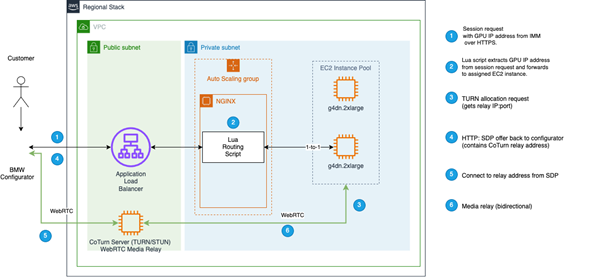
A core security requirement was keeping GPU instances running Unreal Engine off the public internet. The BMW Group deployed them in private subnets within AWS VPCs, routing all access through an AWS Application Load Balancer (ALB) integrated with AWS Shield and AWS WAF in a public subnet. However, this did not solve their most critical technical challenge: the strict 1-to-1 mapping between users and GPU instances.
Their solution for the 1-to-1 mapping problem was an auto-scaled fleet of NGINX servers on EC2 instances in the private subnet, positioned between the ALB and the GPU fleet. They customized NGINX’s routing logic with a Lua script that extracts the private IP address of the user’s assigned GPU instance from the request URL. After validating the IP address, NGINX forwards the request directly to that specific instance, maintaining the 1-to-1 user-to-instance mapping while preserving the security architecture.
Outcomes: Launch Day Success
On September 5, 2025, BMW Group achieved their most significant milestone with the world premiere of the all-new BMW Group’s iX3. During the launch day online car configurator served up to 500 parallel 3D real-time configuration sessions to customers.
For the first time, BMW enthusiasts worldwide could experience their dream car configuration with unprecedented interactivity – opening the frunk, exploring practical features, and walking around the vehicle to appreciate design elements from every angle. The interior experience allowed customers to view the BMW Panoramic Vision, gauge trunk space, and explore cabin layout and upholstery details in immersive depth.
Conclusions and Future Outlook
BMW Group’s 3D streaming platform demonstrates how cloud-native architecture can transform traditionally on-premises sales experiences into globally accessible digital services. By separating the control plane and data plane, centralizing orchestration for consistency while distributing execution for performance, they successfully scaled a dealership tool into a worldwide 3D streaming platform capable of handling the Neue Klasse launch.
Looking ahead, BMW Group is exploring dynamic scaling for the instance warm pool, which would minimize the number of instances necessary in the pool and reduce cost.
BMW Group will be extending the streaming experience to additional BMW models soon. This is just the beginning of 3D streaming platform’s evolution.