AWS for Industries
Ultra-low-latency cross-Region crypto trading with Avelacom and AWS
Introduction
In cryptocurrency trading, achieving ultra-low-latency cross-Region connectivity often translates directly to alpha (excess returns exceeding market benchmarks). When arbitrage opportunities between exchanges might exist for only milliseconds, the difference between profit and missed opportunity depends on network performance.
This post demonstrates how combining AWS Direct Connect (Direct Connect) with Avelacom’s proprietary ultra-low-latency network reduced cross-Region round-trip latency by up to 49% for crypto trading workloads. Based on TCP benchmarks across five routes from Tokyo, you’ll find architecture details, measurement methodology, and guidance on when this approach is the right fit.
Crypto liquidity is globally fragmented. Major exchanges operate across Regions: Binance in Tokyo, Bybit in Singapore, Coinbase in the US, and Deribit in London. For trading firms pursuing cross-exchange strategies like statistical arbitrage, market making, or liquidation hunting, this fragmentation creates a challenge. Moving data between AWS Regions fast enough to act on fleeting opportunities requires specialized infrastructure.
The cross-Region latency problem
Within a single AWS Region, firms optimize every microsecond between Amazon Elastic Compute Cloud (Amazon EC2) instances and exchange matching engines. Common techniques include placement groups, Elastic Network Adapter (ENA) tuning, and kernel bypass. These optimizations can achieve sub-150 µs intra-Region latencies.
Cross-Region is different. When your trading engine in Tokyo needs to pull market data from Singapore or the US, the cross-Region hop dominates your latency budget. It adds tens to hundreds of milliseconds depending on destination, compared to the sub-millisecond intra-Region baseline. AWS provides Amazon Virtual Private Cloud (Amazon VPC) peering for cross-Region connectivity. VPC peering is reliable, private, and uses the AWS global backbone. But AWS optimizes it for resilience and scalability across millions of customers, not for point-to-point latency in trading.
The Avelacom approach
Avelacom operates network infrastructure built specifically for latency-sensitive financial applications:
- Proprietary routes: Private fiber infrastructure optimized for latency-sensitive market data feeds and order flow
- Deterministic performance: Controlled network paths that provide predictable, low-jitter data transmission
- High availability: Multi-layer redundant infrastructure providing high uptime
- AWS Direct Connect integration: EC2 → Direct Connect → Avelacom network → Direct Connect → EC2 (referred to as Direct Connect with Avelacom throughout this post)
The key difference lies in physical-layer optimization. Avelacom engineers its network to minimize physical distance between Regions through optimized terrestrial and submarine routes, reducing latency for long-haul inter-Region connectivity.
Reference architecture
Figure 1 illustrates the two network paths tested between AWS Regions.
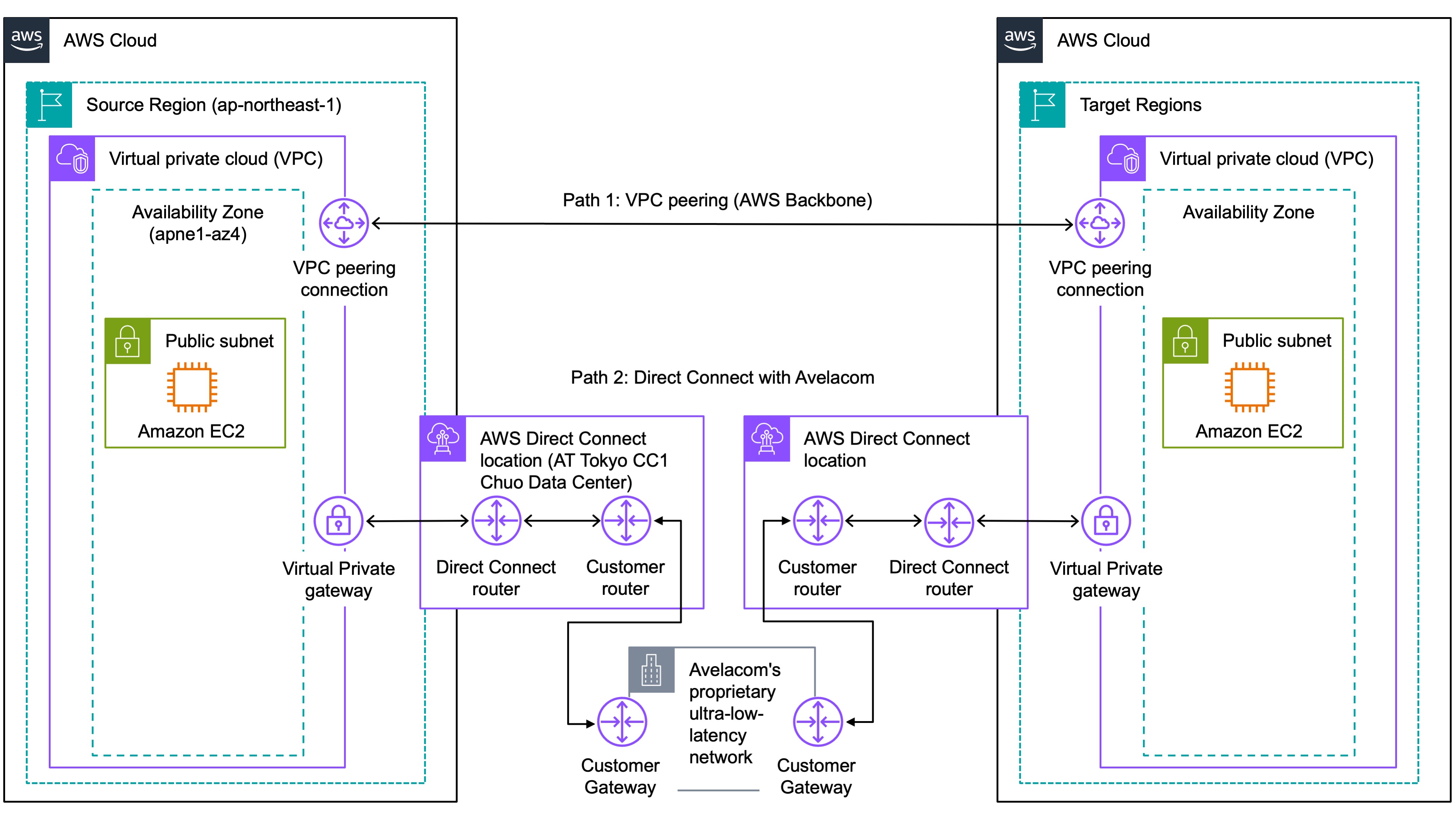
Figure 1: Cross-Region latency architecture comparing VPC peering and Direct Connect with Avelacom paths
Tokyo (ap-northeast-1) serves as the primary hub, a logical choice given Binance’s concentration of volume. From Tokyo, the solution connects to:
| Route | Regions | Use Case |
|---|---|---|
| Tokyo ↔ Singapore | ap-northeast-1 ↔ ap-southeast-1 | Binance ↔ Bybit APAC arbitrage |
| Tokyo ↔ Virginia | ap-northeast-1 ↔ us-east-1 | APAC ↔ Coinbase US |
| Tokyo ↔ Frankfurt | ap-northeast-1 ↔ eu-central-1 | APAC ↔ EU venues |
| Tokyo ↔ London | ap-northeast-1 ↔ eu-west-2 | APAC ↔ Deribit/ Polymarket |
| Tokyo ↔ Stockholm | ap-northeast-1 ↔ eu-north-1 | APAC ↔ Nordic/EU venues |
Network paths compared:
- VPC peering: EC2 → VPC peering → AWS backbone → EC2
- Direct Connect with Avelacom: EC2 → Direct Connect → Avelacom network → Direct Connect → EC2
Test methodology
- Instance type: c7i.large with ENA enhanced networking
- Measurement tool: sockperf, TCP ping-pong mode, 60 seconds per route, 64-byte messages
- Sample size: 242–909 observations per route (determined by RTT; shorter routes complete more round-trips in 60s)
- Control: Identical EC2 instances, same private IPs. Only variable is the network path (route table swap: VPC peering → virtual private gateway)
- VPC peering test: 2026-04-28 07:59–08:05 UTC
- Direct Connect with Avelacom test: 2026-04-28 08:16–08:23 UTC
Why sockperf? ICMP ping measures network-layer latency but doesn’t reflect what trading applications experience. sockperf’s TCP ping-pong mode establishes a real TCP connection with 64-byte messages. It measures the time for a message to complete a full round trip through the application layer, making it closer to actual trading message latency than ICMP-based tools.
Results
Figure 2 presents P50 (median) round-trip time across these five routes.
| Route | VPC peering P50 RTT | Direct Connect with Avelacom P50 RTT | Improvement |
|---|---|---|---|
| Tokyo → Singapore | 68.0 ms | 65.4 ms | 3.8% |
| Tokyo → Virginia | 150.2 ms | 135.4 ms | 9.9% |
| Tokyo → Frankfurt | 224.3 ms | 136.5 ms | 39.1% |
| Tokyo → London | 210.0 ms | 139.6 ms | 33.5% |
| Tokyo → Stockholm | 245.3 ms | 124.3 ms | 49.3% |
The values represent sockperf TCP ping-pong P50 (median) RTT we measured on 2026-04-28.
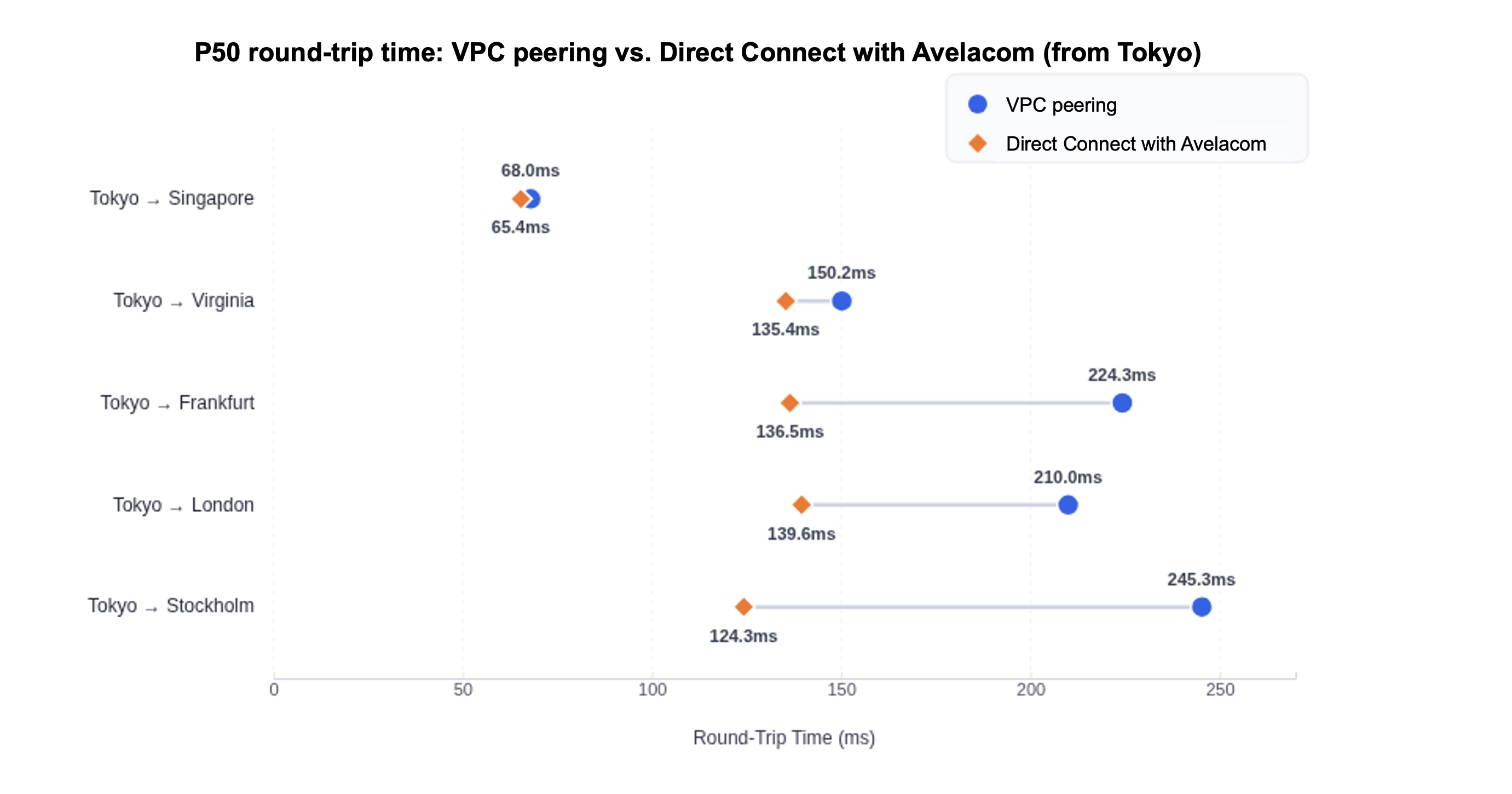
Figure 2: P50 round-trip time comparison across five routes from Tokyo (VPC peering vs. Direct Connect with Avelacom)
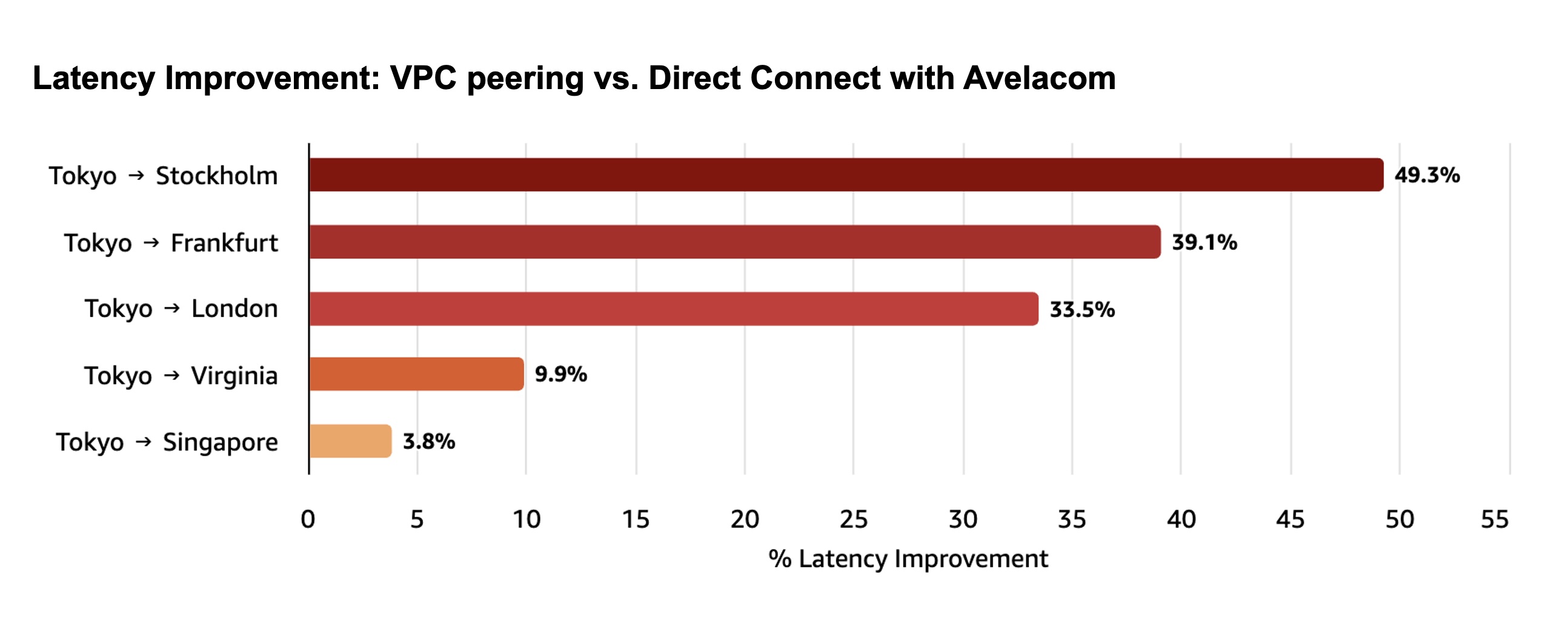
Figure 3: Percentage latency improvement using Direct Connect with Avelacom versus VPC peering (sorted by magnitude)
P99 tail latency
For trading applications, P99 tail latency matters because strategies that work at median but fail at P99 are unusable.
| Route | VPC peering P99 | Direct Connect with Avelacom P99 | Improvement |
|---|---|---|---|
| Tokyo → Singapore | 68.1 ms | 65.6 ms | 3.7% |
| Tokyo → Virginia | 150.4 ms | 135.6 ms | 9.8% |
| Tokyo → Frankfurt | 224.5 ms | 136.6 ms | 39.1% |
| Tokyo → London | 210.2 ms | 139.8 ms | 33.5% |
| Tokyo → Stockholm | 245.9 ms | 124.5 ms | 49.4% |
P99 latencies track closely with P50 on both paths, indicating stable, predictable performance. Jitter (standard deviation) remained under 90 µs across these five routes.
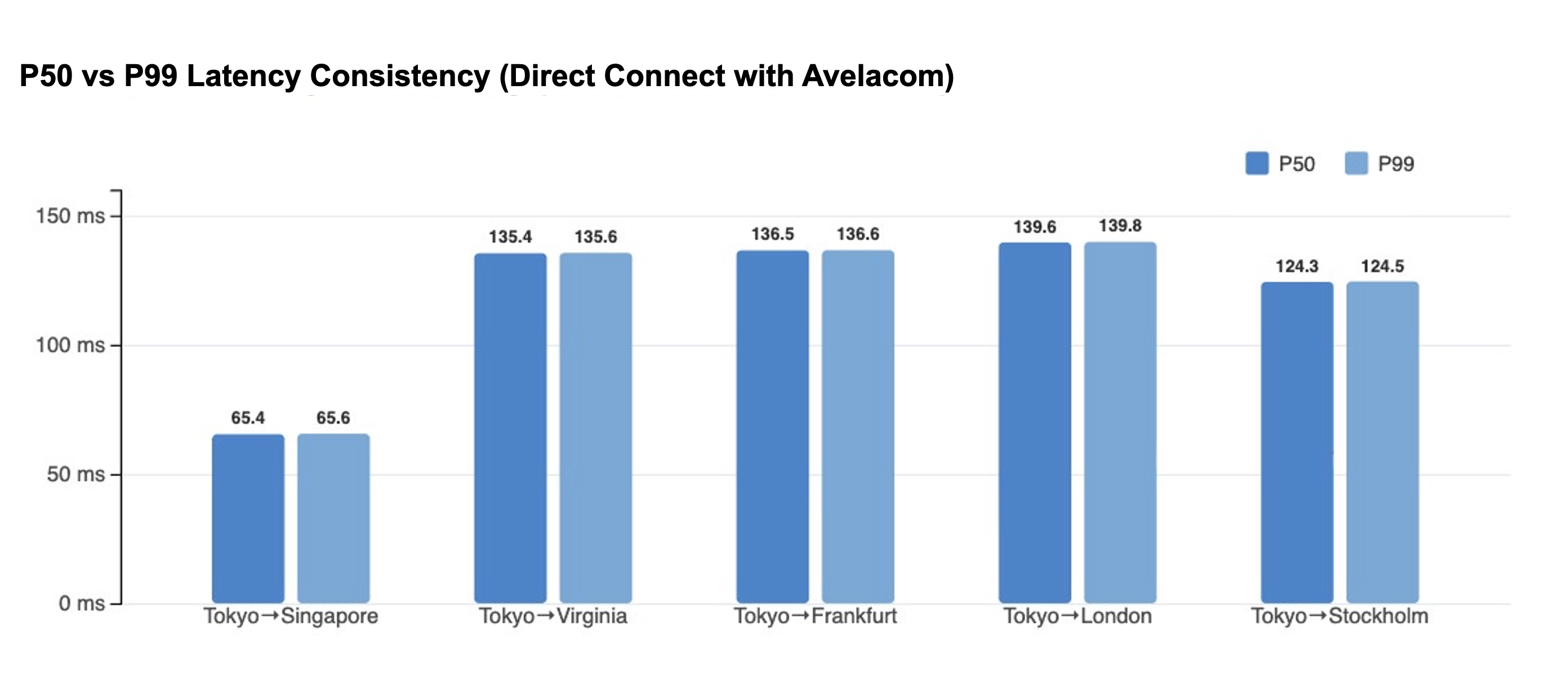
Figure 4: P50 vs P99 latency consistency (Direct Connect with Avelacom)
Note: Latency results might vary based on time of day, network conditions, and infrastructure changes. We recommend that you conduct your own testing to validate performance for your specific use cases.
Key findings
- EU routes show the largest gains. Frankfurt 39.1%, London 33.5%, Stockholm 49.3%. Avelacom’s network takes a physically shorter path to EU than standard AWS routing.
- Singapore shows modest gains (3.8%): already a short submarine cable hop with limited physics headroom for further improvement.
- Testing showed no packet loss on either path across the tested routes, indicating equivalent reliability.
When Direct Connect with Avelacom makes sense
It’s a good fit when:
- Your bottleneck is cross-Region latency (not intra-Region)
- You need predictable, consistent performance for execution strategies
- You’re running cross-exchange arbitrage, market making, or multi-Region risk management
- Your trading volume justifies dedicated connectivity costs
Examples of scenarios where native AWS options might suffice include:
- Latency tolerance is in hundreds of milliseconds
- Cost optimization is the priority
- Architecture simplicity is paramount
Cost components
This architecture involves two separate cost dimensions:
- AWS Direct Connect: Port hour rate and data transfer out. For pricing, see the AWS Direct Connect pricing page.
- Avelacom network: Route-specific pricing based on bandwidth, SLA tier, and number of Region pairs. Contact Avelacom directly for a quote based on your requirements.
Conclusion
For crypto trading firms where cross-Region latency can translate directly to profitability, Avelacom’s proprietary ultra-low-latency network delivers measurable improvements over standard AWS connectivity:
- Up to 49% RTT reduction on Tokyo–EU routes
- Sub-90 µs jitter across the five tested paths, with P99 tracking closely to P50
- No packet loss on either path during testing
- Predictable, consistent performance across repeated test sessions
The fragmented nature of crypto liquidity means cross-Region connectivity directly impacts execution speed. For strategies where milliseconds matter, dedicated infrastructure reduced cross-Region RTT by up to 49%. We measured these results using TCP ping-pong benchmarks on 2026-04-28 (see the Test methodology section above).
Next steps
To explore this architecture, contact your AWS account team for Direct Connect design guidance and contact Avelacom to discuss available routes and SLA options. Consider starting with a proof of concept on your highest-priority Region pair before committing to a production deployment.