Migration & Modernization
Superhuman’s AI advantage: measuring the business value of AI adoption
This post shares quantified results of the company Superhuman, which made AI to be the default way of work for their platform team. As a result, developer output rose 60%, 1,300 autonomous pull requests shipped in a single half, and experimentation rates tripled. This post looks at how the Superhuman’s platform team did it, what they measured, and what other engineering organizations can take away.
1. Introduction
1.1 Meet Superhuman: an AI-Native company that uses and builds AI
Superhuman, formerly Grammarly, is on a mission to unlock the superhuman potential in everyone. What began in 2009 as a writing assistance tool has evolved into a comprehensive AI productivity platform that reaches users across more than one million applications and websites. With annualized revenue exceeding $700M, over 40 million people and 50,000 organizations using the product worldwide, the company offers a suite of products including Docs (collaborative documents), Mail (email productivity), Grammarly (writing assistance), and Superhuman Go (AI assistant). The scale of that footprint makes the internal engineering story told in this post all the more relevant: by making AI the default way to work, Superhuman’s platform team achieved a 60% increase in developer output, shipped over 1,300 agent-generated code changes in a single half, and tripled experimentation rates.
What makes Superhuman’s story instructive is a distinction easy to overlook: Superhuman doesn’t only sell AI productivity tools. It uses AI to build them. At the center of this building process is the platform team, a group whose mandate is not to ship customer-facing features but to build the internal tools, processes, and mechanisms every other engineering and product team depends on. In an organization that has grown through acquisitions and operates across time zones and continents, the platform team is the force multiplier. When it improves its processes, the whole company works faster.
1.2 The AI productivity opportunity
The question is no longer whether AI delivers business value. It’s how to measure it, and how to build the foundation that makes measurement possible.
The evidence is already in. According to the GLG cross-industry study Cloud Migration Business Impact (2025), organizations using generative AI report a 26% average return on investment (ROI) from generative AI (GenAI) projects, 15% higher revenue, and 29% faster time-to-value for new products and services. The same study shows that organizations with high cloud adoption show the highest AI returns, because AI needs the data infrastructure, elasticity, and integration capabilities that cloud provides natively.
AI doesn’t deliver returns as a standalone technology purchase. It takes enterprise-wide transformation across people, processes, and platforms. With the AWS AI Value Framework, you can assess AI-driven business value across five dimensions: 1) AI Economics, 2) Governance and Compliance, 3) Experience Optimization, 4) Risk and Resilience and 5) Innovation. Figure 1 illustrates how the five pillars of the AWS AI Value Framework offer to measure AI business outcomes.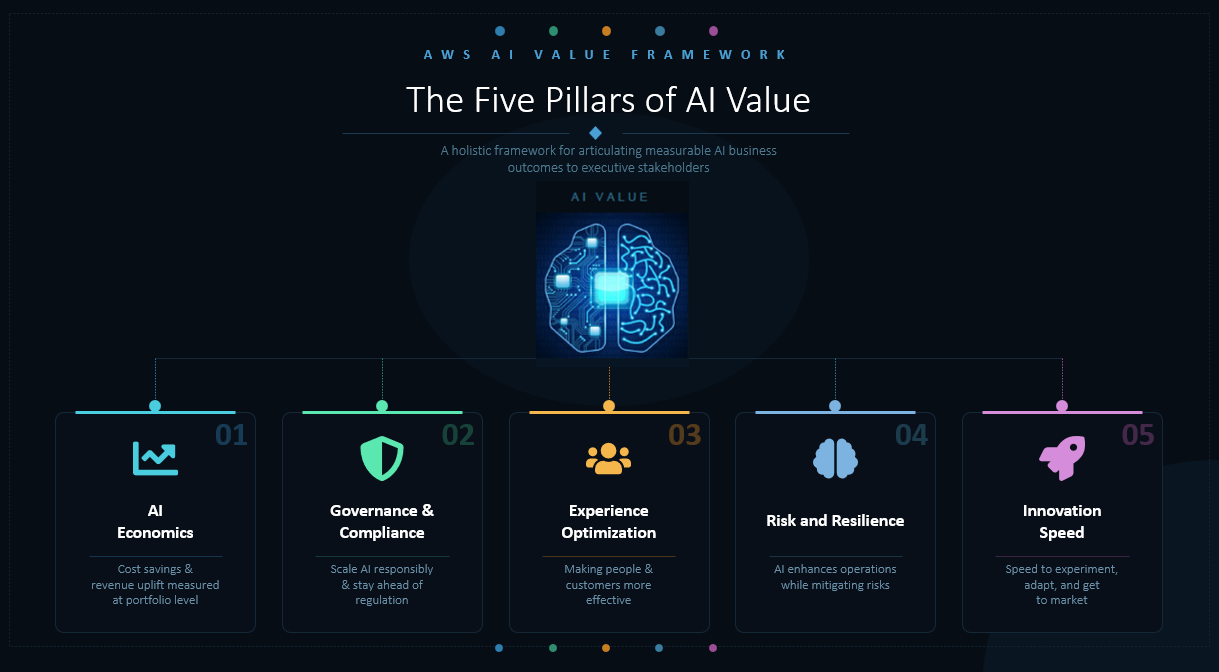
The following section examines Superhuman’s platform team results through three of these pillars: experience optimization, risk and resilience, and innovation speed – each with quantified outcomes from H1 2025 vs H1 2026.
2. Business value of using AI for software development
2.1 Experience optimization: doing more with the same team
Engineering teams routinely face a productivity ceiling: headcount is flat, hiring skilled talent takes months, and the backlog of maintenance work grows faster than teams can absorb it. Superhuman’s platform team confronted the same constraint: how to increase output without increasing headcount. To achieve this, Superhuman didn’t mandate AI adoption. The company made it the easiest path. In July 2025, 51% of roughly 500 engineers were weekly active users of the agentic coding tool. By June 2026, it was 89%. The inflection came in early 2026, when enablement became a company-wide effort on two fronts:
- Process: A weekly “AI Friday” ritual where engineers and non-engineers share what they tried with AI that week, findings good and bad, plus workshops and regular hackathons.
- Environment: Connectors giving AI tools governed access to internal systems, a self-service prototyping platform, and access to AI tooling with no approval queue.
Output. Staff productivity is the easy number – the one Superhuman trusts most is more output from the same people. The 410 engineers active in both periods went from about 2.5 to 4.15 merged pull requests per engineer per week, a 60% increase (H1 2025 vs. H1 2026, measured by Superhuman’s version-control systems). Superhuman attributes the result to rolling out AI as a platform including support channels, documentation, and tooling, rather than as a license purchase. Just as telling is where that capacity went. Across the same engineers, the share of maintenance rose from 39% to 45% of everything they merged. The team finally completed long-deferred upgrades, cleanups, and fixes that had never survived a sprint before. Engineers also report saving about 6.5 hours a week – a signal worth watching, since felt gains sustain adoption.
What didn’t change. Cycle time per pull request stayed flat at about 20 hours (median). AI multiplied how much Superhuman’s engineers ship, but it did not make any single change move through review faster. Generation accelerated, but review, CI, and merge stayed human-paced. That’s the constraint we’re working on now, with agentic review and test tooling as the most promising levers. Review capacity kept pace – median time-to-first review improved from 54 to 36 minutes even as volume grew 56%, in part because an AI reviewer now takes the first pass.
2.2 Risk and resilience: building systems that don’t break
That is the first of AI’s two returns: shipping more. The second comes from completing work that previously went undone because no team could justify dedicating an engineer to it. Reliability work does not arrive in one queue. It arrives through multiple channels: on-call requests, follow-up actions from post-incident reviews, production bugs, code-analysis findings, and security findings. Each stream competed for the same scarce resource – an engineer’s attention – and each accumulated a backlog, the moment attention shifted elsewhere. Superhuman’s approach has been to attach an AI flow to every stream.
Post-incident reviews, production bugs, code-quality findings. A pilot agent converts post-incident action items into tickets, and those tickets – along with production bugs and static-analysis findings – flow to the autonomous coding agent.
Solution: The always-on, fault-tolerant software factory. Superhuman’s autonomous coding agent picks up labeled tickets, writes the code, opens the pull request, and iterates on automated build-and-test feedback – engineers review the result. In H1 2026, it produced more than 1,300 pull requests across 90+ repositories, and engineers merged about two-thirds of them. In one repository, it reduced static-analysis findings by roughly three quarters. It patches container-image vulnerabilities the day they are flagged and cleans up experiment flags after A/B tests conclude. It runs around the clock, taking on whatever the day’s ticket volume brings. This is not “engineers going faster.” It is work that was not prioritized, now getting done: approval costs dropped from weeks of sprint negotiation to minutes of code review – with engineers still holding the merge button.
Operational continuity: Superhuman’s on-call bot, built on the internal agent platform, resolves some requests outright and assists with many more. Across roughly 4,100 requests in 13 engineering support channels in H1 2026, requesters closed 15% with the bot’s answer alone. In the busiest on-call channel, they kept the bot’s answer while still engaging the engineer in a further 45% of requests. Both figures come from explicit requester actions, so they are floors rather than ceilings. The net effect: about 5 hours per week returned to each on-call engineer, with first replies in minutes versus the typical dozen or more for a human on-call.
Security posture: AI now runs threat-intelligence monitoring, maintains custom detections tuned to our environment, and triages automated alarms. A security engineer reviews and directs that work, covering ground that previously would have required a dedicated detection and data-engineering team.
Higher shipping volume has a cost of quality associated with it. Superhuman’s constraint analysis shows the bottleneck has moved from writing code to validating it. 28% of pull requests require rework, and reworked changes take 5.7X longer. That is why the current platform investment goes into validation, not just generation: multi-reviewer AI code review with the strictest verdict-winning, auto-approve only for explicitly low-risk classes of change, and quality gates in every pipeline. Superhuman’s conclusion after 18 months of measuring: AI amplifies whatever engineering system it lands in and validation discipline is what keeps velocity from becoming a risk.
2.3 Innovation: shipping faster, experimenting more
Velocity that ships the wrong products is waste. For Superhuman, experimentation velocity, agility and time to market have two facets: shipping faster and validating sooner.
Shipping faster: Consider one quarter of Superhuman’s multi-year migration from Amazon ECS onto Amazon EKS. In Q3 2025, moving 19 services took 8 engineers, each shepherding a migration end-to-end. In Q4, a different approach – decomposing every migration into a dozen repeatable layers and running an AI harness across all services at once – let 4 engineers migrate 21 services, roughly doubling output per engineer against a hard deadline. And these were not lift-and-shift copies: each service was a heterogeneous, hand-configured system that had to be standardized onto Amazon EKS, re-instrumented for observability, validated in quality assurance (QA), and cut over in production without dropping live traffic. This is why the team wrote the approach up as an internal case study others could reuse. The engineers who ran it are the first to add the caveat: the AI handled the repetitive configuration work, but pipeline changes, cross-checking, and coordination still took real engineering time – AI writes, engineers own the outcome. Platform investment compounds the effect: a fast-lane framework auto-approves low-risk changes, whether a human or an agent authored them, build-pipeline optimization on a single shared repository returned more than 20 hours of continuous-integration (CI) runtime per day, and new internal agents are assembled in hours rather than weeks.
The same Amazon EKS platform that Superhuman migrated to is also what makes autonomous coding agents economically viable. Because that capacity lives in the cloud, Superhuman can resize it in minutes, expanding for a wave of work, then shrinking back, paying only for actual usage rather than a fleet sitting idle. Models are served through Amazon Bedrock, with state and credentials held in AWS-managed services. The same workload on fixed on-premises capacity would force a classic sizing dilemma (provision for peak or provision for average?) that undermines the economics of autonomous agents. Elasticity is not an infrastructure detail. It is what turns “work that never got done” into a line item you can afford.
An often overlooked dependency matters just as much – standardization. Consolidating roughly 100 services onto EKS means one agent skill with deploy, patch and migrate functionalities works everywhere, and AI tools already speak the cloud’s language (its command line interfaces (CLIs), application programming interfaces (APIs), and infrastructure-as-code) with no bespoke integration layer required.
Validating sooner: Superhuman’s self-serve growth team now runs 3X as many experiments per engineer per week, a gain the team credits as much to cross-functional collaboration as to AI. Validation is also moving left of engineering entirely, hands-on prototyping workshops take product managers and designers with zero coding experience to a live prototype faithful to Superhuman’s design system within a one-hour session, and roughly 40% of Superhuman’s designers already prototype with AI. Teams increasingly validated ideas before an engineer committed to a sprint, which means engineering velocity is spent on things customers actually want.
The compounding effect is organizational: What the platform team shipped first wasn’t a fully formed agent platform, but the substrate that makes one possible: governed connectors into internal systems, a self-service prototyping environment, and access with no approval queue. What teams built on top of that was their call – and what several of them built was their own agent platforms, each tuned to a domain the central team didn’t know as well. Read one way, that’s fragmentation. Read another, it’s demand. And demand is the signal a platform team should be waiting for: building a shared foundation before anyone has proven they need one is how platform teams end up with beautifully engineered products nobody adopts. So the sequence ran: enable, let it proliferate, then consolidate. Consolidation is the work now – a shared software factory foundation underneath the platforms that already exist, so the next agent costs less than the last. The teams that own the problems keep owning them.
2.4. Lessons learned, from engineering leaders to peers:
- Platform-first beats team-by-team. Enable the platform team first, so that every improvement it makes cascades automatically to all teams. Superhuman’s adoption tripled in 6 months after enablement became the platform team’s explicit product, including rituals, workshops, and shared tooling.
- AI economics is different. There are two ROI stories, not one. AI assistants return hours to every engineer (license cost to time saved). Autonomous agents take on the deferred work no team could ever justify staffing (elastic compute to backlog burn down). The economics are different, budget and justify them separately.
- Expect a J-curve and an instrument for it. Early adoption leads to a real dip in quality. If you only measure perceived speed, you will misread it. Measure within-cohort throughput, revert rates, and change-failure rate from day one, and reinvest part of the gains into validation. AI-assisted review with humans deciding what merges, quality gates, and fast lanes reserved for low-risk changes.
- Prepare the ground before you scale usage (the environment and the practices). The fastest returns came from investments that have nothing to do with the models themselves: friction-free access to AI tools with no approval queue; channels and rituals for sharing prompts, skills, and learnings; a shared connector layer into internal systems; an environment where prototypes deploy in minutes; and security guardrails that keep the ecosystem safe. Making the codebases AI-ready (documentation and structure an agent can navigate) is the harder, longer haul, and Superhuman is still in the middle of it.
Conclusion
Superhuman’s platform team story shows that AI’s business case is not built on a single metric. It is built on compounding: developers ship more, systems grow more reliable, and the entire organization experiments with greater confidence and speed. Because the platform team’s output is consumed by every engineering and product team in the company, the impact does not stay local. It scales with the organization. Superhuman’s full suite of products is available on the AWS Marketplace.
The real work ahead is in developing processes for collaboration with efficient and responsible AI use, finding the balance where humans remain creative, in control, and leading, while AI makes them faster and more effective. For a company on a mission to unlock the superhuman potential in everyone, serving over 40 million users across writing assistance, collaborative workspaces, email productivity, and proactive AI agents, that foundation is AWS.
Assess the business value of AI and cloud adoption for your organization. Connect with your account team to assess the AI Value Framework for your business.