AWS Security Blog
Tag: Security

How to control access to AWS resources based on AWS account, OU, or organization
AWS Identity and Access Management (IAM) recently launched new condition keys to make it simpler to control access to your resources along your Amazon Web Services (AWS) organizational boundaries. AWS recommends that you set up multiple accounts as your workloads grow, and you can use multiple AWS accounts to isolate workloads or applications that have […]

LGPD workbook for AWS customers managing personally identifiable information in Brazil
Portuguese version AWS is pleased to announce the publication of the Brazil General Data Protection Law Workbook. The General Data Protection Law (LGPD) in Brazil was first published on 14 August 2018, and started its applicability on 18 August 2020. Companies that manage personally identifiable information (PII) in Brazil as defined by LGPD will have […]

Best practices: Securing your Amazon Location Service resources
Location data is subjected to heavy scrutiny by security experts. Knowing the current position of a person, vehicle, or asset can provide industries with many benefits, whether to understand where a current delivery is, how many people are inside a venue, or to optimize routing for a fleet of vehicles. This blog post explains how […]
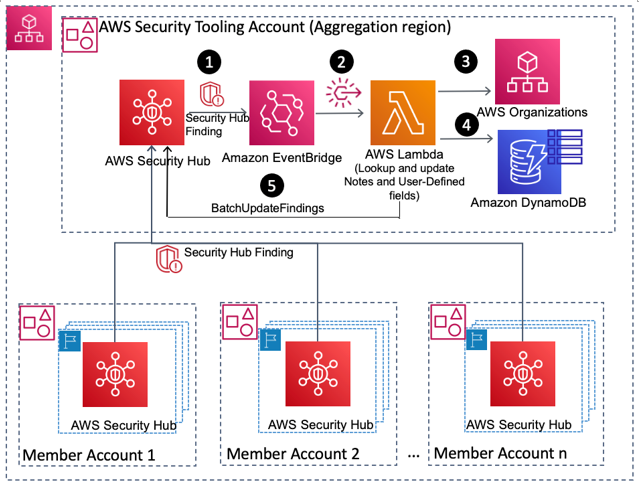
How to enrich AWS Security Hub findings with account metadata
In this blog post, we’ll walk you through how to deploy a solution to enrich AWS Security Hub findings with additional account-related metadata, such as the account name, the Organization Unit (OU) associated with the account, security contact information, and account tags. Account metadata can help you search findings, create insights, and better respond to […]

Hardening the security of your AWS Elastic Beanstalk Application the Well-Architected way
April 7, 2022: This post has been updated with sample Elastic Beanstalk application with hardened security configurations on GitHub. Launching an application in AWS Elastic Beanstalk is straightforward. You define a name for your application, select the platform you want to run it on (for example, Ruby), and upload the source code. The default Elastic Beanstalk configuration […]

Hands-on walkthrough of the AWS Network Firewall flexible rules engine – Part 2
This blog post is Part 2 of Hands-on walkthrough of the AWS Network Firewall flexible rules engine – Part 1. To recap, AWS Network Firewall is a managed service that offers a flexible rules engine that gives you the ability to write firewall rules for granular policy enforcement. In Part 1, we shared how to […]

Introducing the Security at the Edge: Core Principles whitepaper
Amazon Web Services (AWS) recently released the Security at the Edge: Core Principles whitepaper. Today’s business leaders know that it’s critical to ensure that both the security of their environments and the security present in traditional cloud networks are extended to workloads at the edge. The whitepaper provides security executives the foundations for implementing a […]

Ransomware mitigation: Top 5 protections and recovery preparation actions
August 4, 2025: This post was updated to include the name change of CloudEndure Disaster Recovery to AWS Elastic Disaster Recovery. In this post, I’ll cover the top five things that Amazon Web Services (AWS) customers can do to help protect and recover their resources from ransomware. This blog post focuses specifically on preemptive actions […]

Confidential computing: an AWS perspective
Customers around the globe—from governments and highly regulated industries to small businesses and start-ups—trust Amazon Web Services (AWS) with their most sensitive data and applications. At AWS, keeping our customers’ workloads secure and confidential, while helping them meet their privacy and data sovereignty requirements, is our highest priority. Our investments in security technologies and rigorous […]

Protect public clients for Amazon Cognito by using an Amazon CloudFront proxy
September 8, 2023: It’s important to know that if you activate user sign-up in your user pool, anyone on the internet can sign up for an account and sign in to your apps. Don’t enable self-registration in your user pool unless you want to open your app to allow users to sign up. Sep 6 […]