AWS Skilling and Social Impact
VR-powered learning brings STEM education to life with Da1ilmverse and AWS
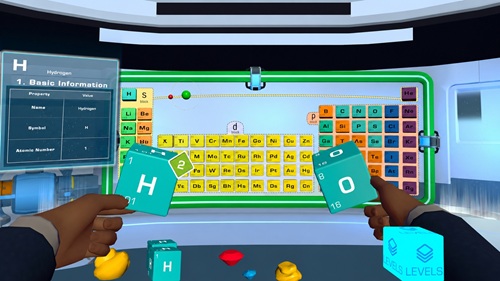 For millions of students across Asia, Africa, and the Middle East, high-quality STEM education is often out of reach. Many attend under-resourced schools without fully-equipped science labs or reliable internet access, making complex concepts in science, technology, engineering, and mathematics (STEM) harder to grasp from a textbook alone.
Da1ilmverse is an education technology company that pairs immersive virtual reality (VR) learning environments with an AI-powered teacher built on Amazon Web Services (AWS) so that students can see abstract STEM concepts in action. In early pilots, students who learned through VR outperformed their peers and were more curious and engaged.
The quality of a child’s education can hinge on which school they attend or which teacher they happen to get, but where you learn should not be a determining factor in how much you learn.
“The challenge students face is that the quality of education varies from institute to institute, teacher to teacher,” said Waqas Suhail, CEO of Da1ilmverse. “Our goal is to reduce that gap, providing a student in a remote village with access to the same quality of learning as one in a well-resourced city school.”
Virtual teachers support an immersive classroom
Da1ilmverse started its education technology journey with a platform called Ilmversity, an AI-powered learning management solution that supports more than 400 institutions and 300,000+ students and parents globally.
Ilmversity handles the academic and administrative work of running a school, from records to scheduling, so that educators can spend less time on operations and more time on teaching. As the solution scaled, the team kept hearing the same thing from schools: the challenge was helping students understand more difficult concepts, especially in STEM.
Jawad Ijaz, co-founder and chief technology officer at Da1ilmverse, knew that challenge personally. “When I was in school, I conceptualized things the wrong way because I was visualizing something different from what it actually was,” said Ijaz. “I really struggled for a few years to figure out that this is not the way to visualize it.”
The question that drove the organization’s next chapter was simple: what if a student learning a concept for the first time could actually see how it works? Da1ilmverse turned to AWS AI services to bring this possibility to life.
- Amazon Bedrock is a service for building generative AI applications and agents on AWS. It powers the AI-driven, voice-based learning that makes the virtual teacher feel present and responsive.
- Amazon Polly is a fully managed service that generates voice on demand. It gives the virtual teacher a natural-sounding human voice, which can often be the difference between a tool learners tune out and one they engage with.
Inside Da1ilmverse’s VR environments, abstract ideas become something students can see and interact with. Ask the virtual teacher how an engine works, for example, and it can build one in front of you, peel back its layers, and show fuel firing into the cylinders as the pistons move. In the tool’s immersive chemistry lab, students can run as many experiments as they like, hazard-free, and are no longer limited to a couple of reactions squeezed into a 45-minute class.
Just as important, support for students is available around the clock and from anywhere in the world. Someone working their way through a problem in a rural classroom will now gain access to the support and guidance they need. These immersive experiences also work with or without an internet connection, syncing when a signal is available, so that schools in remote areas are able to benefit.
“This technology provides kids on a mass level with the same high-quality information through that AI teacher,” said Suhail. “This can change the way we educate our kids and transform the way we used to learn.”
Early results, lasting curiosity
To test whether immersive learning helped students, Da1ilmverse ran pilots that split classes into two groups. One group learned through VR environments and the other through conventional teaching. The team then gave both groups the same quiz. Students who learned in the VR environments came away with a clearer grasp of the material and scored higher. In one physics pilot, students who had struggled with foundational concepts began asking their teacher more advanced questions.
With Da1ilmverse, schools can convert their existing computer labs into VR labs rather than building costly new facilities. After seeing the results, many institutions chose to make that change. One school in Zimbabwe built its own immersive lab, a sign that virtual learning can take root even where resources are tight.
With support from the AWS Education Equity Initiative, a five-year, $100 million commitment of AWS technology empowering organizations to create digital learning solutions for underserved populations globally, Da1ilmverse is working to bring this way of learning to more communities.
The early wins are shaping what Da1ilmverse builds, as the team wants to explore how AI can study a school’s curriculum and automatically generate matching immersive environments. Further out, Da1ilmverse envisions something more ambitious: a complete virtual campus where students can learn, talk, and explore, no matter where they are in the world.
This post was written by Aanya Niaz, Global Leader, AWS Education Equity Initiative.