亚马逊AWS官方博客
PKFARE Introduces AI Customer Service Agent to Simplify Post-Ticketing Automation in Flight Distribution
In the global flight distribution industry, customer service continues to face structural challenges, especially in post-ticketing scenarios. Service teams are expected to deliver fast and accurate solutions while dealing with highly fragmented customer requests, complex passenger rules, and communication that requires deep domain expertise.
As a global travel wholesaler with more than a decade of experience in flight distribution, PKFARE sources flight content across diverse channels through multiple technical integrations, including GDS(Global Distribution System), NDC(New Distribution Capability), and airlines’ proprietary APIs. As its supplier and distributor network has expanded, traditional manual customer service models have come under growing pressure. Efficiency, consistency, and scalability have struggled to keep pace with increasing business complexity and volume.
1. Post-Ticketing Challenges
Post-ticketing operations today are under two primary pressures:
- Highly Fragmented Customer Requests
Post-ticketing requests cover a wide range of personalized travel scenarios. Customer service teams often need to clarify and reconfirm details through multiple rounds of communication, creating long service cycles that consume significant time and resources.
- Extremely Complex Passenger Rules
Airline post-ticketing rules vary significantly across airlines and distribution channels:
-
- Airline-specific rule systems, each with independent refund and change policies.
- Channel-dependent policies, where rules differ across distribution channels and integration pipes.
Although PKFARE maintains a structured passenger rule database covering over 300 airlines, customer service team still spend substantial time interpreting customer requests and navigating dense rule sets. Industry-specific terminology—such as PNR (Passenger Name Record) and FC (Fare Calculation)—further raises the bar for professional expertise.
Together, these factors result in heavy workloads, slower response times, and ongoing challenges in delivering consistent, scalable service across the industry.
2. Solution Approach
Building on its deep experience in flight distribution and post-ticketing operations, PKFARE developed an AI Customer Service Agent based on a layered, generative AI-driven architecture.
Figure 1: Architecture of PKFARE AI Customer Service Agent
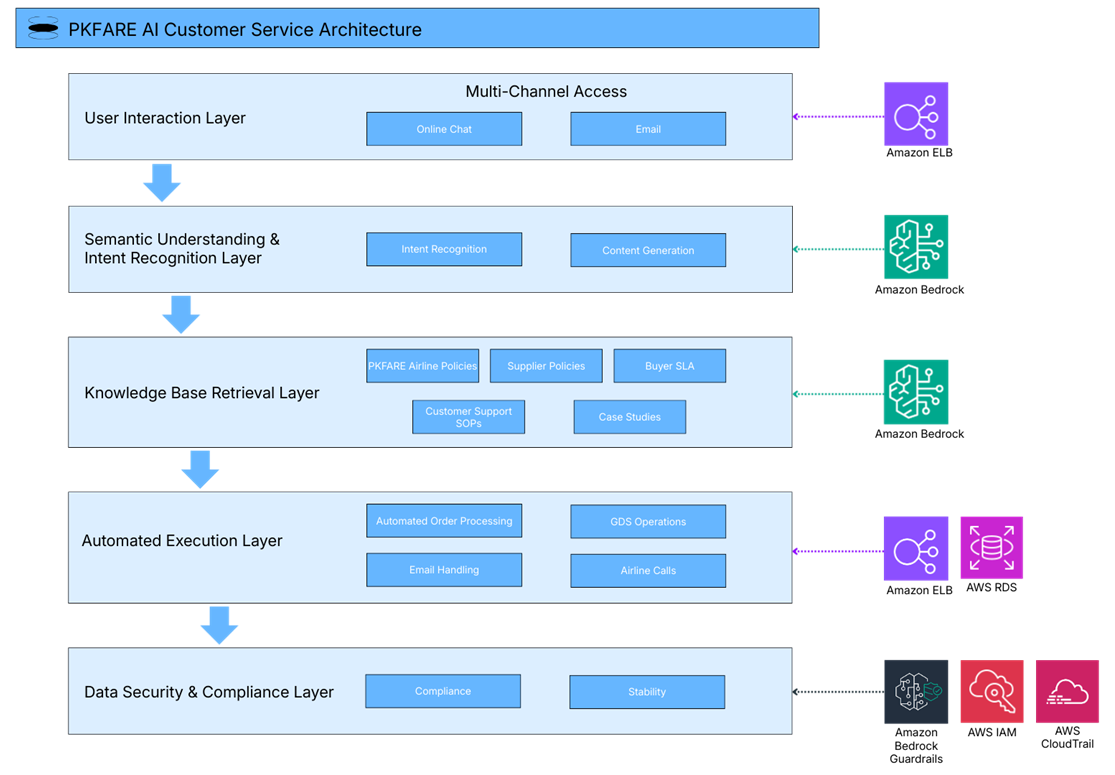 |
The solution is deployed on a secure, scalable AWS infrastructure and delivers end-to-end intelligent processing—from user intent recognition to automated execution.
Key AWS services include:
- Amazon Bedrock: Provides access to Anthropic Claude, enabling long-context understanding and advanced reasoning.
- Amazon Bedrock Guardrails: Enforces compliance and output controls.
- AWS IAM: Implements fine-grained access control (FGAC) based on least privilege principle.
- AWS CloudTrail: Records and audits all API activities for security and compliance.
- Amazon EC2: Hosts the AI chatbot application and supporting services for context engineering.
- Amazon ELB: Manages and distributes user session requests to ensure load balancing and high availability.
- Amazon RDS: Supports reliable and scalable management of relational database.
Figure 2: Service Architecture Diagram
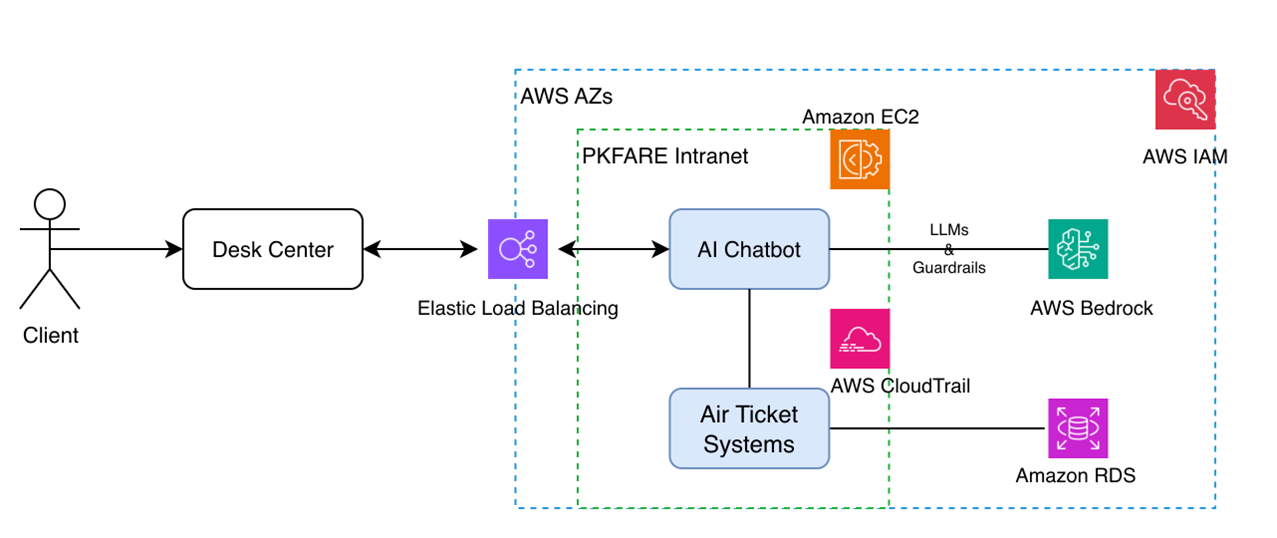 |
Together, these AWS services enable PKFARE’s AI Customer Service agent to deliver end-to-end intelligent processing—from user intent recognition through to automated execution.
- Semantic Understanding & Intent Recognition Layer
To address fragmented requests and industry-specific language, PKFARE leverages Anthropic Claude on Amazon Bedrock for deep semantic understanding and long-context reasoning. With support for up to a 128K token context window, the model can accurately parse complex airline refund and change policies, interpret professional terminology, and identify user intent with high precision.
This capability forms a reliable foundation for downstream automation and decision-making across refund, change, and reissue scenarios.
- Knowledge Base Retrieval Layer
To overcome common AI customer service limitations—such as generic answers or insufficient domain depth—PKFARE developed an intent–scenario normalization approach for knowledge retrieval, rather than relying on conventional RAG architectures.
First, the system interprets and maps user intent to standardized scenarios (such as involuntary refunds). It then invokes predefined “Agent Skills” that encapsulate airline policies, service SOPs, and operational logic in structured, callable modules. This design ensures responses are consistent, accurate, and context-aware.
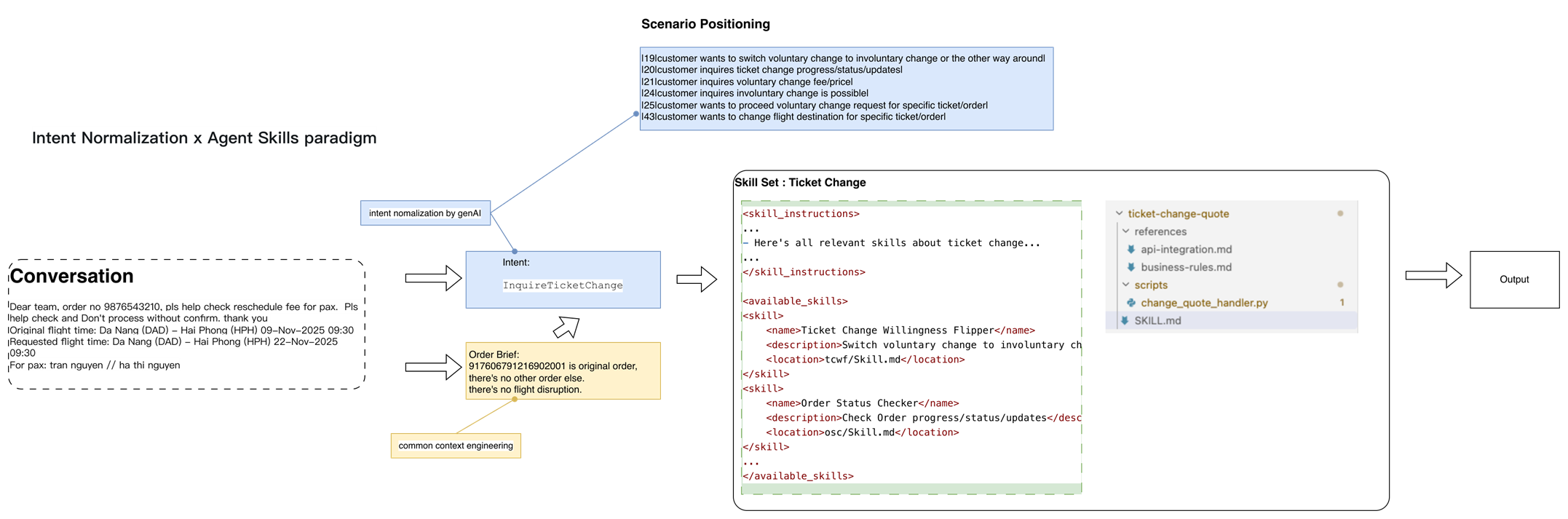 |
Based on this framework, PKFARE established a standardized context engineering model centered on intent normalization and skill management, resulting in a significant reduction in maintenance complexity. Workflows that previously required 3 days of expert configuration can now be managed through intent and skill updates—often within an hour. The separation of scenarios also allows ongoing optimization to be delegated to generative AI, enabling a sustainable cycle of continuous improvement in both intent recognition and skill effectiveness.
- Automated Execution Layer
Beyond answering questions, the PKFARE AI Customer Service Agent supports closed-loop execution. Integrated with PKFARE’s supply-side systems, the agent can:
-
- Respond to inquiries via email and voice
- Complete forms on airline and supplier platforms
- Execute refund, change, and reissue operations
This enables true bidirectional automation, from customer inquiry to final resolution.
- Data Security & Compliance Layer
Security and compliance are enforced throughout the system using Amazon Bedrock Guardrails and AWS-native controls, ensuring outputs strictly comply with industry standards and airline policies, providing dual assurance for answer accuracy and professionalism. Specific protective measures include:
-
- Data Transmission Security: All interfaces use TLS 1.3 encryption. API calls are permission-controlled via AWS IAM—assigning access rights to different modules based on the principle of least privilege.
- PII Data Masking: For sensitive user information like PNR, ID numbers, and phone numbers, a “dynamic masking algorithm” is used—data is stored using AES-256 encryption and displayed showing only the last 4 digits (e.g., phone number 138****1234). Only masked fields are passed during AI inference.
- Compliance Auditing & Tracing: AWS CloudTrail logs all AI operation activities (including user queries, AI decision processes, execution results). Logs are immutable and support multi-dimensional searches by airline, time, ticket ID, etc., meeting IATA (International Air Transport Association) regulatory requirements.
- Fine-grained Guardrail Configuration: A custom compliance rule library covers over 150 industry compliance rules (e.g., prohibiting generation of fake refund/change policies or unauthorized refund percentage promises). Triggered rules lead to automatic interception and generation of standardized alerts.
- Elastic Scaling & Stability Assurance
To ensure elastic scaling and system stability, PKFARE leverages Amazon Bedrock’s elastic computing architecture, which dynamically allocates resources based on real-time traffic. This enables the system to seamlessly handle sudden load spikes during peak inquiry periods.
During initial pilot deployments:
-
- 100% of customer requests received a first response within 3 seconds
- Single-dialog completion rates consistently exceeded 80%
“Balancing accuracy and flexibility remains a key challenge in the AI agent context engineering. PKFARE addresses this through a combination of progressive disclosure skills and proprietary intent normalization, delivering strong improvements in both adaptability and precision.
— Carlos Xie, PKFARE AI Innovation Lead
3. Initial Results
Following its successful launch, PKFARE AI Customer Service agent delivered notable improvements in customer service efficiency during a pilot period of less than one month, providing a practical blueprint for intelligent transformation in the industry:
- Efficiency Gains: Handled approximately 25% of standard customer service tickets, allowing human to focus on more complex, high-value requests and value-added services.
- Rapid Response: Enabled 24/7 instant responses, reducing the average first response time from 15 minutes to 1 minute—a 15× improvement over the traditional model. For common inquiries, response times drop to mere seconds.
- Consistent Quality: Maintained accurate, stable, and policy-compliant outputs, ensuring consistent and reliable customer service experience.
“The implementation of AI-powered flight customer service agent demonstrates that even in mature, highly complex verticals, AI has tremendous potential for practical application. Its true value lies not in replacing humans, but in streamlining business processes and transforming service experiences. In the coming years, PKFARE will continue expanding AI across both flight and hotel distribution, making it a core driver of intelligent industry evolution.”
—— Konson Zhao, PKFARE CTO
4. Technology-Driven, Expertise-Empowered: Building Vertical Domain Intelligent Agents
Through close collaboration with AWS, PKFARE combines advanced AI technology with deep industry expertise to build an intelligent agent tailored for flight distribution customer service. By bringing together general AI capabilities and domain-specific knowledge, the agent delivers more reliable, accurate, and professional performance in real operational scenarios.
- Technology Foundation: Elastic Computing with Industry Context
Built on Amazon Bedrock and powered by Anthropic Claude, the system benefits from a highly elastic and scalable computing architecture, along with strong language understanding and reasoning capabilities. On top of this foundation, PKFARE has embedded more than ten years of industry know-how—such as complex distribution rules, frequently changing airline policies, and proven service workflows—directly into the AI’s training and decision processes. This allows the AI to go beyond generic conversation and provide responses that reflect real business logic and operational judgment. - Expertise Integration: Accurate, Compliant, and Actionable Responses
Amazon Bedrock Guardrails play a critical role in ensuring compliance, security, and consistency, keeping agent outputs aligned with industry and operational standards. At the same time, PKFARE’s structured knowledge base and rule logic, developed from real customer service scenarios, significantly improve the AI’s ability to handle complex cases such as ticket refunds and changes with clarity and precision. - Business Value: Closing Gaps and Supporting Scalable Growth
The AI Customer Service Agent co-developed by PKFARE and AWS addresses a long-standing gap in the flight distribution industry, where AI adoption has often remained superficial. Supported by AWS’s global infrastructure, the system enables stable service delivery while supporting PKFARE’s ongoing business expansion. More importantly, it helps shift the industry from manual, rule-heavy operations toward AI-driven automation, turning customer service from a cost-focused function into a scalable, efficiency-driven capability.