Benefits
Overview
Redox, a leader in healthcare data interoperability, helped a major US health system automate the manual processing of critical patient faxes. With annual fax volume expected to nearly quadruple after an organizational change, the customer’s Health Information Management (HIM) team faced significant operational challenges. Working alongside Amazon Web Services (AWS), Redox built a generative AI solution to accurately classify and route incoming faxes to more than 1,200 destinations. As a result, the customer went from a fully manual process to robust automation in 4 weeks—significantly reducing operational costs while processing critical patient documents in seconds instead of days.
About Redox
Redox provides a secure, cloud-based platform that translates, normalizes, and orchestrates real-time healthcare data across more than 12,000 organizations, including more than 100 unique EHRs and over 30 other system types.
Opportunity | Automating manual fax routing at scale using AWS
Redox, an AWS Partner that has offerings available on the AWS Marketplace, helps organizations across the healthcare ecosystem rapidly exchange, translate, and route real-time data through a unified platform and standardized API. Today, 70–90 percent of healthcare systems still rely on faxes. Due to a general lack of electronic health record (EHR) interoperability, organizations use faxes as a universal but inefficient bridge for communication.
One of Redox’s customers, a US health system that operates hundreds of facilities, faced the challenge of manually processing tens of millions of incoming faxes. The customer’s HIM team was tasked with manually triaging and routing time-sensitive faxed documents like referrals and prescription refills to the correct department. As the health system implemented a new EHR, its manually processed fax volume was expected to rise more than 350 percent. Handling that surge would have required quadrupling the HIM team. The health system needed a way to manage the workload without added costs or operational delays that could negatively impact patient experience and outcomes.
Redox recognized the need to automate its customer’s fax workflows using generative AI. The goal was to classify each fax and automatically route it to the correct downstream system for clinical review while significantly reducing the need for human intervention. Redox used its existing secure, scalable, and Health Insurance Portability and Accountability Act of 1996 (HIPAA)–compliant AWS infrastructure to explore comprehensive AI services and tools.
Solution | Embedding AI into Redox’s platform using Amazon Bedrock
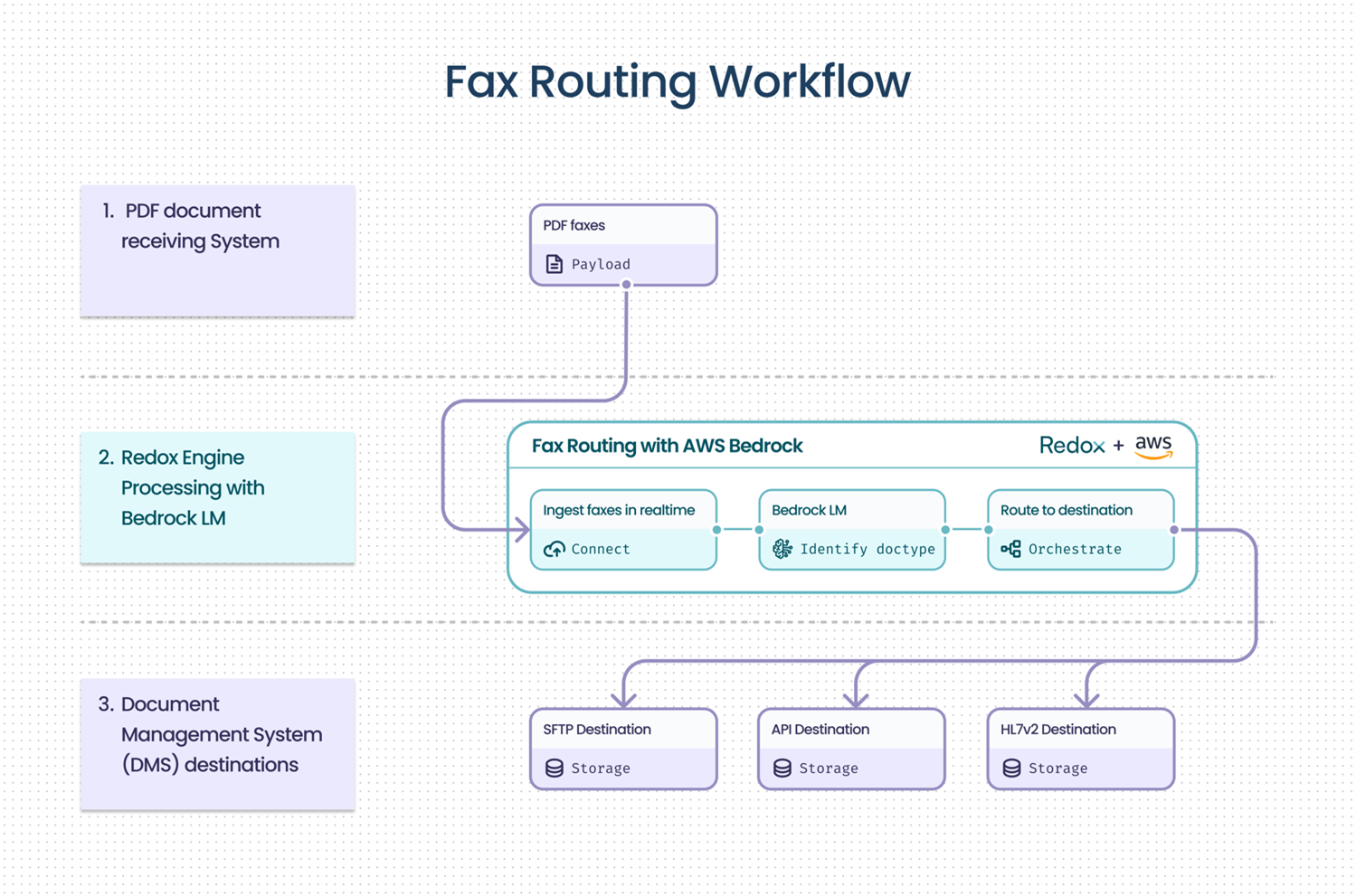
Redox worked with the AWS team to embed generative AI capabilities into its platform’s existing orchestration layer using Amazon Bedrock, which is a comprehensive, secure, and flexible service for building generative AI applications and agents. Redox also used Amazon Nova Foundation Models—which deliver frontier intelligence and industry-leading price performance—to classify incoming documents; specifically, Redox used Amazon Nova Lite. “What we found in Amazon Bedrock and Amazon Nova is a developer-friendly solution that helps us provide even more efficient and cost-effective solutions to our customers without needing to rebuild our digital infrastructure from scratch,” says Tim Kessler, field chief technology officer at Redox.
Redox was able to quickly embed generative AI capabilities powered by AWS as a modular step within its existing orchestration layer. This made it possible for the project to go from kickoff to production in 4 weeks, which was significantly ahead of schedule. This rapid deployment showcases how Redox’s modular platform, built on AWS, made it simple to plug in high-value external tools and services—backed by more than 9,000 transformation models, 20 communication methods, and normalization for any healthcare data format.
Amazon Nova Lite hit early accuracy benchmarks. From there, the Redox team iterated on prompt optimization and routing logic to increase accuracy and achieve consistent performance at scale. “Throughout the entire process, the AWS team was incredibly helpful—always making sure that we had all the support that we needed and connecting us to any AWS experts who could help along the way,” says Kessler.
Outcome | Accelerating patient care while reducing operational costs
With this solution, Redox helped its customer achieve 85–90 percent document classification accuracy at launch. The solution also helps Redox maintain HIPAA-compliant document handling by reducing the risk of manual processing errors while cutting fax processing time down to seconds. As a result, the customer’s HIM team saw a significant reduction in manual task processing volume, significantly lowering operational costs.
Most importantly, the solution expedited and improved patient care by reducing time-consuming data backlogs. “Instead of a pharmacy prescription sitting on someone’s desk waiting to be read and sent to the right team, it’s landing with the correct team within a matter of seconds,” says Solvei Wallace, partnerships director at Redox. “That’s a huge win for patients’ well-being.”
With additional AI-driven fax and document workflows already in development, Redox believes this approach can serve as a blueprint for using generative AI to tackle long-standing administrative bottlenecks in healthcare. “Everyone’s talking about AI and what it can do,” says Rachel Witalec, chief product officer at Redox. “We built something meaningful—very quickly—by using Amazon Bedrock and Amazon Nova Lite to help automate fax routing. It solves a real life problem, provides tangible value, and paves the way for future AI-driven innovations.”
Architecture Diagram

What we found in Amazon Bedrock and Amazon Nova is a developer-friendly solution that helps us provide even more efficient and cost-effective solutions to our customers.
Tim Kessler
Field Chief Technology Officer at RedoxAWS services used
Did you find what you were looking for today?
Let us know so we can improve the quality of the content on our pages