AWS News Blog
20 years in the AWS Cloud – how time flies!

|
 AWS has reached its 20th anniversary! With a steady pace of innovation, AWS has grown to offer over 240 comprehensive cloud services and continues to launch thousands of new features annually for millions of customers. During this time, over 4,700 posts have been published on this blog—more than double the number since Jeff Barr wrote the 10th anniversary post.
AWS changed my life
Reflecting on what I was doing 20 years ago, I met Jeff in Seoul on March 13, 2006, when he came as the keynote speaker for the Korea NGWeb conference. At that time, Amazon was one of the first pioneers to initiate an API economy, introducing ecommerce API services. After the keynote speech, he returned home that evening, and I believe he wrote the Amazon S3 launch blog post on the flight back to the United States.

That short meeting with him brought significant changes to my life. He became my role model as a blogger, and I began building API-based services in my company and opening them to third-party developers. When I was a PhD student while taking a break from work, I realized that for individual researchers like me, AWS Cloud services are powerful tools for conducting large-scale research projects. After returning to work, my company became one of the first AWS customers in Korea in 2014. Countless developers—myself included—have embraced cloud computing and actively used its capabilities to accomplish what was previously impossible.
Over the past decade, the technology landscape has transformed dramatically. Deep learning emerged as a breakthrough in AI, evolving through generative AI based on large language models (LLMs) to today’s agentic AI technology. Jeff wrote, “When looking into the future, you need to be able to distinguish between flashy distractions and genuine trends, while remaining flexible enough to pivot if yesterday’s niche becomes today’s mainstream technology.” This principle guides how AWS approaches innovation—we start by listening to what customers truly need. The real trend isn’t pursuing every emerging technology, but rather reimagining solutions that address customers’ most critical challenges.
20 years of AWS
For the first 10 years, Jeff selected his favorite AWS launches and blog posts. Amazon S3, Amazon EC2 (2006), Amazon Relational Database Service, Amazon Virtual Private Cloud (2009), Amazon DynamoDB, Amazon Redshift (2012), Amazon WorkSpaces, Amazon Kinesis (2013), AWS Lambda (2014), and AWS IoT (2015).
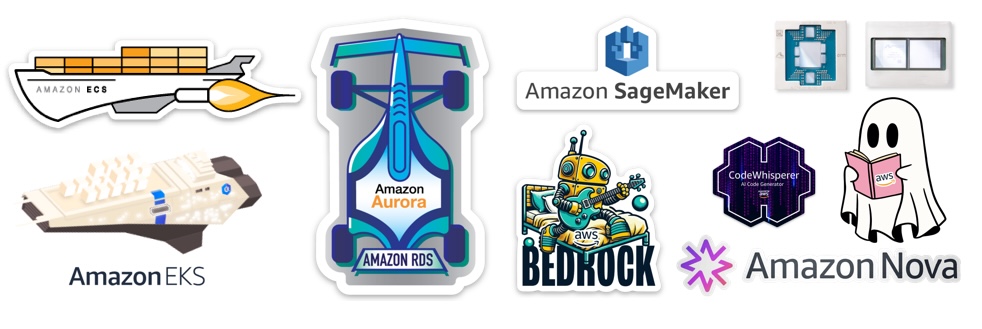
While I also hate to play favorites, I want to choose some of my favorite AWS blog posts of the past decade.
- Deploying containers easily (2014) – Amazon Elastic Container Service makes it straightforward for you to run any number of containers across a managed cluster of Amazon EC2 instances using powerful APIs and other tools. In 2017, we launched Amazon Elastic Kubernetes Service as a fully managed Kubernetes service and AWS Fargate as a serverless deployment option.
- High availability database at global scale (2017) – Amazon Aurora is a modern relational database service offering performance and high availability at scale. In 2018, we launched Amazon Aurora Serverless v1, and this serverless database evolved to Amazon Aurora Serverless v2 to scale down to zero. In 2025, we also launched Amazon Aurora DSQL is the fastest serverless distributed SQL database for always available applications.
- Machine learning (ML) at your fingertips (2017) – Amazon SageMaker is a fully managed end-to-end ML service that data scientists, developers, and ML experts can use to quickly build, train, and host machine learning models at scale. In 2024, we launched the next generation of Amazon SageMaker, a unified platform for data, analytics, and AI and introduced Amazon SageMaker AI to focus specifically on building, training, and deploying AI and ML models at scale.
- Best price performance for cloud workloads (2018) – We launched Amazon EC2 A1 instances powered by the first generation of Arm-based AWS Graviton Processors designed to deliver the best price performance for your cloud workloads. Last year, we previewed EC2 M9g instances powered by AWS Graviton5 processors. Over 90,000 AWS customers have reaped the benefits of Graviton supporting popular AWS services such as Amazon ECS and Amazon EKS, AWS Lambda, Amazon RDS, Amazon ElastiCache, Amazon EMR, and Amazon OpenSearch Service.
- Run AWS Cloud in your data center (2019) – AWS Outposts is a family of fully managed services delivering AWS infrastructure and services to virtually any on-premises or edge location for a truly consistent hybrid experience. Now, AWS Outposts is available in a variety of form factors, from 1U and 2U Outposts servers to 42U Outposts racks, and multiple rack deployments. Customers such as DISH, Fanduel, Morningstar, Philips, and others use Outposts in workloads requiring low latency access to on-premises systems, local data processing, data residency, and application migration with local system interdependencies.
- Best price performance for ML workloads (2019) – We launched Amazon EC2 Inf1 instances powered by the first generation of AWS Inferentia chips designed to provide fast, low-latency inferencing. In 2022, we launched Amazon EC2 Trn1 instances powered by the first generation of AWS Trainium chips optimized for high performance AI training. Last year, we launched Amazon EC2 Trn3 UltraServers powered by Trainium3 to deliver the best token economics for next-generation generative AI applications. Customers such as Anthropic, Decart, poolside, Databricks, Ricoh, Karakuri, SplashMusic, and others are realizing performance and cost benefits of Trainium-based instances and UltraServers.
- Build your generative AI apps on AWS (2023) – Amazon Bedrock is a fully managed service that offers a choice of industry leading AI models along with a broad set of capabilities that you need to build generative AI applications, simplifying development with security, privacy, and responsible AI. Last year, we introduced Amazon Bedrock AgentCore, an agentic platform for building, deploying, and operating effective agents securely at scale. Now, more than 100,000 customers worldwide choose Amazon Bedrock to deliver personalized experiences, automate complex workflows, and uncover actionable insights.
- Your AI coding companion (2023) – We launched Amazon CodeWhisperer as the industry’s first cloud-based AI coding assistant service. The service delivered code generation from comments, open-source code reference tracking, and vulnerability scanning capabilities. In 2024, we rebranded the service to Amazon Q Developer and expanded its features to include a chat-based assistant in the console, project-based code generation, and code transformation tools. In 2025, this service evolved into Kiro, a new agentic AI development tool that brings structure to AI coding through spec-driven development, taking projects from prototype to production. Recently, Kiro previewed an autonomous agent, a frontier agent that works independently on development tasks, maintaining context and learning from every interaction.
- Broaden your AI model choices (2024) – We launched Amazon Titan models further increasing cost-effective AI model choice for text and multimodal needs in Amazon Bedrock. At AWS re:Invent 2024, we announced Amazon Nova models that delivers frontier intelligence and industry leading price performance. Now Amazon Nova has a portfolio of AI offerings—including Amazon Nova models, Amazon Nova Forge, a new service to build your own frontier models; and Amazon Nova Act, a new service to build agents that automate browser-based UI workflows powered by a custom Amazon Nova 2 Lite model.
Build with AI: Your path forward
A decade ago, AWS responded to the emergence of deep learning by launching the broadest and deepest ML services, such as Amazon SageMaker, democratizing AI for a wide range of customers—from individual developers and startups to large enterprises—regardless of their technical expertise.
AI technology has advanced significantly, but building and deploying AI models and applications still remains complex for many developers and organizations. AWS offers the broadest selection of AI models through Amazon Bedrock, including leading providers such as Anthropic and OpenAI. By using our model training and inference infrastructure and responsible AI both practical and scalable, you can accelerate trusted AI innovation while maintaining control of your data and costs—all built on our global infrastructure’s operational excellence.
Reinvent your idea, keep on learning, build confidently with AI you can trust, and share your successes with us! New AWS customers receive up to $200 in credits to try AWS AI for free. If you’re a student, start building with Kiro for free using 1,000 credits per month for one year.
— Channy