AWS Contact Center
Integration as Intelligence: Amazon Connect Customer Integrates with Salesforce via MCP
Why the breadth of your integration architecture determines the capability of your AI agent.
Introduction
Autonomous resolution through agentic integration is redefining how contact centers operate. Advances in AI reasoning, open integration standards, and composable service design have converged to make something previously impossible now practical: AI agents that autonomously resolve complex, multi-system customer issues in real time. Amazon Connect Customer and Salesforce, connected through the Model Context Protocol (MCP), represent the leading edge of this shift.
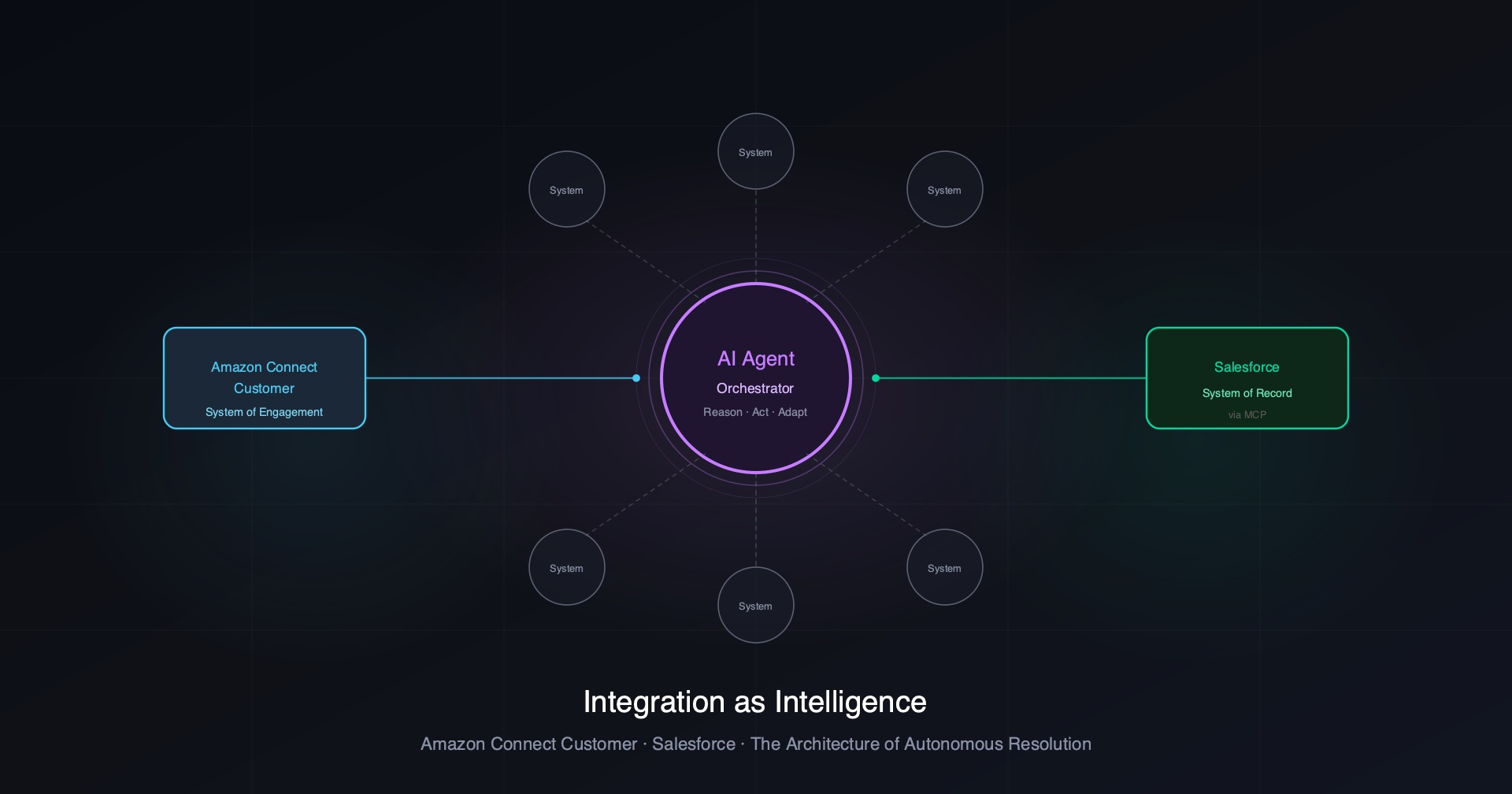
Agentic integration is the architectural philosophy that makes this possible. Rather than pre-coding every decision path into a contact flow, an orchestrator AI agent, powered by large language models (LLMs), dynamically determines which systems to engage, in what sequence, and continuously adapts its execution plan based on intermediate results. The agent reasons about the customer’s intent, chains actions across systems of record such as Salesforce, operational services, and knowledge bases, and resolves complex issues end to end.
In this post, we examine the architectural principles, protocol layer, and strategic implications of agentic integration in the context of Amazon Connect Customer (the system of engagement) and Salesforce (the system of record). We introduce the reasoning loop that drives autonomous resolution, articulate why integration breadth compounds AI capability through the multiplier effect, and present the Model Context Protocol as the open standard that makes composable, multi-system orchestration practical at enterprise scale.
From structural constraint to agent-driven orchestration
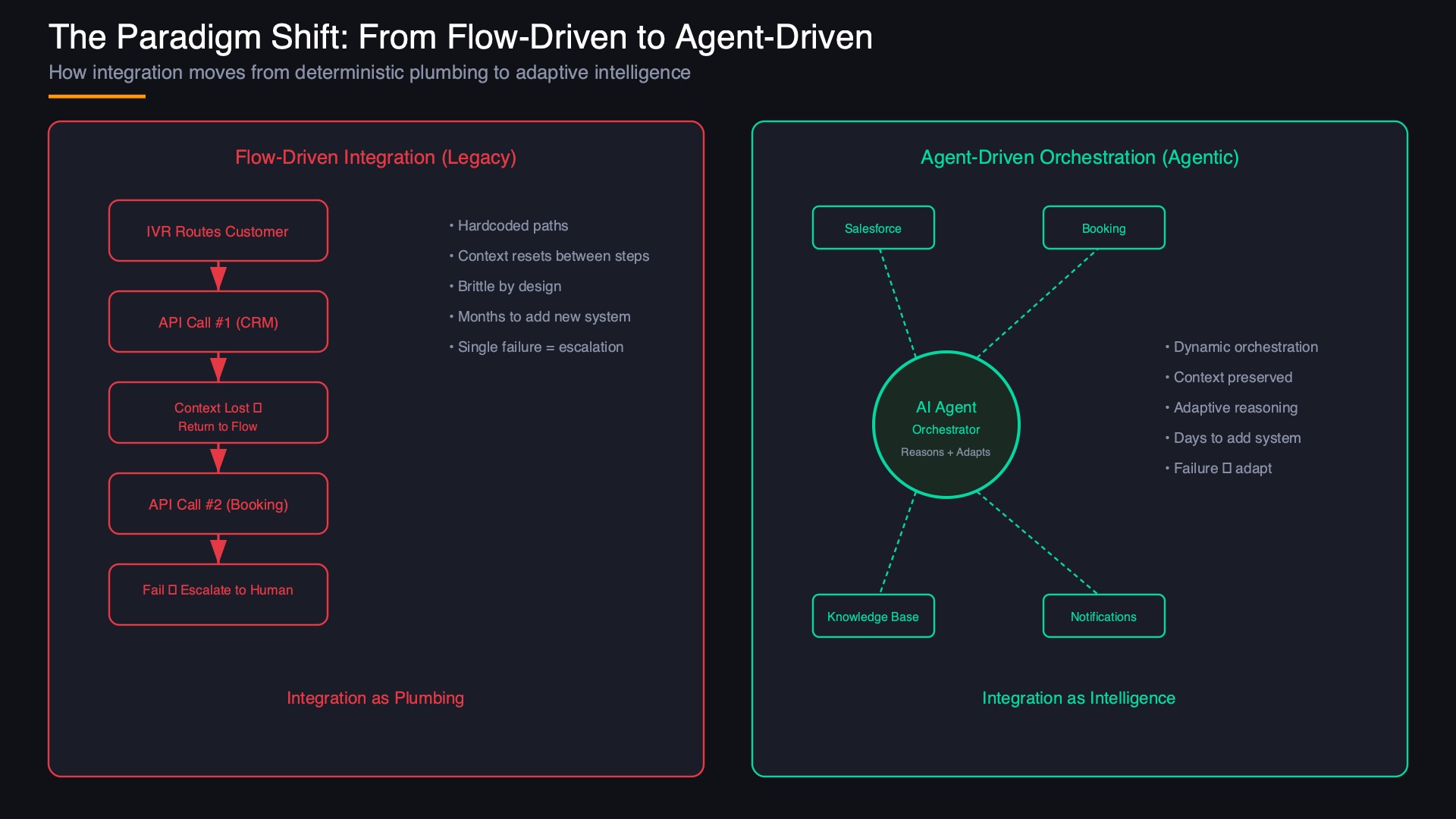
Diagram: The architectural shift from flow-driven API integration to agent-driven orchestration. On the left, a linear flow with hardcoded API calls between Amazon Connect Customer and backend systems. On the right, an AI agent at the center dynamically orchestrating across multiple systems through MCP.
For decades, enterprise integration has operated under a singular assumption: connectivity is a mechanical problem. Contact centers have been the clearest expression of this paradigm. Interactive voice response (IVR) trees route customers through static decision paths, APIs fire in predetermined sequences, and context is discarded at every handoff boundary.
Salesforce, acting as the system of record, holds the complete customer narrative: interaction history, service preferences, loyalty tier, and open cases. Amazon Connect Customer, as the system of engagement, owns the real-time conversation. Yet the integration layer between them remains largely transactional: prescribed API calls, static data lookups, and pre-built connectors that surface information but cannot reason about it or act upon it intelligently.
The consequences are significant. Introducing a new backend system requires re-engineering the integration from the ground up. Modifying a workflow demands months of development. The resulting customer experience is fragmented and linear, even when the data points required to resolve their issue already exist across your systems.
Agentic integration shifts complex resolution logic from pre-coded decision paths to dynamic, agent-driven orchestration.
Amazon Connect Customer positions an AI agent at the architectural center of the customer interaction as the primary reasoning engine. This agent formulates plans, evaluates outcomes, and orchestrates across every system within its reach. The distinction is architectural:
Flow-driven integration is deterministic Each API call is pre-coded. If the primary path fails, the system terminates or escalates. Context resets between steps.
Agent-driven orchestration is adaptive. The AI agent evaluates intent, selects tools, and chains actions dynamically. If the initial approach fails, it reasons about alternatives without the customer perceiving disruption. Salesforce, the booking system, the knowledge base: they all become composable tools within a single conversational context.
Traditional API-based integration is not obsolete. It remains the right choice for high-frequency, fixed input/output operations where reasoning is not needed. But for complex, context-dependent customer interactions, agentic orchestration replaces the underlying paradigm: integration as intelligence rather than integration as infrastructure.
The reasoning architecture: understand, reason, act, remember
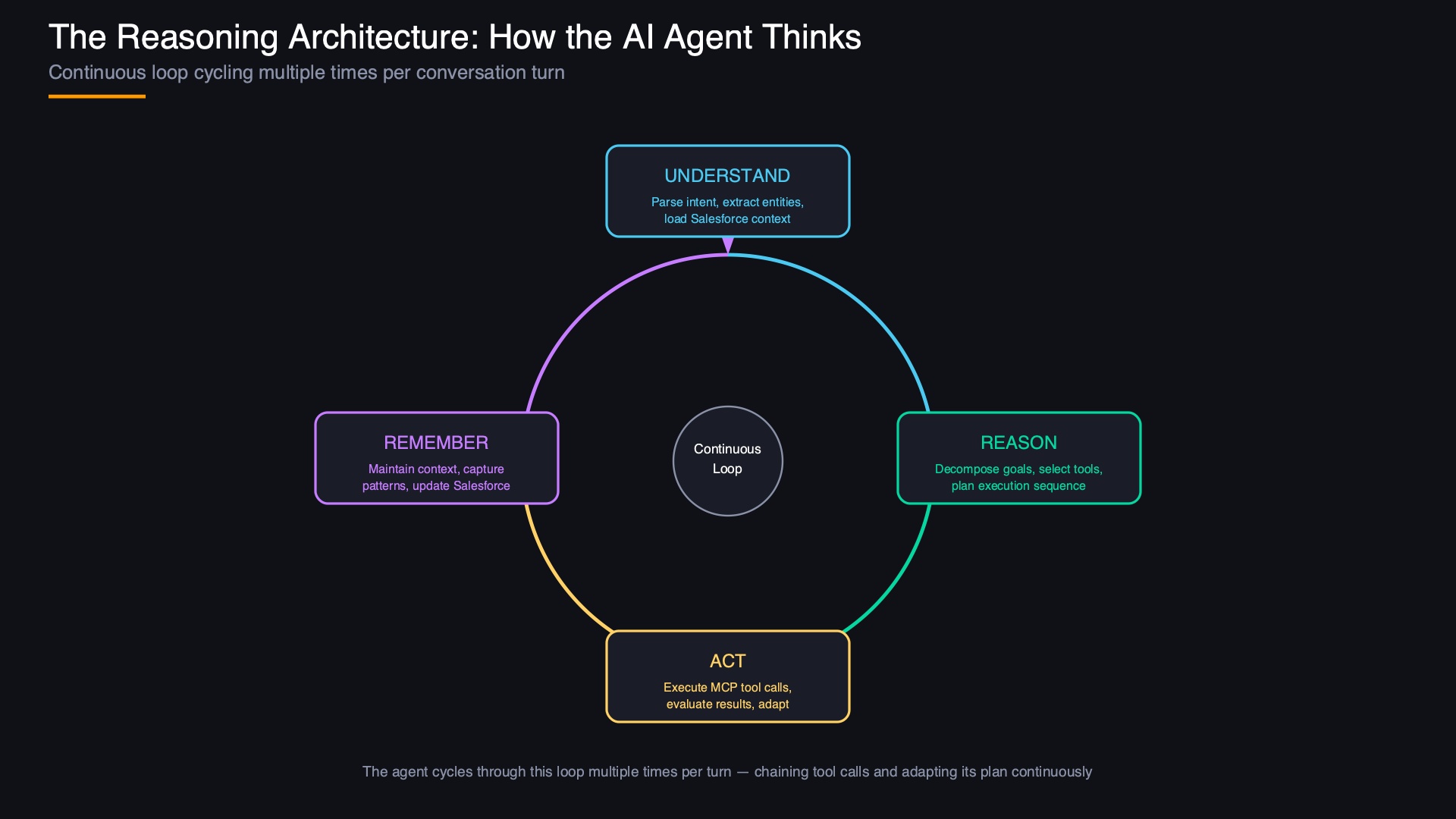
Diagram: The agentic reasoning loop showing four connected stages: Understand (parse intent and load context), Reason (decompose goals and select tools), Act (execute MCP tool calls and evaluate results), and Remember (maintain state and retain patterns). Arrows show continuous iteration within a single conversation turn.
What distinguishes the Amazon Connect Customer AI agent from conventional automation is its reasoning architecture – a continuous loop of four interdependent capabilities that execute iteratively within every conversation turn.
Understand Parse the customer’s utterance, identify intents, extract entities, and load full conversational context, including Salesforce case history, customer profile attributes, and prior interaction records.
Reason Decompose the request into sub-goals, evaluate which tools are required, determine execution sequence, and identify dependencies between tool calls.
Act Execute MCP tool calls against backend systems. Each action returns a structured result, and the agent reasons over that result before determining the subsequent action. Execution is evaluate-and-adapt, not fire-and-forget.
Remember Maintain complete conversational state, preserve session context, and retain resolution patterns.
The critical property: this loop is continuous, not sequential. Within a single turn, the agent may iterate through reason, act, reason, act multiple times. It queries Salesforce, evaluates availability, creates a case, updates records, and dispatches confirmation – all as a single orchestrated sequence.
The compounding principle: the multiplier effect of integration
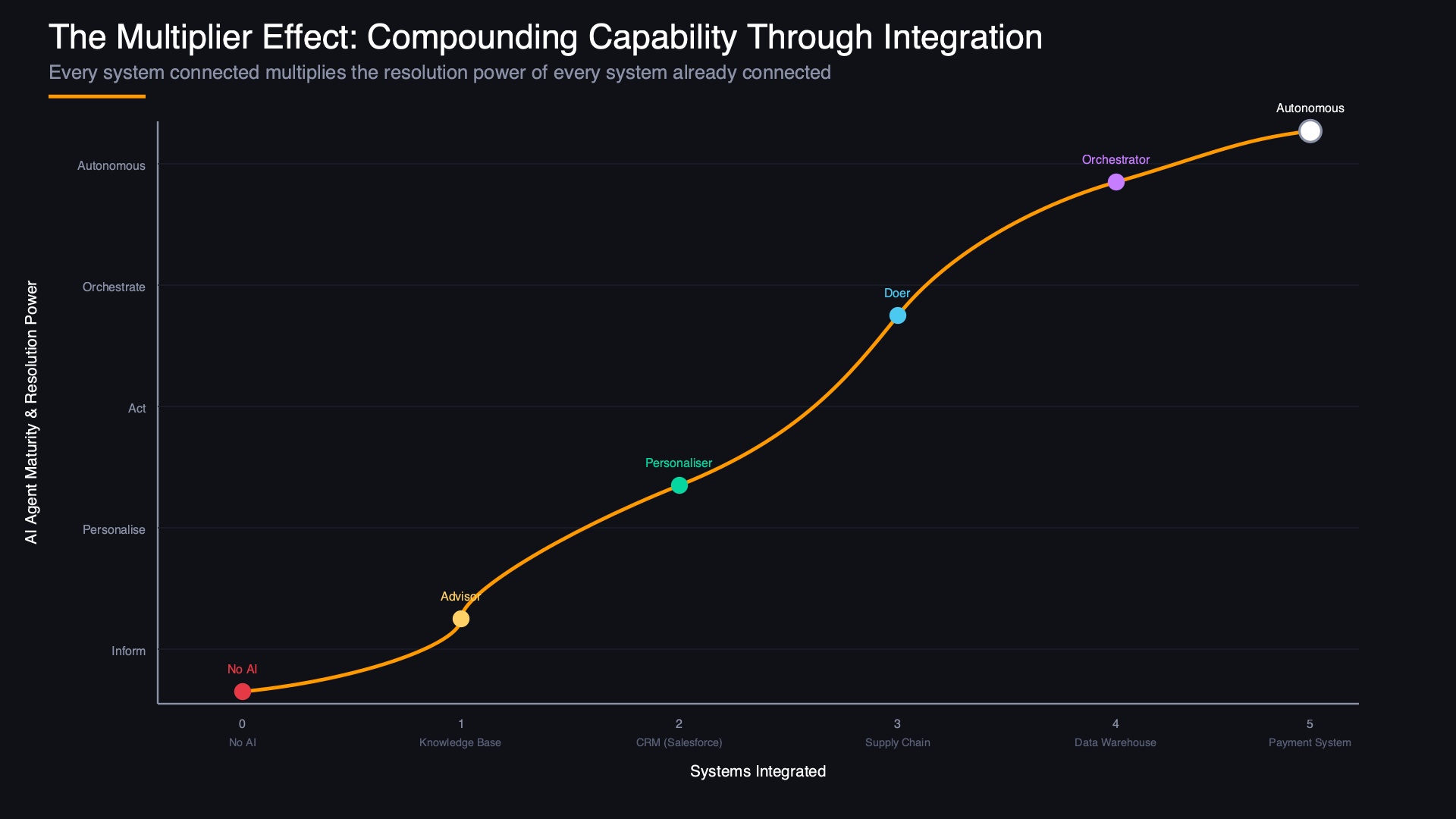
Diagram: The multiplier effect – each additional system increases resolution power. A stacked diagram showing progressive capability: one system enables informing, two enable personalization, three enable autonomous action, four or more enable end-to-end resolution across domains.
The architectural insight that defines agentic systems: the autonomous resolution capability of any AI agent is largely determined by the breadth of systems it can orchestrate.
This is the multiplier effect. Each additional system integrated does not merely add one more capability. It unlocks combinatorial possibilities that were architecturally impossible before. With one system, the agent has one tool. With three systems, it can chain those tools in any sequence, conditionally, based on real-time context. The permutations of action grow significantly with each new connection.
This is compounding capability in its simplest form. Every system you connect multiplies the resolution power of every system already connected. Consider an airline disruption scenario:
- Zero systems: “Your flight is cancelled. Please visit our website.”
- One system (Knowledge Base): “You’re entitled to rebooking within 72 hours.”
- Two systems (+ Salesforce CRM): “As a Gold member, your rebooking is free with priority boarding.”
- Three systems (+ Booking): “I’ve rebooked you on SL-404 at 14:00, seat 12A. Confirmation sent.”
- Four+ systems (+ Ground Transport): “You have a meeting in Manhattan at 18:00. I’ve booked a flight into Newark, rerouted your baggage, and arranged a car to your meeting.”
The progression from “advisor” to “autonomous agent” is a function of integration architecture and the multiplier effect it produces. Each layer multiplies the value of the others.
The protocol layer: Model Context Protocol
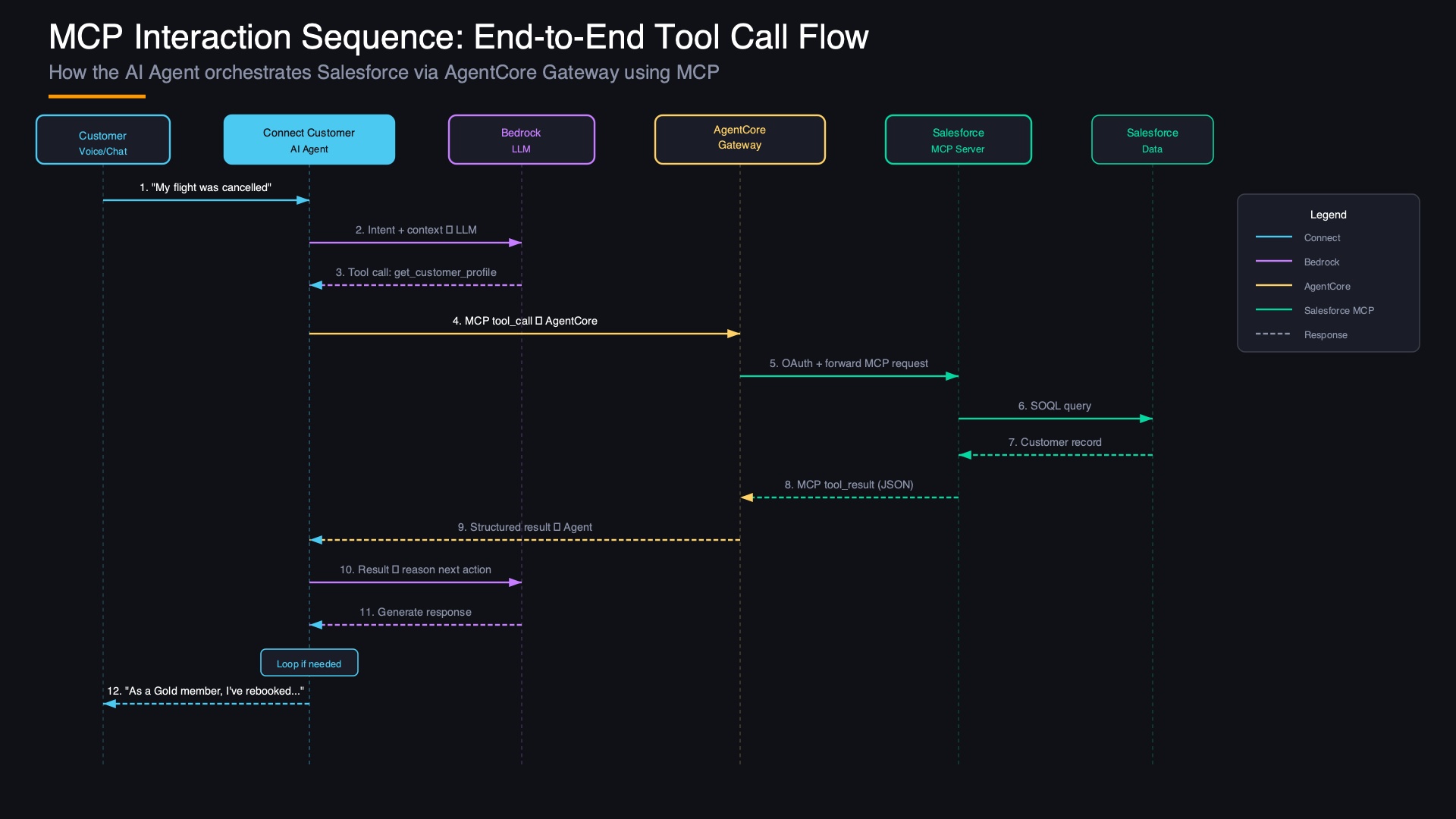
Diagram: MCP runtime sequence – a single tool call flows from the AI agent through AgentCore Gateway to Salesforce and back, with authentication and protocol translation handled transparently.
The architectural component that makes composable agentic integration practical is the Model Context Protocol (MCP). MCP is an open standard defining a uniform interface through which AI agents discover, connect to, and invoke capabilities across external systems.
MCP replaces bespoke integration with a single principle: implement the connector once, and any MCP-compatible agent can discover and invoke it immediately. The agent queries an MCP server for its capability manifest, which includes available tools, input schemas, and expected outputs. It then invokes them as needed. In most implementations, this eliminates the need for custom integration code or hardcoded connections between the agent and backend systems.
To illustrate: MCP provides a universal protocol that allows any compliant agent to connect to any compliant system through a standardized interface, much like a universal connector in the hardware world.
The reference architecture: agentic orchestration
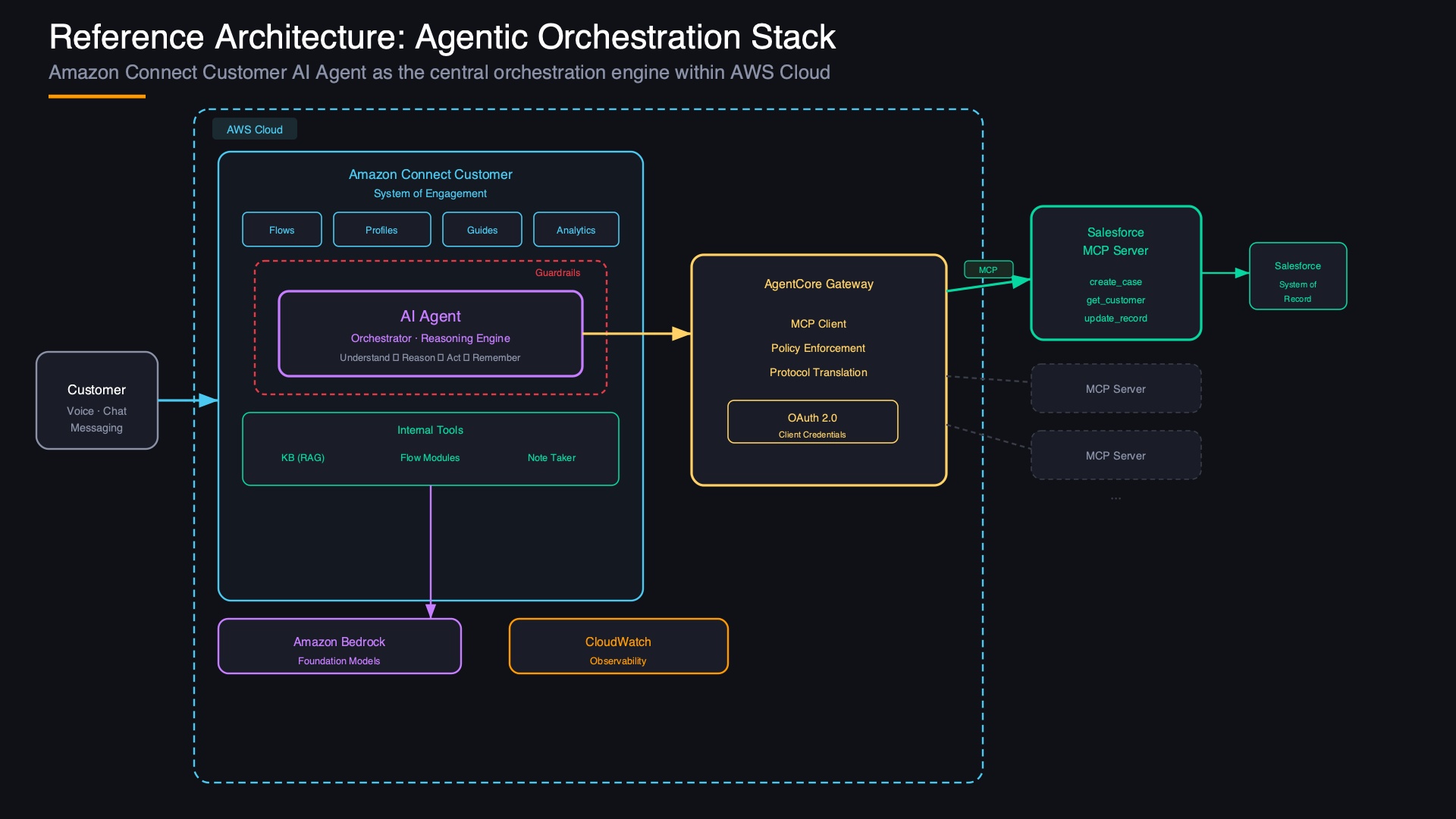
Diagram: High-level architecture showing Amazon Connect Customer at the center with the AI Agent orchestrator. Connected upward to Amazon Bedrock for LLM reasoning, outward through AgentCore Gateway to external MCP Servers (Salesforce and others), with internal tools (Knowledge Base, Flow Modules, Note Taker) on the left, and Amazon CloudWatch providing observability across all layers.
Realizing agentic integration at enterprise scale requires the following architectural components, all operating within the AWS Cloud. The diagram below shows how these components interact within a unified orchestration architecture.
Amazon Connect Customer (System of Engagement) The conversational AI service owning the customer interaction across voice, chat, and messaging. It provides the features that support the agent: Flows for routing and channel management, Customer Profiles for identity and context, Guides for step-by-step resolution paths, and Conversational Analytics for interaction insights.
AI Agent with Guardrails The orchestrator and reasoning engine sits at the center of Amazon Connect Customer, surrounded by guardrails that enforce safety, compliance, and policy boundaries. It continuously cycles through understand, reason, act, and remember to resolve customer issues autonomously.
Internal Tools Tools native to Amazon Connect Customer that the AI agent invokes directly. These include the Knowledge Base for policy and product information retrieval using Retrieval Augmented Generation (RAG), Flow Modules for triggering predefined actions, and Note Taker for generating interaction summaries.
Amazon Bedrock (Foundation Models) The reasoning engine powering the AI agent, positioned outside Amazon Connect Customer but within the AWS Cloud. Provides the LLM capability that drives intent understanding, planning, and response generation.
Amazon Bedrock AgentCore Gateway The secure connectivity layer that routes the AI agent’s tool calls to external MCP servers. Handles OAuth 2.0 authentication, policy enforcement, and protocol translation. This allows the agent to reach any MCP-compliant system without bespoke integrations.
External MCP Servers Salesforce MCP Server as the primary system of record connection (case creation, customer queries, record updates), plus any number of additional MCP servers for other external systems. The agent treats all MCP servers identically: discoverable, callable, composable.
Amazon CloudWatch (Observability) Provides logging, metrics, and monitoring across all layers (Amazon Connect Customer, Amazon Bedrock, and AgentCore Gateway) ensuring operational visibility into the agentic system. Each component evolves independently, decoupled by the MCP protocol boundary.
The convergence: Amazon Connect Customer and Salesforce MCP integration
The industry stands at a convergence of three independently maturing capabilities: AI agents with continuous reasoning architectures, an open protocol (MCP) that makes any system composable, and services that position the agent at the architectural center of the interaction.
The integration between Amazon Connect Customer and Salesforce via MCP represents a leading implementation of this convergence. The system of engagement connects to the system of record through a standardized, composable protocol layer.
How it works
Salesforce exposes its capabilities through hosted MCP servers, which are vendor-built interfaces that translate the MCP protocol into Salesforce-native operations. The Amazon Connect Customer AI agent connects through Amazon Bedrock AgentCore Gateway, which handles OAuth 2.0 authentication and enforces access policies.
At runtime, the AI agent issues an MCP tool call. AgentCore authenticates via OAuth and forwards the request. The Salesforce MCP server translates it into the appropriate Salesforce API operation. The structured result returns through the same path. The agent then reasons over the result and determines the next action.
What the agent can do
Through the Salesforce MCP server, the AI agent gains access to Salesforce operations as composable tools. The agent can query Contact, Account, and custom objects to retrieve customer history, preferences, and entitlements for identification and context. It manages the full case lifecycle by creating, updating, escalating, and closing cases within the conversational flow. It performs record operations, reading, creating, updating, and querying any exposed Salesforce object in real time. Finally, it handles activity logging by writing interaction summaries, resolution notes, and follow-up tasks back to Salesforce.
Why this is architecturally significant
Runtime discovery The agent discovers Salesforce capabilities at runtime. When Salesforce adds new tools to its MCP server, the agent can use them without code changes to the orchestration layer.
Bidirectional context flow The agent reads from Salesforce to inform reasoning and writes back to capture actions. The system of record stays current without manual data entry.
Composable with other systems The same MCP pattern extends to any compliant system. The agent orchestrates across Salesforce, booking systems, and internal tools using identical mechanics.
Decoupled evolution Salesforce org changes are reflected in the MCP server without requiring changes to the AI agent, contact flows, or gateway configuration.
Together, Amazon Connect Customer and Salesforce via MCP produce an outcome: a system of engagement that resolves customer issues end to end, autonomously, drawing upon the full depth of the system of record.
Integration is no longer infrastructure. It is the force multiplier that determines whether an AI agent operates as an advisor or as an autonomous resolution engine.
The impact model: business, experience, and strategic implications
Business impact
When the system of engagement orchestrates autonomously across the system of record in real time, the economic model of customer service transforms. Complex, multi-step requests that previously required multiple transfers and minutes of agent handling time can resolve more quickly through automated orchestration. First-contact resolution rates increase as the agent can chain actions across systems without transfers or callbacks. Human escalation contracts to cases that genuinely demand judgment.
Customer experience impact
The customer perceives the systematic absence of friction: no transfers, no repeated verification, no hold time. Every interaction is contextually personalized because the agent draws upon the complete customer record. The shift is from transactional to relational.
Strategic implications for leaders
The differentiator in this space is not model capability, which is commoditizing. It is the breadth and composability of the integration architecture. Integration breadth is a key differentiator in AI strategy.
Leaders should design for orchestration rather than flows. The imperative is to build systems that are discoverable, callable, and composable. The relevant metric changes too: rather than measuring deflection, measure how many complex issues the agent resolved autonomously, end to end.
Customer relationship management (CRM) is the natural first integration. From that foundation, expand outward. Each connection compounds the last. Amazon Connect Customer is the natural choice as the AI orchestration layer because it owns the real-time customer relationship, natively embeds the reasoning engine, and connects to any system via MCP through AgentCore Gateway.
Get started: the agentic integration workshop
To implement the architecture described in this post, we offer a hands-on Agentic Integration Workshop where participants configure, connect, and test an end-to-end agentic resolution system –
Note: The workshop includes cleanup instructions. Follow the cleanup steps to delete provisioned resources and avoid ongoing charges.
Conclusion
In this post, we examined the architectural principles of agentic integration, the reasoning loop, and how Amazon Connect Customer and Salesforce connect through MCP. The multiplier effect demonstrates that each additional system connected to your AI agent compounds the resolution capability of your entire architecture – transforming integration from operational infrastructure into strategic intelligence.
This post examines architectural patterns and strategic implications of agentic integration using Amazon Connect Customer, Salesforce’s MCP server, Amazon Bedrock, and the Model Context Protocol.
About the author

Chintan Gandhi is an Amazon Connect Customer Integrations, Applied AI Leader at AWS. He helps customers adopt and scale agentic systems. Outside of work, Chintan enjoys spending time with family, playing chess and cricket, reading books, and sometimes amateur fiction writing.