AWS Contact Center
Rethinking the Case: How Amazon Connect’s Approach Unlocks the Future of Customer Service
We’re Willing to Be Misunderstood
At Amazon, one of our leadership principles is Customer Obsession and sometimes that means making decisions that feel counterintuitive in the short term but deliver exponential value over time. We’re willing to be misunderstood for long periods if it means building the right foundation for our customers’ future.
If you’re migrating to Amazon Connect Customer from platforms like Salesforce Service Cloud, ServiceNow, or NICE CXone, you might experience a moment of friction when you first encounter Cases. You expect a case to be a routable object; something that moves through queues, gets assigned to agents, and follows a linear path to resolution. Amazon Connect Customer doesn’t work that way. (Neither do cases in reality).
This isn’t a gap in functionality. It’s a deliberate architectural decision and once you understand the reasoning behind it, you’ll see why it’s more powerful for both your current operations and your AI-driven future.
The core insight: Amazon Connect Customer separates the unit of work from the container of work. Contacts (emails, calls, and chats) and tasks (items of work) are routable objects. Cases are persistent containers that orchestrate, track, and provide context. That distinction matters enormously as contact centers evolve from human-only operations to hybrid human-AI workflows.
What Is a Case in Amazon Connect Customer?
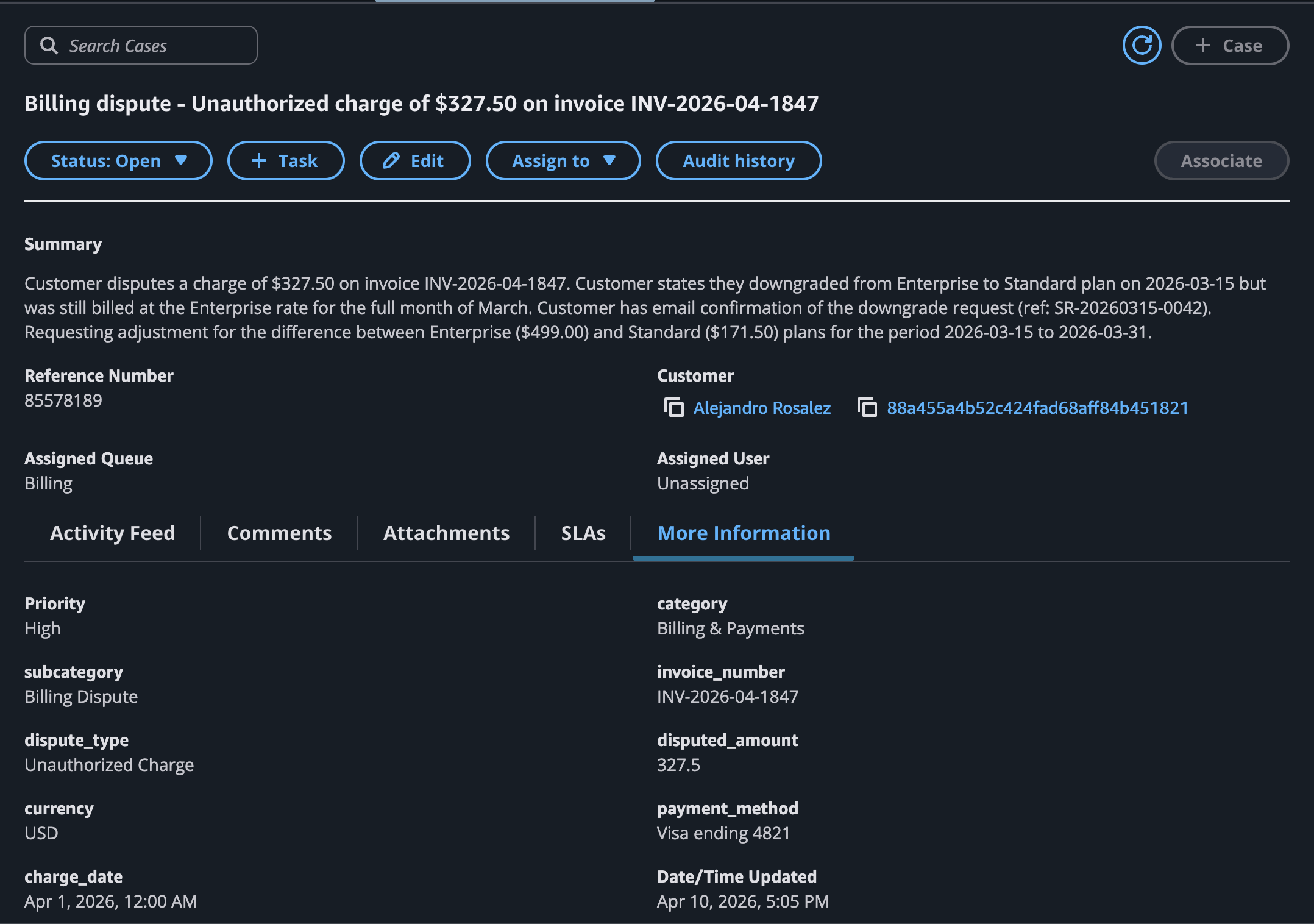
In Amazon Connect Customer, a case is a collection of contacts and work items tied to a common customer goal or business process (Issue tracking and resolution). Think of it as a mission brief rather than a queue ticket.
Support scenario: A customer reports a billing issue that requires multiple interactions: an initial call, follow-up research, a callback, and final resolution. The case tracks all of these interactions as a unified customer journey.
Automation scenario: A new account setup requires identity verification, credit approval, and system provisioning. The case orchestrates these steps across multiple teams and systems while maintaining a complete audit trail.
Here’s the key concept: contacts and tasks are the routable objects, not the case itself. The case is the persistent record and orchestration layer. It tracks progress, SLAs, ownership, and history, but it doesn’t move through queues.
Contrast with legacy platforms: In traditional CCaaS systems, the case itself is a routable object. It gets assigned to an agent or queue, and if that agent becomes unavailable or the queue is backed up, the case gets stuck. Complex workflows requiring multiple specialists create a painful trade-off between specialization (routing to the right expert) and continuity (keeping context intact).
Amazon Connect Customer eliminates this trade-off by design.
The Power of Separating Work from the Container
When you separate routable work items from the case container, several powerful capabilities emerge:
Parallel routing: Multiple work items from a single case can route simultaneously to different agents or teams. No more sequential bottlenecks when multiple specialists need to contribute.
Sequential routing: Work items can be chained in order when dependencies exist, with the case maintaining continuity across each step.
Specialization without fragmentation: A case owner retains visibility and SLA accountability while specialists handle discrete tasks. Context never gets lost in handoffs.
Agentic readiness: As AI agents take on more customer interactions, the case becomes the “mission brief” for the AI. The agent knows what’s been attempted, what’s pending, what the customer’s history looks like, and what the ultimate goal is.
Key insight: In an agentic world, you need a persistent, structured view of the entire process, not just the next step in a queue. Amazon Connect’s architecture provides exactly that foundation.
Use Case Deep Dive #1: Single-User Stranded Workflow
Let’s start with a common pain point: the stranded workflow.
Scenario: A customer contacts support with a complex technical issue. The agent needs to research the problem, schedule a callback when parts arrive, and then complete a follow-up configuration task. Ideally, the same agent handles all three steps for continuity.
The problem in traditional models: The case routes to a specific agent. If that agent goes on break, takes PTO, or gets pulled into a meeting, the case sits in their queue: stranded. When it finally gets re-routed, the next agent starts from scratch, re-reading notes, and losing valuable context.
The Amazon Connect Customer approach:
- A case is created and owned by the agent
- Individual contacts (inbound call, outbound callback, follow-up task) are created as discrete routable work items under that case
- The agent can pick up each work item in context, with full case history visible in the agent workspace
- If the agent is unavailable, the specific work item can be re-routed to another qualified agent without losing the case record or SLA tracking
- The case owner can monitor progress even if they don’t handle every interaction
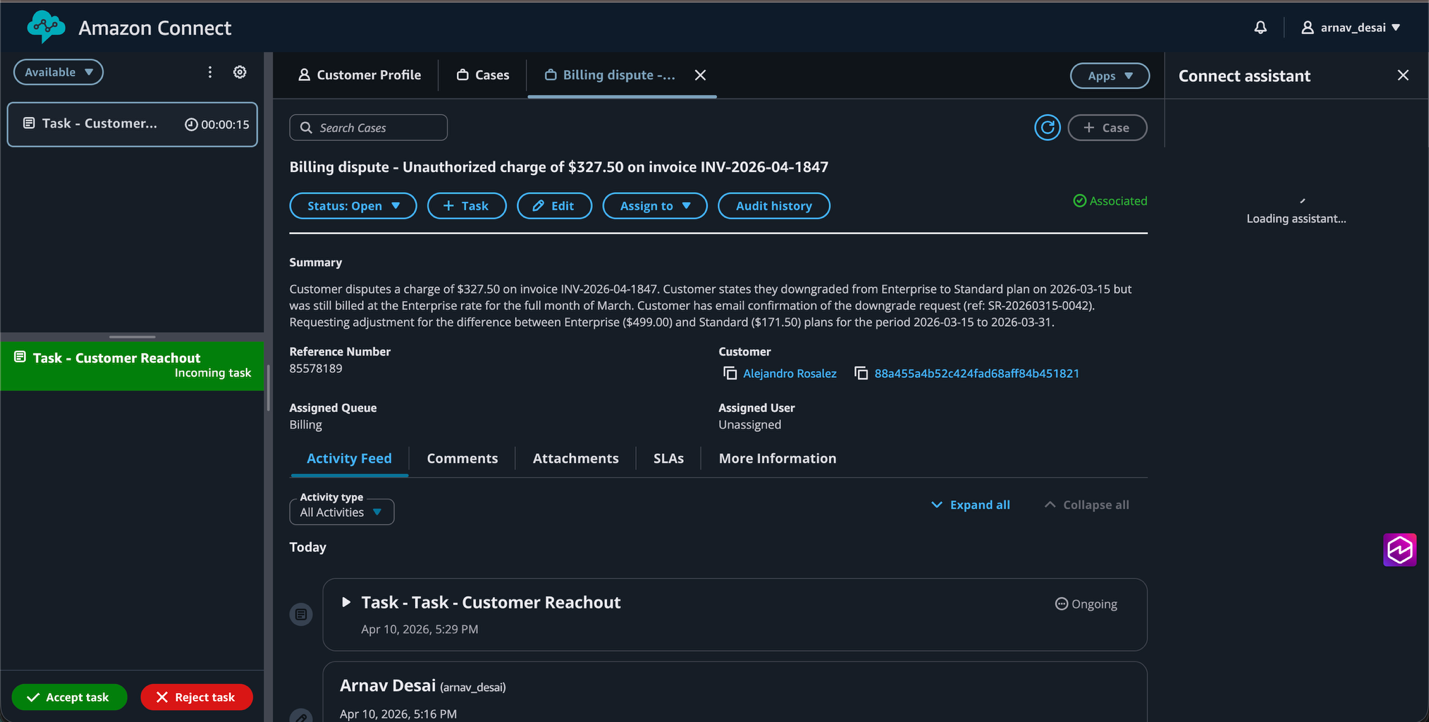
Outcome: No stranded work. No lost context. SLA tracking continues at the case level, not the individual interaction level. The customer experience remains seamless even when operational realities require flexibility.
Use Case Deep Dive #2: Multi-User Parallel and Sequential Workflows
Now let’s look at scenarios that require multiple specialists.
Scenario A – Parallel Workflows
A customer calls about a billing dispute that shows potential fraud indicators. This requires simultaneous investigation by both a billing specialist and a fraud analyst.
In traditional platforms: The case routes to billing first, then to fraud or vice versa. Each team waits for the other to finish. The customer waits days, weeks, or sometimes months for resolution.
In Amazon Connect Customer:
- Two tasks are created under one case and routed independently one to the billing queue, one to the fraud queue
- Both specialists work simultaneously, each seeing the full case context
- A case owner (often the original agent or a supervisor) monitors both tasks in real time
- The SLA clock runs at the case level, not the task level
- When both tasks are resolved, the case owner can review and close the case, all with a complete audit trail.
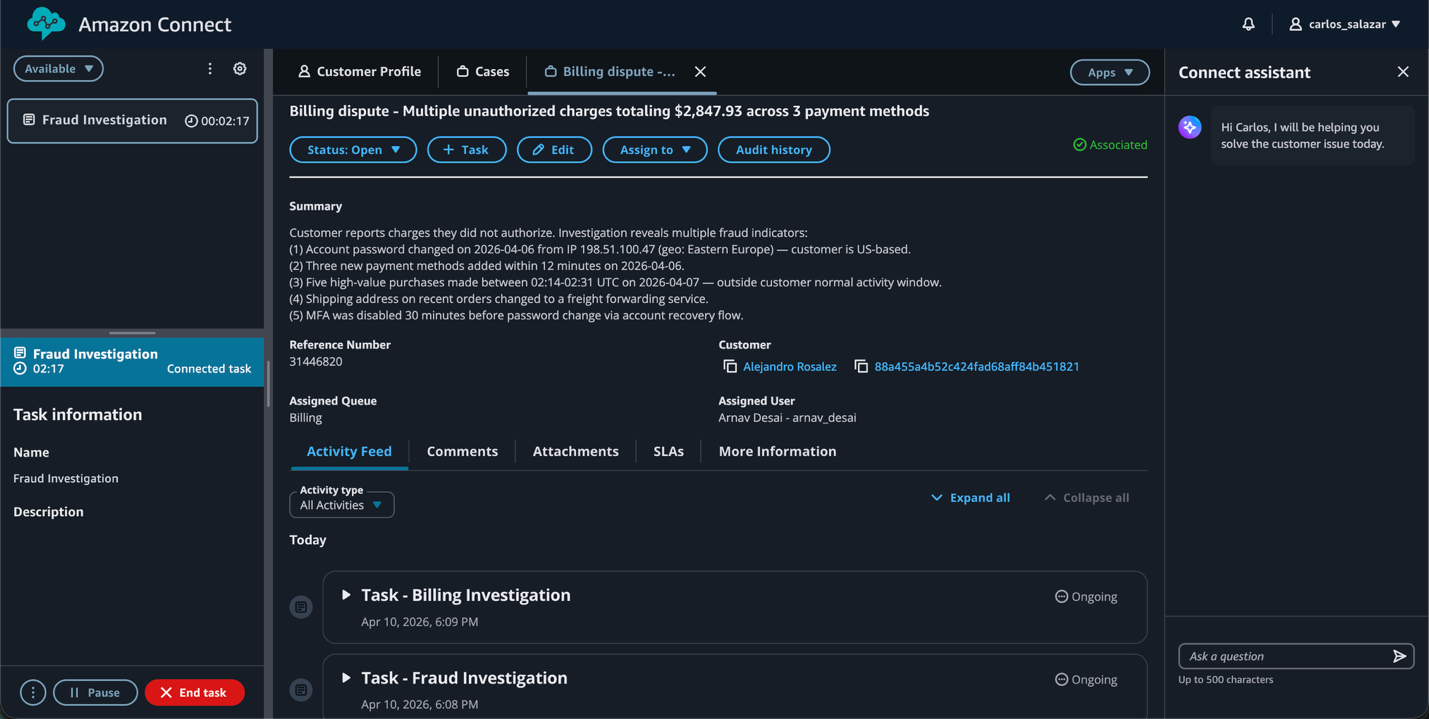
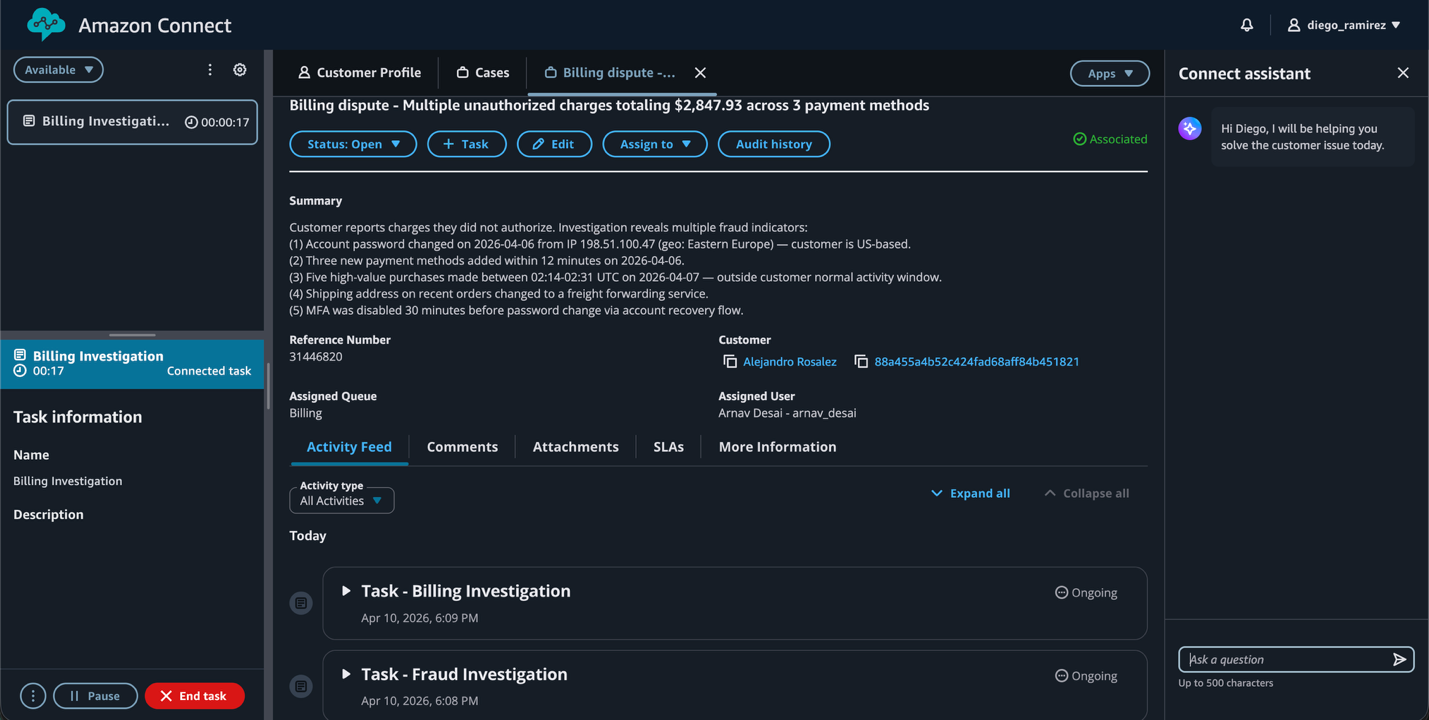
Result: What used to take 3-5 days now completes in hours. The customer gets faster resolution. Your specialists work in parallel instead of waiting in sequence.
Scenario B – Sequential Workflows
A new enterprise account setup requires identity verification → credit check → system provisioning, each handled by a different specialized team.
In Amazon Connect Customer:
- Tasks are created and routed in sequence based on business rules
- Each step is a discrete routable work item with clear ownership
- The case tracks completion of each step and automatically triggers the next
- Full audit trail is maintained for compliance and quality assurance
- If any step fails, the case owner is notified and can intervene without losing context
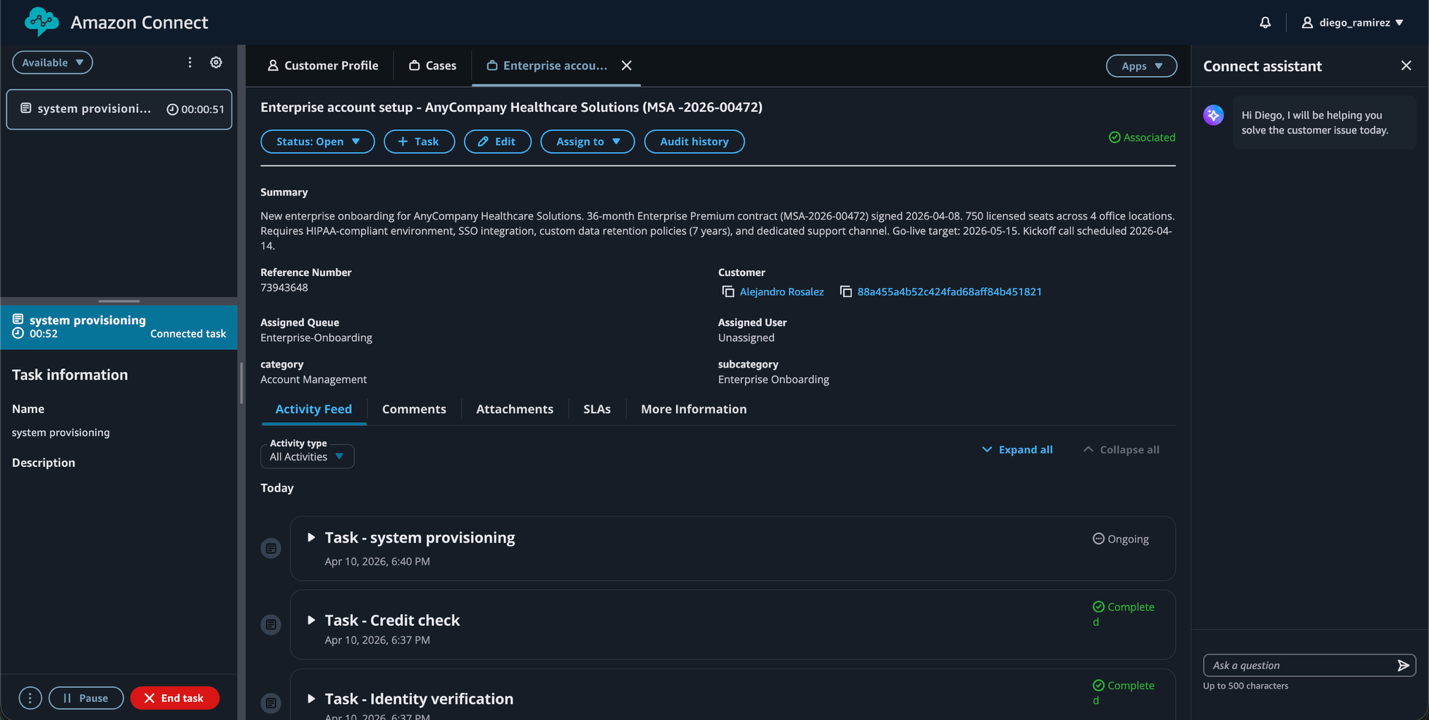
Key takeaway: Amazon Connect lets you model real business processes, not just “who answers the phone next.” Your workflows can reflect the actual complexity of your operations without forcing everything into a linear queue structure.
Looking Ahead: Cases in an Agentic Future
Here’s where Amazon Connect’s architectural decision becomes truly strategic.
As AI agents handle more customer interactions autonomously, they need structured context to act intelligently. When an AI agent picks up a customer case, it needs to know:
- What has been tried already?
- What was the outcome of each attempt?
- What’s the current SLA status?
- What’s the customer’s history and sentiment?
- What’s the ultimate goal we’re trying to achieve?
The case provides all of this. It’s the source of truth that enables AI agents to make informed decisions rather than starting from scratch with each interaction.
The architecture of separating routable work items from the case container is future-proof:
- Human agents, AI agents, and hybrid workflows can all operate under the same case model
- Orchestration becomes possible at scale without rebuilding your routing architecture
- Context flows seamlessly between human and AI interactions
- Compliance and audit requirements are met automatically through the persistent case record
Amazon Connect’s approach positions you to adopt agentic AI without rearchitecting your contact center. The foundation is already built.
Conclusion: Different by Design
Cases in Amazon Connect are containers, not queues and that’s intentional.
We acknowledge the learning curve for customers coming from platforms where cases route like any other work item. It requires a mental model shift. But the payoff is substantial:
- More flexible routing that supports both parallel and sequential workflows
- Better SLA management at the process level, not just the interaction level
- Specialization without fragmentation, enabling your experts to contribute without losing continuity
- A foundation built for the future, where AI agents and human agents collaborate seamlessly
This is customer obsession in action. We built Amazon Connect Customer not to replicate what existed before, but to enable what comes next.