AWS Contact Center
The Blind Spot in Contact Center Observability
Modern contact centers have become highly observable. Administrators can monitor network performance in real time, inspect application health, track routing behavior, analyze call data, and audit workstation conditions across hundreds or thousands of agents simultaneously. The infrastructure layer has never been more transparent. Yet, one of the most important devices in the entire voice path remains effectively invisible: the headset sitting on the agent’s head.
Modern contact centers generate a wealth of operational insight, from network and application health to routing and call-quality metrics. Endpoint diagnostics and test utilities can add another layer when supervising and troubleshooting individual agents. Yet the picture becomes less complete at the agent’s audio endpoint. The headset adds another source of insight into device health, usage, environment, and audio conditions. Combined with existing infrastructure and call-quality data, this can create a more complete view of the end-to-end voice experience.
That blind spot carries real cost. Audio quality failures are among the most common and most frustrating issues in contact center operations – and the headset is almost always part of the story. But without endpoint telemetry, most organizations are trying to solve an endpoint problem with infrastructure tools that cannot see far enough.
The Diagnostic Problem Nobody Has Solved Well
When an agent reports a poor audio experience such as muffled voice, background noise bleeding through, dropped words or unclear speech, the investigation that follows is rarely clean. Support teams must work through a wide chain of potential causes: Was it the network? The browser? A codec issue? The operating system audio stack? The agent’s physical environment? The microphone placement? A wireless interference problem? Or the headset hardware itself?
Each of those possibilities requires a different diagnostic path. Without endpoint-level data, teams default to a process of elimination that is time-consuming, often inconclusive, and invisible to the people who need answers fastest. Mean time to resolution extends. Agents receive generic guidance. Issues recur because root causes go unconfirmed.
The challenge is compounded by the fact that contact center audio doesn’t fail in simple, clean ways. The headset sits at the intersection of user behavior, physical environment, device health, wireless signal conditions, OS settings, browser behavior, and the contact center platform itself. A call that sounds fine at the platform layer can still deliver a poor experience at the endpoint. However, traditional call-quality metrics may confirm that a problem occurred without explaining what or where.
This is the diagnostic gap that endpoint telemetry is positioned to close.
Headsets Are Generating Data, But Most Organizations Aren’t Using It
Professional headsets – particularly those built for contact center environments – are not passive audio devices. They are instrumented endpoints capable of generating a continuous stream of device-level signals that reflect exactly what is happening at the point of conversation.This telemetry exists, but the question is whether organizations are capturing and activating it.
The unique data available from modern headsets spans four key categories:
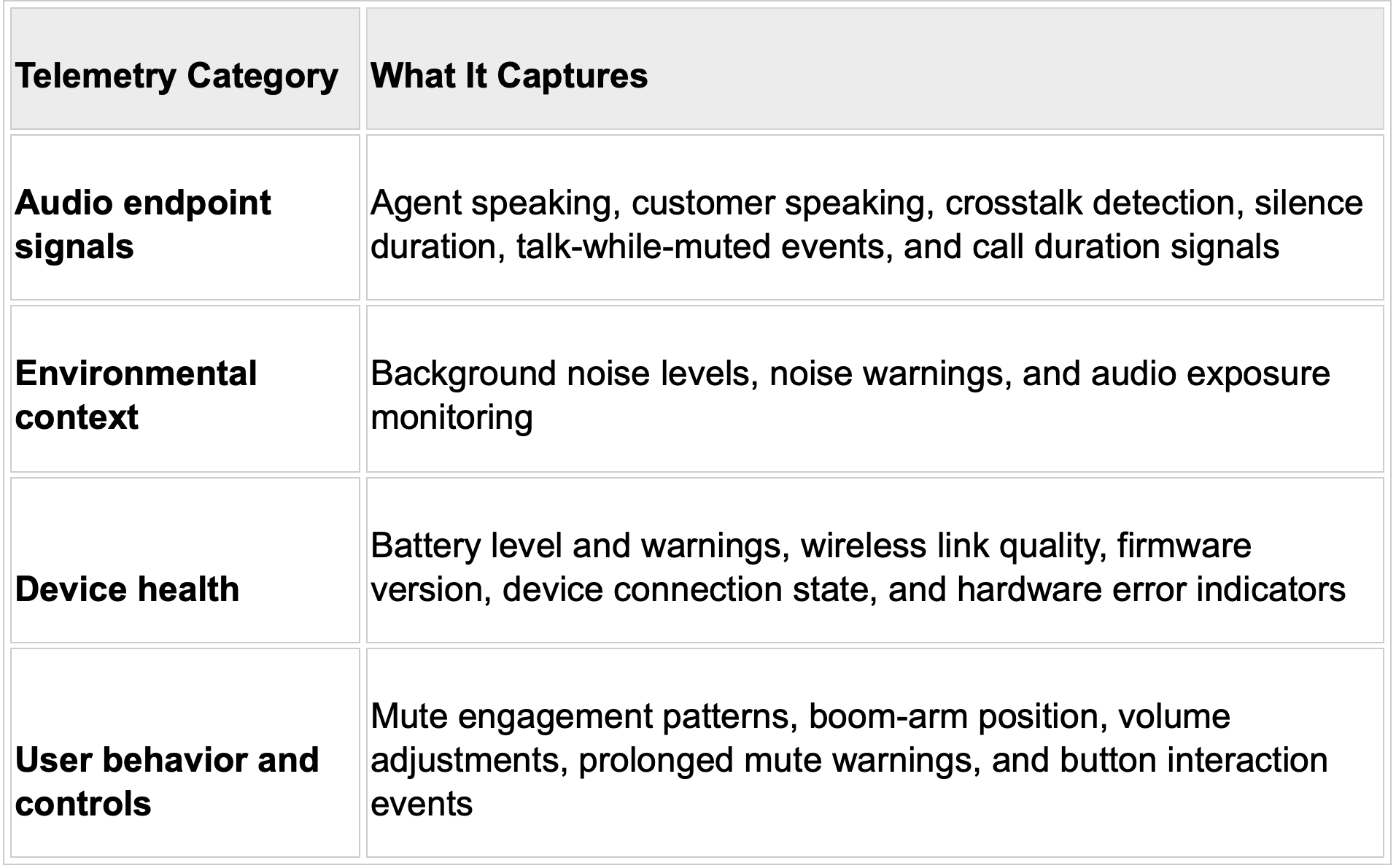
Together, these signals add device-level context to the data already available from network, application, and contact center platform. They help answer not only whether an issue occurred, but what was happening at the audio endpoint when it did.
What Becomes Possible When You Can See the Endpoint
Endpoint telemetry doesn’t replace existing diagnostics, it makes them more actionable. The value emerges across three operational layers.
For administrators and support teams, telemetry shortens troubleshooting cycles by providing direct evidence at the device level. When an agent reports an audio complaint, a support team equipped with endpoint data can immediately assess whether the issue correlates with high background noise, incorrect microphone placement, low battery, wireless degradation, or a mute state the agent was unaware of. That narrows the investigation before it escalates and creates a defensible record of what occurred.
For supervisors and quality teams, real-time and historical telemetry adds context that interaction recordings alone cannot provide. A call flagged for poor customer experience looks very different when paired with data showing the agent’s boom arm was mispositioned, background noise exceeded threshold levels, or the wireless link quality was degrading throughout the interaction. Those signals can guide more direct coaching and process improvement.
For managed service providers and channel partners, headset telemetry expands the value beyond initial device sale. Organizations that have historically differentiated on platform expertise or network performance can now extend their observability footprint all the way to the agent endpoint. Managed services built around endpoint health, firmware compliance, device inventory, and audio quality monitoring represent a meaningfully higher-value engagement model than device fulfillment alone, creating recurring relevance and tighter integration with customer operations.
The AI Readiness Angle Organizations Are Underestimating
There is an additional dimension to this conversation that the industry has been slow to surface: headset telemetry is an AI quality problem, not just an operational one.
Contact centers are increasingly dependent on AI-driven applications – transcription, sentiment analysis, real-time agent assist, translation, and analytics. All of these applications are only as reliable as the voice signal that feeds them. A poor audio input doesn’t just affect the call; it degrades the AI outputs that supervisors, compliance teams, and business analysts are making decisions from.
When transcription fails, sentiment scores are off base, or agent-assist produces irrelevant suggestions, the cause is often environmental or device-related rather than algorithmic. Endpoint telemetry provides the missing layer of context that explains why AI performance varies across agents, shifts, and environments, and it enables organizations to address the root cause rather than tune models around a correctable input problem.
As AI becomes more deeply embedded in contact center operations, the accuracy of the voice signal will become a critical infrastructure concern. Endpoint telemetry is how organizations get ahead of that.
Where to Begin
For organizations and partners ready to evaluate endpoint observability, the path forward does not require a large-scale transformation. The most effective starting point is a pilot built around a small number of high-impact use cases:
- Real-time agent alerts triggered by talk-while-muted behavior, high background noise, or microphone positioning issues
- Troubleshooting dashboards that surface headset context alongside network, workstation, and interaction data for support teams
- Wireless and battery monitoring to reduce preventable audio failures in environments using wireless devices
- Endpoint inventory visibility to standardize device models, track firmware versions, and enforce device compliance across the agent population
Starting focused allows organizations to demonstrate measurable value quickly with reduced support tickets, faster resolution times, and improved coaching before expanding telemetry use cases across the contact center.
The Last Unmonitored Endpoint
The contact center industry has invested heavily in making its infrastructure observable. Network, platform, application, and workstation layers are well-instrumented and well-understood. The headset has remained the exception. It is a critical component of the voice experience that generates meaningful data most organizations have never thought to collect.
As endpoint telemetry capabilities mature and integration patterns with major contact center platforms become more accessible, the case for treating the headset as an observable, manageable part of the technology stack is becoming difficult to ignore.
The organizations that move first will have a structural advantage: better troubleshooting, stronger agent experiences, more reliable AI performance, and for partners, a differentiated service offering that extends beyond the device transaction. The data is already there, but the question is whether you’re listening to it.
To learn more about Amazon Connect Customer, visit the Amazon Connect Customer documentation. To learn more about Jabra telemetry, visit Jabra Telemetry.
About the author
 As World Wide Sr. Applied AI Solution Architect , Puneet sits at the intersection of enterprise AI strategy and real-world deployment, advising organizations across industries on how to move AI initiatives from ideation to pilot to production. With a Ph.D. in Innovation Management and almost 30 years of experience spanning senior roles he brings a rare combination of academic rigor, hands-on operational credibility, and deep technical breadth across AI and enterprise technology to conversations about AI adoption, customer experience transformation, and organizational change management. He regularly speaks at industry events and writes on topics ranging from AI adoption and ethics to the human cost of getting technology decisions wrong. He brings both a practitioner’s perspective on what actually works when AI meets legacy organizations, and a willingness to challenge the hype with grounded, experience-based insight.
Vern Fernandez leads Strategic Alliances for Jabra, a global technology company focused on professional audio, video and collaboration solutions.