AWS Database Blog

Author: Ezat Karimi
Ezat is a Senior Solutions Architect at AWS, based in Austin, TX. Ezat specializes in designing and delivering modernization solutions and strategies for database applications. Working closely with multiple AWS teams, Ezat helps customers migrate their database workloads to the AWS cloud.
Building search experiences for JSON data with Amazon OpenSearch Service
In this post, you learn how to use Amazon OpenSearch Service as a discovery layer that combines full-text, vector, and geospatial search across JSON documents in a single query, using a restaurant discovery app as a working example.
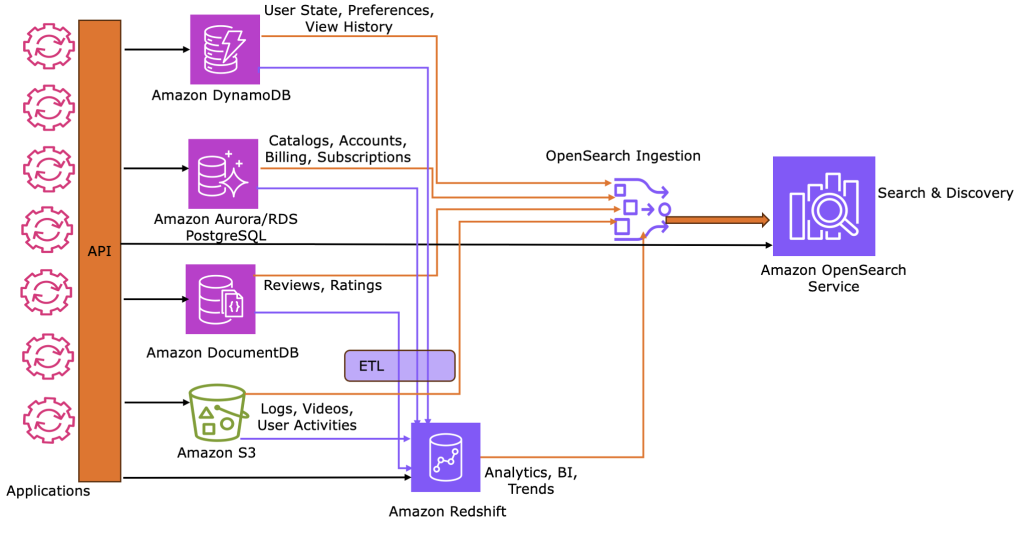
How to build unified JSON search solutions in AWS
Using a movie streaming reference architecture, this post shows how to implement and sync operational, analytical, and search JSON workloads across AWS services. This pattern provides a scalable blueprint for any use case requiring multi-modal JSON data capabilities.
Analyze JSON data efficiently with Amazon Redshift SUPER
Amazon Redshift transforms how organizations analyze JSON data by combining the analytical power of a columnar data warehouse with robust JSON processing capabilities. By using Amazon Redshift SUPER datatype, you can efficiently store, query, and analyze complex hierarchical data alongside traditional structured data without sacrificing performance. This post focuses on JSON features of Amazon Redshift.
PostgreSQL as a JSON database: Advanced patterns and best practices
This post shows you how to use PostgreSQL to store and search JSON data effectively. You’ll learn when to use JSON versus JSONB, how to create the right indexes, and how to write queries that perform well at scale.
JSON database solutions in AWS: Amazon DocumentDB (with MongoDB compatibility)
JSON has become the standard data exchange protocol in modern applications. Its human-readable format, hierarchical structure, and schema flexibility make it ideal for representing complex, evolving data models. As applications grow more sophisticated, traditional relational databases often struggle with several challenges: Rigid schemas that resist frequent changes Complex joins for hierarchical data Performance bottlenecks when […]

Building a job search engine with PostgreSQL’s advanced search features
In today’s employment landscape, job search platforms play a crucial role in connecting employers with potential candidates. Behind these platforms lie complex search engines that must process and analyze vast amounts of structured and unstructured data to deliver relevant results. This post explores how to use PostgreSQL’s search features to build an effective job search engine. We examine each search capability in detail, discuss how they can be combined in PostgreSQL, and offer strategies for optimizing performance as your search engine scales.

Dynamic data masking in Amazon RDS for PostgreSQL
There are a variety of different techniques available to support data masking in databases, each with their trade-offs. In this post, we explore dynamic data masking, a technique that returns anonymized data from a query without modifying the underlying data. In this post, we discuss a dynamic data masking technique based on dynamic masking views. These views mask personally identifiable information (PII) columns for unauthorized users. This post discusses how to implement this technique in Amazon RDS for PostgreSQL and Amazon Aurora PostgreSQL including Babelfish for Aurora PostgreSQL.

Migrate generated columns to PostgreSQL using AWS Database Migration Service
AWS launched Amazon Database Migration Accelerator (Amazon DMA) to accelerate your journey to AWS Databases and Analytics services and achieve cloud adoption benefits such as cost savings and performance improvements. In this post, we share Amazon DMA’s approach to migrate generated columns to PostgreSQL implementations, such as Amazon RDS for PostgreSQL or Amazon Aurora PostgreSQL-Compatible […]

Key considerations while migrating bulk operations from Oracle to PostgreSQL
AWS launched Amazon Database Migration Accelerator (Amazon DMA) to accelerate your journey to AWS databases and analytics services and achieve cloud adoption benefits such as cost savings and performance improvements. Amazon DMA has assisted thousands of customers globally to migrate their workloads (database and application) to AWS databases and analytics services. In this post, we […]