AWS Database Blog

Author: Josh Hart
Josh is a Principal Solutions Architect at Amazon Web Services. He works with ISV customers in the UK to help them build and modernize their SaaS applications on AWS.

Scheduled scaling of Amazon Aurora Serverless with Amazon EventBridge Scheduler
In this post, we demonstrate how you can implement scheduled scaling for Aurora Serverless using Amazon EventBridge Scheduler. By proactively adjusting minimum Aurora Capacity Units (ACUs), you can achieve faster scaling rates during peak periods while maintaining cost efficiency during low-demand times.

Multi-tenant vector search with Amazon Aurora PostgreSQL and Amazon Bedrock Knowledge Bases
In this post, we discuss the fully managed approach using Amazon Bedrock Knowledge Bases to simplify the integration of the data source with your generative AI application using Aurora. Amazon Bedrock is a fully managed service that makes foundation models (FMs) from leading AI startups and Amazon available through an API, so you can choose from a wide range of FMs to find the model that is best suited for your use case.

Self-managed multi-tenant vector search with Amazon Aurora PostgreSQL
In this post, we explore the process of building a multi-tenant generative AI application using Aurora PostgreSQL-Compatible for vector storage. In Part 1 (this post), we present a self-managed approach to building the vector search with Aurora. In Part 2, we present a fully managed approach using Amazon Bedrock Knowledge Bases to simplify the integration of the data sources, the Aurora vector store, and your generative AI application.

Enforce row-level security with the RDS Data API
April, 2026: Aurora Serverless v2 has been renamed Aurora serverless. No action required. As applications grow to serve more users with sensitive data, implementing robust security controls becomes critically important. One way to enhance security and meet complex access requirements is through row-level security. Row-level security allows you to limit data access at the row […]

Choose the right PostgreSQL data access pattern for your SaaS application
In a multi-tenant environment, the process of identifying the database isolation strategy most suitable for your workload is essential. Your isolation strategy ensures that one tenant cannot access another tenant’s data, and defines how the actions of tenants affect one another. The isolation strategy is driven by a combination of business, domain, security, cost, resiliency, […]

Modernize legacy databases using event sourcing and CQRS with AWS DMS
When moving from monoliths to microservices, you often need to propagate the same data from the monolith into multiple downstream data stores. These include purpose-built databases serving microservices as part of a decomposition project, Amazon Simple Storage Service (Amazon S3) for hydrating a data lake, or as part of a long-running command query responsibility segregation […]

Large object storage strategies for Amazon DynamoDB
Customers across all industries use Amazon DynamoDB as the primary database for their mission critical workloads. DynamoDB is designed to provide consistent performance at any scale. To take advantage of this performance, one of the most important tasks to complete is data modeling. Your success with DynamoDB depends on how well you define and model […]
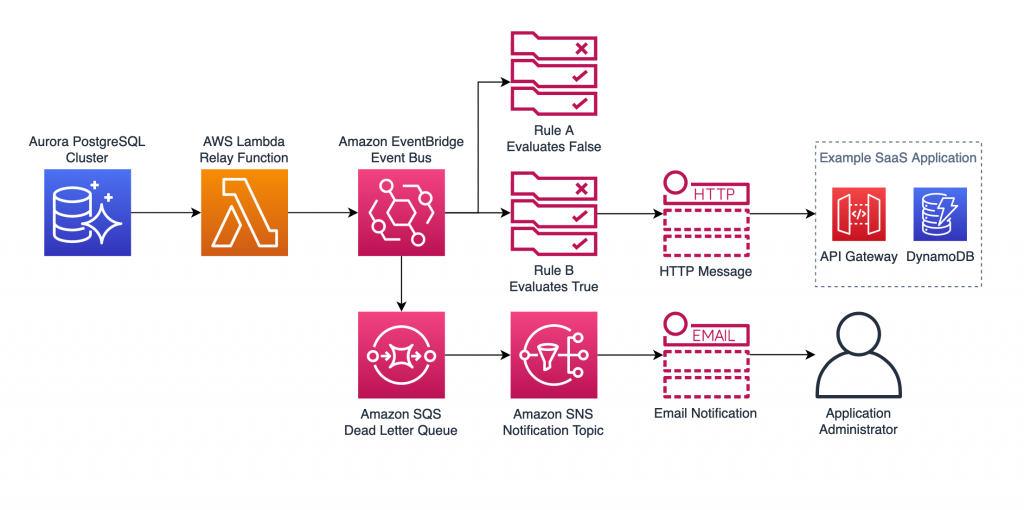
Send webhooks to SaaS applications from Amazon Aurora via Amazon EventBridge
Customers developing software as a service (SaaS) applications often need to send outgoing webhooks (HTTP call-backs in response to events) to other SaaS applications such as Salesforce, Marketo, or ServiceNow. When processing webhooks, you often have to implement custom logic or services to enqueue and emit these events. This introduces additional complexity and operational overhead. […]