AWS Database Blog
Category: Amazon Neptune

Discover more insights in your graphs with new features from Amazon Neptune ML
Amazon Neptune ML is a feature of Amazon Neptune that brings the power of the state-of-the-art graph neural network (GNN) models to all graph developers. You can use Neptune ML for tasks like node classification, node regression, and link prediction. This allows you to train GNN models powered by the Deep Graph Library (DGL) to […]
Announcing openCypher for Amazon Neptune: Building better graph applications with openCypher and Gremlin together
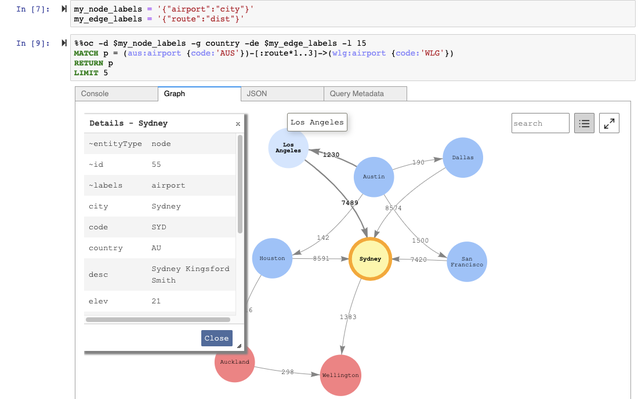
Today, we announced that openCypher for Amazon Neptune is available in lab mode. Developers can now use openCypher and Apache TinkerPop Gremlin to build or migrate property graph applications. Neptune’s purpose-built graph engine now supports three open graph query languages: Apache TinkerPop Gremlin, openCypher, and the World Wide Web Consortium’s (W3C) SPARQL 1.1, giving developers […]

Learn how Dream11, the World’s largest fantasy sports platform, scale their social network with Amazon Neptune and Amazon ElastiCache
This is a guest post co-written by Bharat Kumar, Graph Databases Lead at Dream11. Dream11, the flagship brand of Dream Sports, is the world’s largest fantasy sports platform, with more than 100 million users. We have infused the latest technologies of analytics, machine learning, social networks, and media technologies to enhance user experience. Dream11 is […]

Build a graph application with Amazon Neptune and AWS Amplify
More and more organizations are adopting graph databases for various use cases, such as legal entity lookup tools in the public sector, drug-drug interaction checkers in the healthcare sector, and customer insights and analytics tools in marketing. If your application has relationships and connections, using a relational database is hard. But Amazon Neptune, a fully […]

Transform data into knowledge with PoolParty Semantic Suite and Amazon Neptune
This is a guest blog post by Ioanna Lytra, Data & Knowledge Engineer, and Albin Ahmeti, Data & Knowledge Engineer, at the Semantic Web Company. According to the International Data Corporation (IDC), more data will be created in the next 3 years than in the prior 30 years combined. In the ideal world, this data […]

Visualize your AWS Infrastructure with Amazon Neptune and AWS Config
As an organization, you run critical applications on AWS, and the infrastructure that runs those critical applications can be spread across different accounts and have complex relationships. When you want to understand the landscape of your existing setup, it can seem daunting to go through lists of resources and try to understand how the resources […]

Configure AWS services to build a knowledge graph in Amazon Neptune using Data Lens
This is a guest post by Russell Waterson, Knowledge Graph Engineer at Data Lens Ltd. Customers use knowledge graphs to consolidate and integrate information assets and make them more readily available. Building knowledge graphs by getting data from disparate existing data sources can be expensive, time-consuming, and complex. Project planning, project management, engineering, maintenance and […]

Build a knowledge graph in Amazon Neptune using Data Lens
This is a guest post by Russell Waterson, Knowledge Graph Engineer at Data Lens Ltd. Customers use knowledge graphs to consolidate and integrate information assets and make them more readily available. Building knowledge graphs by getting data from disparate existing data sources can be expensive, time-consuming, and complex. Project planning, project management, engineering, maintenance and […]
Use AWS Lambda functions with Amazon Neptune
Many Amazon Neptune connected data applications for knowledge graphs, identity graphs, and fraud graphs use AWS Lambda functions to query Neptune. This post provides general connection management, error handling, and workload balancing guidance for using any of the popular Gremlin drivers and language variants to connect to Neptune from a Lambda function. The connection management […]

Building a knowledge graph in Amazon Neptune using Amazon Comprehend Events
On 28-Oct-22, the AWS CloudFormation template and Jupyter notebook linked in this post were updated to 1/ add openCypher queries along with the existing Gremlin and SPARQL queries, 2/ updated to use Sagemaker newer Amazon Linux 2 instances, 3/ fixed a bug in the RDF generation code that improperly labeled a property as an RDF […]