AWS HPC Blog
Category: Uncategorized

How Proteros accelerates drug discovery by using AWS ParallelCluster
Proteros is a leader in structure-based drug discovery solutions, and supports pharmaceutical, biotechnological, and academic clients with advanced technologies like Cryogenic Electron Microscopy (Cryo-EM) and Protein Crystallography (PX). In this blog post, we’ll explore how Proteros implemented an HPC solution that scales with their scientific ambitions. We’ll talk about how they started with a secure […]
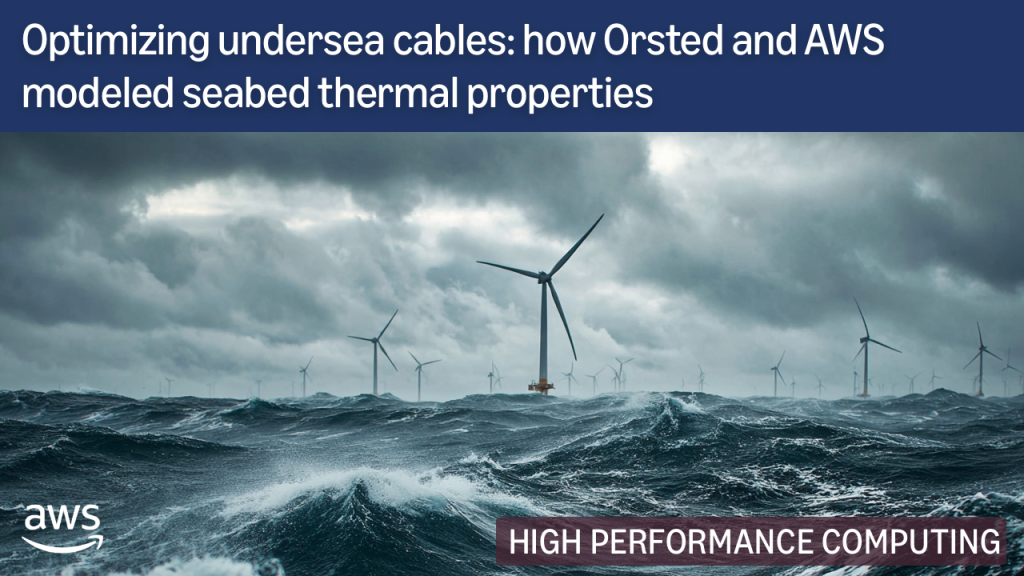
Optimizing undersea cables: how Orsted and AWS modeled seabed thermal properties
This post was contributed by Ross Pivovar, Rafał Ołdziejewski, Cindy Xin Qi Lee Offshore wind farms play a critical role in the global transition to renewable energy and clean power generation. But generating electricity is only half the battle—safely and efficiently transporting that power to the grid through undersea cables is equally important. Today, we’ll […]
A scientific approach to workload-aware computing on AWS
HPC workloads demonstrate predictable resource patterns that can directly determine optimal cloud instance selection. To save you conducting extensive custom benchmarking, this blog post presents a data-driven methodology for instance selection based on established performance research. In this post, you’ll learn how to use coupling patterns to drive instance selection. We’ll outlines our scientific methodology […]
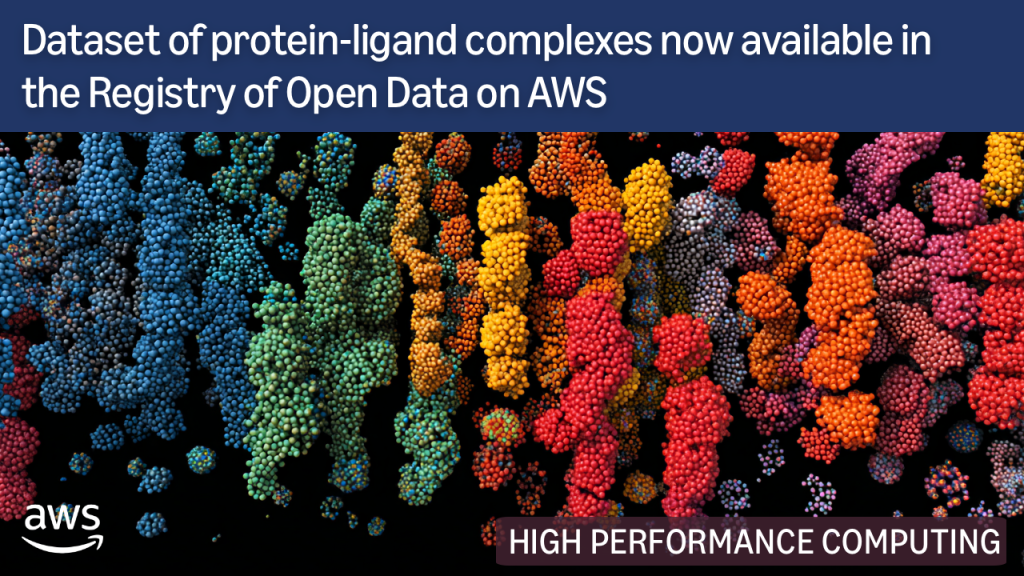
Dataset of protein-ligand complexes now available in the Registry of Open Data on AWS
This post was contributed by U. Deva Priyakumar, Rakesh Srivatsava, Prathit Chatterjee, Vladimir Aladinskiy, Ramanathan Sethuraman, Yusong Wang, Alex Iankoulski, and Beryl Rabindran Today, we’re excited to announce the release of a comprehensive dataset featuring molecular dynamics (MD) trajectories for over 16,000 protein-ligand complexes (PLCs). This dataset, now available on AWS as part of the […]
Announcing expanded support for Custom Slurm Settings in AWS Parallel Computing Service
Today we’re excited to announce expanded support for custom Slurm settings in AWS Parallel Computing Service (PCS). With this launch, PCS now enables you to configure over 65 Slurm parameters. And for the first time, you can also apply custom settings to queue resources, giving you partition-specific control over scheduling behavior. This release responds directly […]
How DTN accelerates operational weather prediction using NVIDIA Earth-2 on AWS
Cyclone chasing just got a whole lot smarter! Check out how DTN’s AI-powered weather model is rewriting the forecast. Brace yourself for the future of weather prediction.
Announcing Capacity Blocks support for AWS Parallel Computing Service
This post was contributed by by Kareem Abdol-Hamid, Kyle Bush Today we’re happy to announce that support for Amazon EC2 Capacity Blocks for Machine Learning are now supported in AWS Parallel Computing Service (AWS PCS). This allows you to reserve and schedule GPU-accelerated Amazon EC2 instances for future use. That includes the NVIDIA Hopper GPU […]

Smashing computational barriers: data-driven ball-impact modeling on AWS
Elevate your engineering capabilities with lightning-fast impact prediction. Our new blog post delves into how advanced ML models, like U-Nets and Fourier Neural Operators, are revolutionizing transient response forecasting for critical industries like consumer electronics, automotive, and aerospace. Gain a competitive edge by integrating these cutting-edge techniques.

Scalable Cryo-EM on AWS Parallel Computing Service (PCS)
Cryo-EM data processing just got a major boost! Learn how AWS Parallel Computing Service can help structural biology teams scale their HPC infrastructure and streamline Cryo-EM research. Discover a recommended reference architecture that leverages the power of the cloud.

Scaling your LLM inference workloads: multi-node deployment with TensorRT-LLM and Triton on Amazon EKS
LLMs are scaling exponentially. Learn how advanced technologies like Triton, TRT-LLM and EKS enable seamless deployment of models like the 405B parameter Llama 3.1. Let’s go large.