AWS for Industries
Highlights from Clinical Trials at the 2026 AWS Life Sciences Symposium
This post is part of a series covering the 2026 AWS Life Sciences Symposium.
On average, it takes 10–12 years and roughly $2.6 billion to bring a new medicine to patients. Roughly two-thirds of that time and cost is consumed by the clinical phase alone. Protocols are getting more complex, patient populations are smaller and harder to reach, and every delay carries a human cost measured not in dollars but in the patients who run out of time waiting.
Meanwhile, three forces are converging to change the picture: a rapidly deepening understanding of disease biology and biomarkers, regulators who are willing to adapt their frameworks, and technology—particularly AI—that has finally caught up to the industry’s ambition.
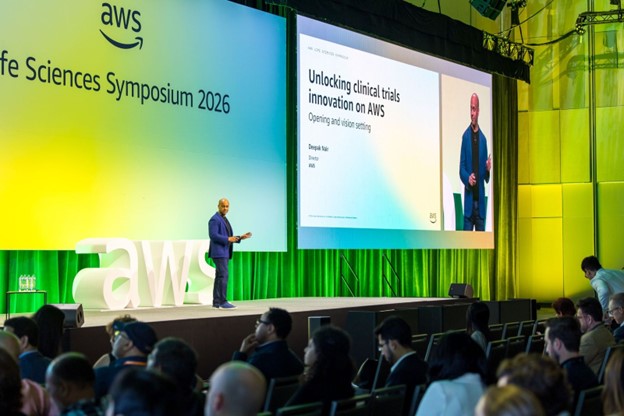
At the 2026 AWS Life Sciences Symposium, the Clinical Trials track brought a shift into focus that’s well underway. Six global life sciences leaders—Novartis, Merck (with BCG), Novo Nordisk, Labcorp, Eli Lilly, and Bayer—took the stage to demonstrate what AI in drug development looks like in practice across every stage of a clinical trial.
Their work traces the shape of a new operating model for clinical research in which decisions are made in days rather than months and data flows continuously rather than in batches.
From committees to computational twins
Every trial begins with a decision-heavy planning phase that has traditionally unfolded as a waterfall, with protocol writers, biostatisticians, clinical operations, and regulatory teams passing documents back and forth over weeks. Each handoff adds delay, and each revision cycles back through the chain. By the time a protocol is finalized, the evidence base behind it might already be stale, and the sites chosen to execute it might not be the right ones for the eligible patient population.
Novartis is collapsing that trial planning sequence into something closer to a single intelligent conversation. The company built an AI-powered intelligent decision system that acts as a computational twin for clinical trial planning. It’s a virtual environment where teams can test trial decisions before committing resources.
By integrating internal trial data, external real-world evidence, and predictive AI models, the system simulates the operations of a trial and optimizes the footprint in minutes. Probabilistic timelines for health authority approval, site startup, and patient recruitment are generated on the fly, and scenario comparisons mean teams can weigh trade-offs transparently.
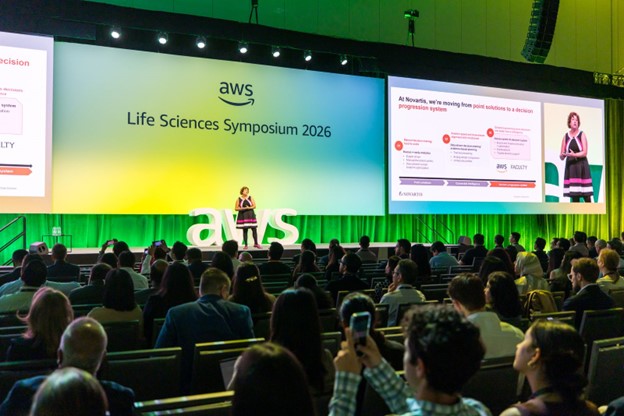
What once required a 70-page planning document, more than 20 accountable roles, and weeks of serial reviews now targets one-day planning with fewer than five accountable roles, each with autonomy within clear guardrails. Decisions are time-stamped, traceable, and system-linked. A single human-in-the-loop role means AI insight translates reliably into action.
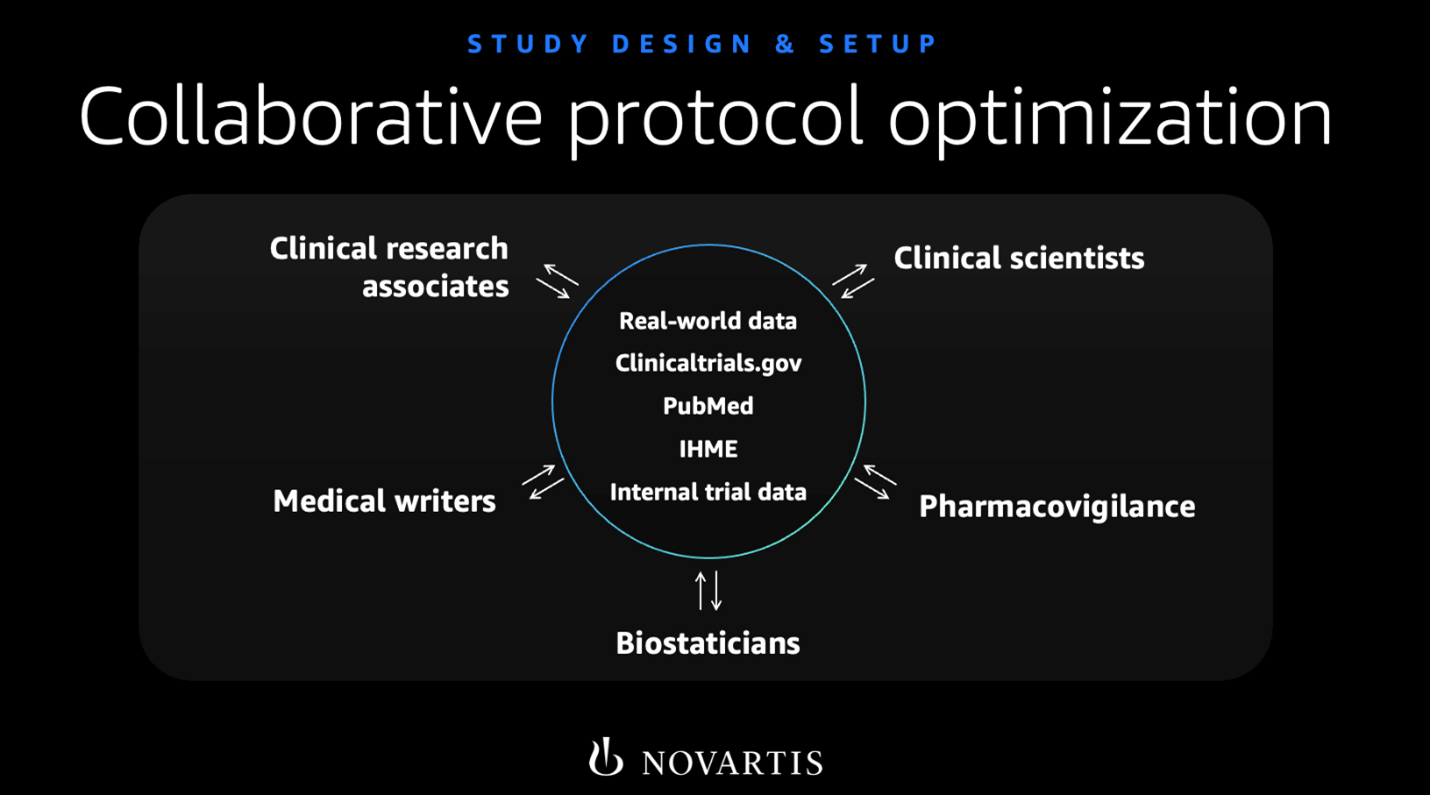
The lesson from Novartis is that AI only creates value when workflows are rebuilt around it, accountability is explicit, and every decision feeds back into the system as learning. Faster decisions owned by fewer, better-equipped people with closed-loop learning turns today’s choices into tomorrow’s intelligence.
Grounding the trial in real-world evidence
A well-designed protocol is only as good as the patient reality it anticipates. Historically, pressure-testing a protocol against real-world data has been a months-long cycle of custom data pulls, email threads, and iterative feedback.
The process typically yields a dataset confirming patient existence, yet reveals little about whether the study’s required variables, data completeness, and longitudinal follow-up are actually present.
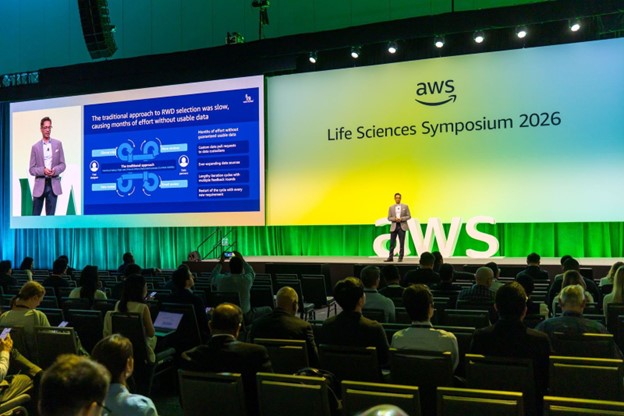
Novo Nordisk rebuilt that cycle around a query-in-place model. Instead of moving data to analysts, analysts now interrogate data where it lives in real time through a privacy-preserving environment that combines tokenized identity resolution, more secure cross-dataset compute, and conversational discovery.
In an analysis of 1,175 tokenized trial participants queried across four real-world data categories, Novo Nordisk exposed a 10-fold gap between data “coverage” and data “usability.” In one category, 11% of patients appeared in the data, but only 1% had fully usable records for the variables of interest. That kind of insight would have been invisible under the old workflow and it fundamentally changes how feasibility is assessed, compressing a cycle that once took months into days. Teams can pressure-test trial design assumptions against the live data environment before committing to expensive prospective work.
Labcorp is operationalizing that philosophy at population scale. Its Patient Journey Studio for Alzheimer’s disease transforms what was once a static registry into a dynamic, interrogable intelligence solution. Drawing on more than 600 million patient encounters and enriched with biomarker and genomic data from the hundreds of thousands of patients who have received Alzheimer’s biomarker testing in routine care, the solution tracks disease progression longitudinally, surfaces at-risk populations earlier, generates the real-world evidence payers increasingly require for coverage decisions, and addresses health equity gaps by explicitly including populations often underrepresented in research.
For a disease with a 98% clinical trial failure rate and an annual economic burden in the hundreds of billions of dollars, this is a structural change in how the industry can approach one of its hardest problems. The architecture scales beyond a single disease: What Labcorp built for Alzheimer’s serves as a blueprint for any condition where fragmented data has stalled scientific progress.
Predicting trial performance
Roughly half of all clinical trial sites never enroll a single patient, and about 40% of trials miss their recruitment targets. When a trial falls behind, sponsors activate more sites to compensate, driving further cost and complexity. And when it falls behind far enough, it becomes unviable. That is rarely a failure of science, but rather a failure of operational prediction.
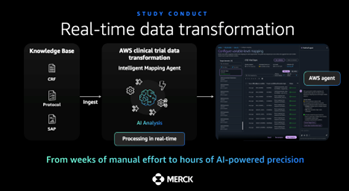
During the symposium, Merck detailed how they directly confronted this with STRIDE, an AI-enabled site selection solution built in collaboration with BCG. Rather than ranking sites by historical relationships or gut feel, STRIDE predicts site performance using historical enrollment rates, activation timelines, and non-enrollment risk, then surfaces explainable rankings that keep clinical judgment central. Strategic attributes, including diversity contribution potential, new-to-Merck sites, and competitive market exposure are flagged alongside raw performance so decision-makers can see the full picture.
Global and local teams can collaborate in a single workspace where fast-activating sites, high-enrollment locations, and diversity-supporting facilities are visible at a glance, replacing the fragmented spreadsheets and disconnected trackers that used to govern one of drug development’s most consequential decisions. STRIDE sits on top of a unified clinical data solution Merck has spent years building.
Predictive intelligence matters after the trial is running, too. Facing an increase in new study starts, trial growth, and volume, Eli Lilly built its Clinical Supply Control Tower to make the global movement of investigational drug products predictable and resilient.
The Control Tower ingests data from eight value streams, including demand planning, materials, inventory, production, finance, warehouse management, suppliers, and sensors. The tower turns these into predictive analytics, scenario planning, automated alerts, batch tracking, compliance-ready audit trails, and recommended actions delivered through intelligent dashboards. What began in 2021 as a foundational data strategy evolved through site inventory management and has now become an operating system for clinical supply that can anticipate demand, flag risk early, and make the sophisticated coordination of getting the right therapy to the right site at the right time feel less fragile.
From siloed data to program-centric intelligence
A clinical trial generates millions of data points across dozens of systems, and historically biostatisticians have spent weeks manually standardizing it for submission. With an average of seven protocol amendments per study, each one adds weeks of delay and compounds compliance risk.
Bayer is dismantling those silos with its Data Science Ecosystem, built on a medallion architecture that cleanly separates raw, conformed, and business-ready data and a federated, role-based access model that replaces system-centric views with program-centric ones. Program teams now sit at the center of the access model, with more secure visibility across all the data their program needs.
The shift is a precondition for embedding AI agents into business flows. A clinical biomarker flow that once took months now runs in 2 weeks, powered by automated ETL agents and subject-matter experts working alongside them. Humans are signing off and agents are running the programs.
The payoff extends into decision-making. Bayer’s multimodal Data Navigator means teams can interrogate clinical, pharmacokinetic, molecular biomarker, digital biomarker, and imaging data together in a single exploration environment. That turns Phase 1 portfolio decisions into nearly real-time conversations grounded in integrated evidence, and it facilitates something the industry has long aspired to: concurrent development of clinical diagnostics alongside the drug itself. By the time a therapy reaches late-phase trials, its companion diagnostic is progressing in lockstep.
Conclusion
Seen individually, these are six impressive programs. Together they describe the clinical trial being rebuilt as a connected intelligent system. The next chapter being written by the industry over the next 18 to 24 months is connecting them into a single continuous flow from patient need to regulator-ready evidence. Agentic workflows will give those teams transformative capacity.
Every month compressed from a trial timeline is a month sooner that a patient with an unmet need gets access to a therapy that could help them. Protocols are designed with real-world patients in mind, which means fewer people are excluded before they have a chance to participate. Every site chosen well means patients aren’t forced to travel hundreds of miles for care.
Patients are waiting. Let’s be impatient.
To learn more about how AWS is helping life sciences organizations transform clinical trials, visit AWS for Health & Life Sciences.