AWS for Industries
How Multi-Agent AI Turns Supply Chain Data into Decisions and Actions
How Multi-Agent AI Turns Supply Chain Data into Decisions and Actions
Supply chain is one of the most critical competitive differentiators for retail companies—and one of the most operationally complex. Every decision carries quantifiable cost consequences that may seem minimal at the time: shaving a single day off inventory turnover, reducing stockout rates by one percentage point, catching a logistics anomaly an hour sooner. However, at the scale of millions of SKUs and billions in revenue, these gains compound into meaningful impact on cost, customer experience, and speed to market. The prerequisite is decision quality: the ability to make the right call, at the right time, with the right information. That capability is now within reach. LLMs (large language models) can reliably use tools, and orchestration frameworks have matured to coordinate multiple specialized agents through complex workflows at production quality.
For retailers, becoming “data-driven” is the most frequently cited goal of supply chain transformation. After years of digital investment, most organizations have the data infrastructure in place, from ERP (Enterprise Resource Planning), WMS (Warehouse Management System), and TMS (Transportation Management System) to data lakes and dashboards. The dominant solution has been the control tower: a centralized dashboard that aggregates multi-source data and provides visualization and alerting. Control towers solved the “data visibility” problem, but they remain fundamentally data-informed—analytical capabilities are locked in at build time, they can display but not reason, and iteration cycles are measured in weeks or months. The full chain of data-driven decision-making is Collect → Query → Insight → Act. The past decade solved collection. But true data-driven decision-making also requires data to be automatically queried, analyzed, and translated into action—not sitting in a dashboard waiting for someone to look at it. For many retailers, this part of the chain still depends heavily on manual effort: operations teams query data through the data engineering team, analyze it in spreadsheets, and coordinate over email. We group these remaining bottlenecks into three layers: query barriers (SQL skill requirements, inconsistent business definitions, complex multi-table joins), insight gaps (turning raw data into business conclusions still requires manual analysis and domain experience), and action disconnect (even when insights are clear, acting on them means emails, meetings, and manual coordination with response times measured in days).
This is the gap that agentic AI can close—not by replacing the data infrastructure, but by automating the reasoning chain that sits on top of it.
From control tower to agentic AI
Agentic AI represents the next evolution of the supply chain control tower, shifting from “viewing data” to “querying data” and from “passive display” to “active reasoning.” Instead of waiting for someone to build the right dashboard or write the right query, supply chain teams can ask questions in natural language and receive not just data, but structured analysis, root cause attribution, and execution-ready action materials.
The impact is practical. The minimum unit for answering a supply chain question drops from “one analyst plus half a day” to “one sentence plus 30 seconds.” When the cost of asking drops that dramatically, more questions get asked, more anomalies get investigated, and decision coverage expands from a handful of monitored KPIs to any issue worth pursuing. Conclusions become reproducible—the same question with the same data produces a consistent analytical path that can be audited and improved—rather than dependent on individual experience.
More importantly, agentic AI can systematically address the three layers of decision bottlenecks that control towers leave unresolved:
| Decision bottleneck | Control tower | Agentic AI |
|---|---|---|
| Query barriers | Requires SQL skills and data engineering support | Agents automatically translate natural language into SQL queries |
| Insight gaps | Displays predefined metrics | Agents perform anomaly detection, multi-dimensional drill-down, and root cause attribution |
| Action disconnect | Insights stay in reports; action depends on manual coordination | Agents generate execution-ready materials and send notifications to the right teams |
Architecture: Supervisor-Workers with a semantic layer
Based on a real-world implementation with a global footwear and apparel retailer, we designed a multi-agent architecture where specialized agents each handle one step of the analytical chain. The architecture is built on Amazon Bedrock AgentCore and the open-source Strands Agents SDK.
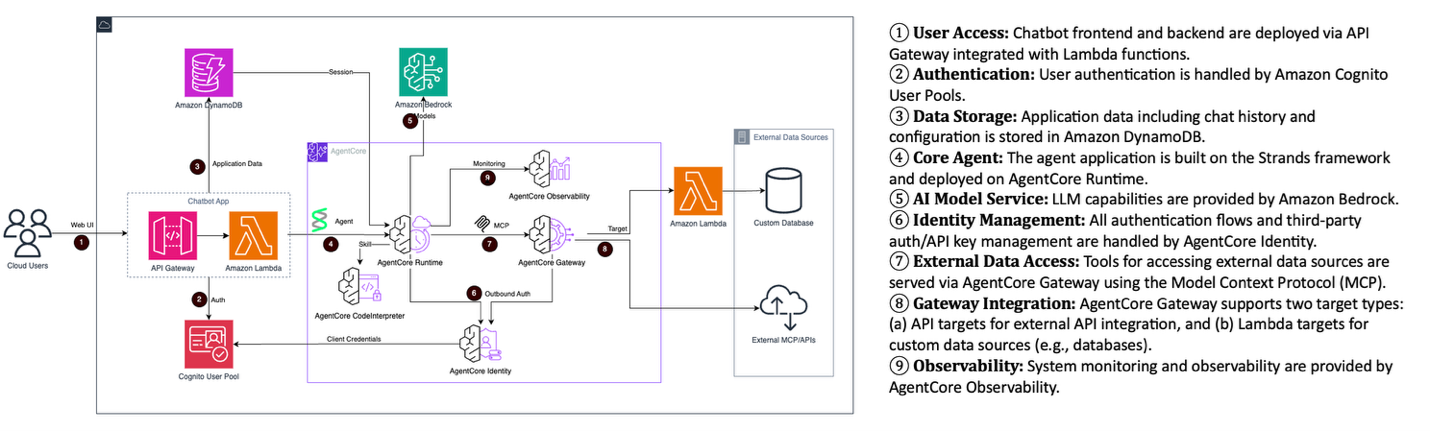
Figure 1: Multi-agent architecture diagram showing AWS-based chatbot system with API Gateway, Lambda, DynamoDB, Bedrock, and AgentCore components
A Supervisor Agent interprets user intent and orchestrates the workflow. For simple queries, it routes directly to a summary. For complex analytical questions, it coordinates a pipeline of specialized Worker Agents:
- Query Agent converts natural language to SQL and executes baseline queries and period-over-period comparisons
- Detail Agent performs multi-dimensional drill-down by category, time, region, and other dimensions when anomalies are detected
- Research Agent investigates root causes from multiple angles
- Summary Agent organizes findings into structured business reports
- Action Agent generates execution-ready materials—notifications, approval summaries, work orders
We found that splitting responsibilities this way was essential for accuracy. When all capabilities were packed into a single agent’s prompt, SQL generation accuracy degraded as the prompt grew. After decomposition, accuracy improved significantly, in part because of a self-correction mechanism where the agent analyzes SQL errors and retries.
Two design choices proved especially important:
A semantic layer for business terminology. The most common source of agent errors was not SQL syntax but misunderstanding business terms. “Slow-moving inventory” means different things at different companies. We injected a mapping from business terms to SQL expressions directly into the Query Agent’s prompt—for example, defining “fulfillment rate” as COUNT(status='delivered') / COUNT(*)—and required all queries to include a date filter. This semantic layer is the structured codification of enterprise business knowledge, and its quality sets the ceiling for the system’s accuracy.
Model Context Protocol (MCP) for data source decoupling. Agents access data through MCP rather than connecting to databases directly. This abstraction proved its value when the underlying query engine was migrated from one platform to another—the agent code required zero changes; only the MCP Server implementation was replaced. In supply chain, where data sources change constantly as channel partner relationships evolve, this decoupling is not optional.
Putting it to work: Channel fulfillment analysis
To illustrate how these components work together, consider a scenario based on the retailer’s actual operations (with anonymized data). During a monthly review, an operations manager asks: “How did our channel partners perform on fulfillment last month? Are there any that need attention?”
The Supervisor Agent routes this to the Query Agent, which maps “fulfillment performance” to the semantic layer’s definitions, queries data by channel, and compares with the prior month. Channel B’s fulfillment rate is flagged as anomalous—down 6.8% month-over-month. The Detail Agent drills down and identifies the footwear category as the source, with the anomaly concentrated in weeks two and three. The Research Agent investigates and finds that Channel B’s unpaid order ratio rose from 8% to 22%, triggering credit controls that froze approximately 340 orders. The Summary Agent produces a structured report with root cause attribution and recommendations. The Action Agent sends notifications to the channel account manager and credit control team and generates an order release request summary ready for the approval workflow.
The entire analysis takes about 30 seconds. What previously required half a day of spreadsheet work and email coordination becomes a single conversation, from question to insight to action.
Conclusion
The bottleneck in supply chain decision-making is no longer data visibility—it is the manual work between data and action. Control towers got us to data-informed. Agentic AI gets us to data-driven: data automatically queried, analyzed, and translated into decisions and actions.
The starting point does not have to be large. One scenario, one question, one conversation is enough to reduce the distance from data-informed to data-driven.
Ready to transform your supply chain operations with agentic AI? Start making the leap—explore Amazon Bedrock AgentCore to build multi-agent systems and the open-source Strands Agents SDK to get your first supply chain agent up and runn