Migration & Modernization
Classifying Your AI migration to Plan for Success
An AI migration means different things to different teams, and that ambiguity is expensive. Are you migrating with AI, to AI, or from AI? The answer shapes your staffing plan, governance model, and timeline, because each motion carries a different risk profile and demands a different set of skills.
Gartner found that by the end of 2025, at least 50% of generative AI projects were abandoned after proof of concept. Separately, S&P Global’s 2025 survey found that 42% of companies abandoned most of their AI initiatives, up from 17% the year prior. RAND Corporation research identifies misunderstandings about the intent and purpose of AI projects as the most common reason for failure. A simple lens: with, to, and from, separates these motions before the confusion compounds.
In this post, we walk through each motion, what it means for staffing and risk, and what happens when organizations get the classification right or wrong.
The Mental Model
Migrating with AI means that AI serves as tooling that accelerates the migration process itself. This includes discovery, wave planning (the sequencing of workloads into migration groups), dependency mapping (identifying how systems interconnect), and stakeholder alignment. The destination doesn’t change; the speed and fidelity of getting there does.
Migrating to AI means that AI is the destination. You’re adopting AI capabilities, deploying models, or building intelligent applications as the outcome of the migration. The AWS Move to AI Modernization Pathway provides a structured approach for this motion.
Migrating from AI means you’re moving away from an existing AI platform, whether that involves swapping model providers or consolidating fragmented machine learning (ML) infrastructure.
In practice, most migrations involve two or even three of these motions simultaneously. This is precisely why naming each one matters. Teams that treat a blended migration as a single workstream end up under-resourcing at least one motion.
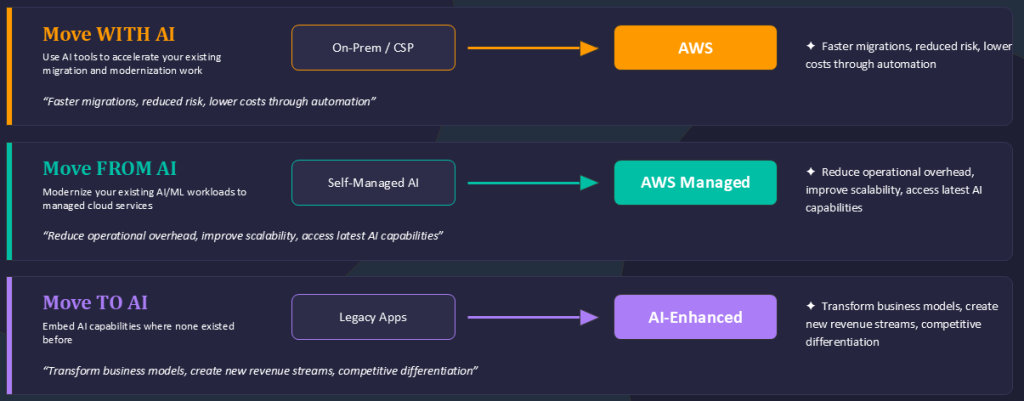
Migrating with AI: compressing timelines and raising the quality bar
Traditional cloud migrations are planning-intensive. Discovery, assessment, and wave planning tend to consume the bulk of effort before a single workload moves. AI changes these phases by improving the speed and fidelity of the journey. With AWS Transform, for example, you can complete dependency mapping, intelligent wave planning, and network conversion in minutes. These tasks once took weeks. AWS Transform uses agentic AI (AI systems that autonomously plan and execute multi-step tasks) to orchestrate VMware migration and many modernization processes.
The resourcing implication is clear: you staff for migration expertise augmented by AI, not AI expertise applied to migration.
Migrating to AI: where the risks diverge
When AI is the destination, a different category of risk emerges. It is rooted in the fact that AI systems behave probabilistically. The same input can produce different outputs, behavior shifts as data distributions change, and the quality of every decision depends on the data the system was trained on. Data quality and model selection become mission-critical.
In a traditional lift-and-shift (rehost) migration, data moves largely as-is and the application’s behavior doesn’t change based on data quality. When AI is the destination, incomplete or biased data doesn’t merely degrade performance. It produces outputs that look confident but are wrong. Gartner predicts that through 2026, organizations will abandon 60% of AI projects unsupported by AI-ready data.
Governance expands from access control to behavioral control
AI systems introduce risks such as hallucination (generating plausible but incorrect outputs), prompt injection (manipulating AI through crafted inputs), and unintended data disclosure. Legacy governance models were not designed to handle these. Your governance model must account for non-determinism, because the same prompt can produce different results and the system’s behavior evolves as it encounters new data.
Testing shifts from validation to evaluation
Traditional migrations test pass/fail equivalence. AI engagements require measuring accuracy, fairness, and robustness across diverse inputs. You need to build that evaluation into the operational lifecycle, because model performance can degrade over time as data distributions shift. With Amazon Bedrock Evaluations, you can embed automated, human-based, and large language model (LLM)-based evaluation workflows directly into your development and deployment pipeline.
Talent plans expand
Confusing the “with” and “to” motions is where resourcing plans tend to break. Teams end up hiring or staffing for the wrong motion entirely.
Migrating from AI: portability, model choice, and the refactor pattern
Organizations do switch AI platforms, and a key driver is a platform that treats model choice as a first-class design principle. With Amazon Bedrock, you can access foundation models from leading AI companies through a single unified API. Providers include Anthropic, Cohere, Meta, Mistral AI, and Amazon’s own Nova and Titan families. This single-API architecture means you can evaluate, compare, and switch between models without rewriting application code. That portability constraint is what makes most “from” migrations challenging in the first place. You can leverage AWS Transform to rapidly assess a model-to-model migration.
For teams moving existing AI applications onto AWS, Amazon Bedrock AgentCore Gateway lets you add agentic AI capability to your application. This often requires no modification to your legacy source code. If you’re building AI today, designing around model choice and a unified API helps make sure that a future “from” motion is a refactor, not a rewrite.
These three motions show up in real migration outcomes.
The lens in practice
The “to” motion staffed as “with”
As Yahoo Finance reported, a global insurance company approved a two-year AI pilot for claims processing but resourced it as a tooling initiative rather than an AI adoption. The pattern is endemic to the industry, only 7% of insurance carriers have scaled AI beyond pilot, with 70% of scaling challenges traced to people and process. Applying the lens on day one could have changed the staffing plan, the governance model, and the timeline.
The “with” motion recognized
Thomson Reuters faced large-scale .NET modernization and recognized the “with” motion, applying the AI agents in AWS Transform to automate discovery, code base analysis, planning, and refactoring. The destination remained a modernized .NET architecture, and AI served as the accelerant. Teams that ask the question early surface this kind of opportunity before it passes.
The “to” and “with” motions conflated
Across financial services, Deloitte’s 2026 Banking Outlook describes AI implementation “throttled by brittle data foundations, mounting compliance demands, and internal resistance,” with initiatives “stuck in isolated proofs of concept.” A study of 125 bank compliance leaders found that more than half of the technical challenges were linked to model governance. The “with” motion moves at migration speed while the “to” motion moves at governance speed. Conflating them means both move at the speed of the slowest constraint.
Conclusion
The with/to/from lens gives you a repeatable way to classify what you’re actually doing, so you plan for the migration you have rather than the one you assumed. Getting the classification right from day one means your staffing plan matches the skills required, your governance model addresses the actual risks, and your timeline reflects reality rather than optimism. Start by asking your team: Is AI our tool, our destination, or what we’re moving away from? To explore AI migration strategies:
- For “with” migrations: Learn about AWS Transform. It offers AI-driven discovery, wave planning, and refactoring that compresses migration timelines dramatically.
- For “to” migrations: See the AWS Move to AI Modernization Pathway for a structured approach to adopting AI as a destination, including governance and evaluation guidance. Investigate AWS Transform to accelerate your model migrations.
- For “from” migrations: Explore Amazon Bedrock model choice for unified API access across providers, and AgentCore Gateway for modernizing legacy AI applications without rewriting source code.
Or connect with your AWS account team to discuss your specific migration scenario.
Visit AWS Migration and Modernization for the full suite of resources.