Migration & Modernization
Maximizing Cloud Value Through AI-Powered Acceleration: From Intelligence to Action
Introduction
Organizations maximizing cloud value through AI-powered acceleration have a competitive advantage, a stark contrast to the 56% of CEOs reporting zero return on their AI investments according to PwC. Despite billions invested across the industry, more than half of business leaders see neither increased revenue nor decreased costs from AI initiatives. Yet 12% who are succeeding have discovered that AI’s true power lies in the convergence of cloud infrastructure with autonomous, intelligent systems that actively drive business outcomes. These leaders are achieving measurable gains across five critical dimensions: business agility, cost optimization, staff productivity, operational resilience, and sustainability.
The numbers tell an interesting story. Gartner predicts that 40% of enterprise applications will incorporate AI agents by end of 2026, up from less than 5% in 2025, and that by 2028, at least 15% of day-to-day work decisions will be made autonomously through agentic AI. AI budgets have nearly doubled year-over-year, with 30% dedicated to agentic AI. Global AI spending will reach $2.52 trillion in 2026, representing 44% year-over-year growth. Salesforce C-suite research shows full AI implementation jumped 282% in one year, from 11% to 42% of organizations, and companies have already automated 31% of workflows using agentic AI, with plans to expand to another 33% this year.
In this blog post, we will explore how AI agents work. We will show you how to join the 12% of customers who are succeeding in discovering the AI-powered cloud value, and the steps they are taking to achieve it. Customers with modernized infrastructure already in the cloud have positioned themselves to capture this advantage, and understanding how AI agents work is the first step.
Understanding AI Agents: Intelligence Meets Orchestration
To understand how this works, consider planning a complex international trip. A traditional search engine answers specific questions like flight prices, hotel availability, and weather forecasts. An AI agent acts as your travel companion, understanding your preferences and autonomously handling research, bookings, transportation, and real-time plan adjustments.
The key difference:
- LLM alone = Intelligence without hands
- Agentic AI = Intelligence + hands (actions) + brain (orchestrator) that knows how to use those hands effectively
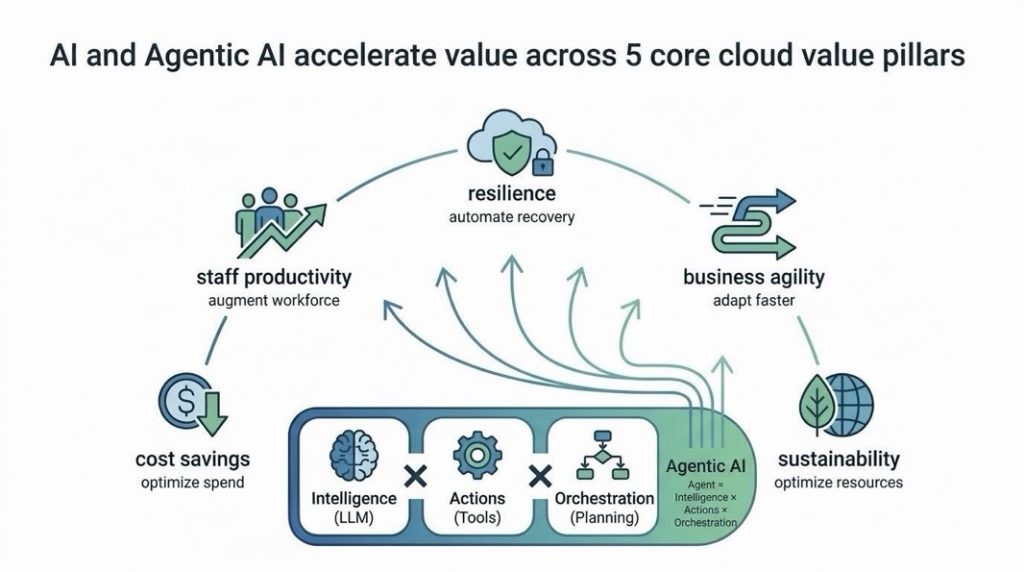
Figure 1 : AI and Agentic AI Accelerating Cloud Value Across Five Pillars of the Cloud Value Assessment Framework
The language model provides reasoning capability to understand context and generate solutions. The orchestration layer allows the agent to plan multi-step workflows, invoke tools and APIs, and adapt based on outcomes. Enterprise-grade guardrails verify agents operate within defined boundaries, including data access controls, action authorization limits, and compliance requirements, while approval workflows enable human oversight for high-impact decisions. Together, they create systems that act autonomously within governed parameters, transforming them from reactive assistants to proactive digital teammates.
Services like Amazon Bedrock provide a foundational platform for building intelligent agents by combining access to leading foundation models with orchestration capabilities powered by Amazon Bedrock AgentCore. AgentCore enables agents to act across tools and data securely at scale, maintaining context without infrastructure management, so teams can focus on business logic. Legacy architectures and siloed systems create technical debt, which prevents agents from accessing the real-time data and APIs they need to act. Migrating to the cloud and modernizing legacy systems eliminate these barriers, giving agents a clean, connected environment where intelligence translates into action. Therefore, cloud modernization is not just an infrastructure decision; it is the foundation that makes agentic AI possible at enterprise scale.
Five Pillars of Cloud Value
As organizations adopt this approach across five critical dimensions, they discover AI doesn’t just make the cloud better; it makes it an important force for business across the five pillars of the cloud value framework.
1. Business Agility: Accelerating Market Response and Innovation
Research from McKinsey & Company shows that organizations implementing Agentic Process Automation can increase business agility by 20%. The ability to sense changes, decide and adapt in real time separates market leaders from followers. This is where the agent formula Intelligence × Actions × Orchestration transforms from concept to competitive advantage. Organizations that have modernized onto cloud-focused architectures can deploy these agents immediately, without the latency of legacy infrastructure. For organizations still running on legacy systems, this agility gap widens with every quarter. Modernizing to cloud-focused infrastructure is not a prerequisite for starting the AI journey; however, it is the accelerant that determines how fast and how far that journey goes.
Consider a retail organization facing unexpected demand spikes during a product launch. The intelligence layer analyzes traffic patterns and predicts capacity requirements. The actions layer automatically scales infrastructure, optimizes inventory allocation, and adjusts marketing spend. The orchestration layer is the glue to sequence these activities and manages dependencies. What traditionally required 3–5 days of cross-functional coordination now completes in under 2 hours, preventing stockouts and abandoned carts that would have resulted in significant revenue loss.
2. Cost Savings: Intelligent Cost Optimization
Companies integrating a FinOps model with AI are 53% more likely to report cost savings exceeding 20%, and organizations with completed cloud migrations can amplify this advantage as they move from reactive analysis to predictive optimization.
AI agents, such as AWS FinOps Agent, continuously watch for cost issues, automatically catching problems like mis-configured auto scaling or unused resources that humans often miss, and, if configured, can fix them in real time by right-sizing instances and optimizing storage based on actual usage. Through multiple AWS partners offering marketplace solutions, deployment is accessible for customers at any stage of their cloud journey. Amazon Bedrock shows this approach with Model Distillation, allowing distilled models to run up to 5x faster and cost up to 75% less with minimal accuracy impact, and Intelligent Prompt Routing, which can reduce costs by up to 30% without compromising quality.
3. Staff Productivity: Amplifying Team Capabilities
AI significantly boosts team productivity by acting as a driver across the entire AI-Driven Development Lifecycle (AI-DLC), a transformative methodology that positions AI as a central collaborator throughout software development’s three phases: Inception, Construction, and Operations. This lifecycle runs more effectively on modernized, cloud-native platforms where CI/CD pipelines, containerized workloads, and unified developer tooling give AI agents the hooks they need to contribute across every phase. For developers and architects, AI-driven tools assist not only in coding during construction but also in solution specification and design exploration during inception, approach validation, and quality assurance (QA). By generating intelligent recommendations, suggesting design trade-offs, and automating repeatable tasks, AI frees technical teams to focus on higher-value work requiring human creativity and judgment.
At NVISIONx, teams found Kiro autonomous agent’s ability to maintain deep contextual awareness across AI-DLC sessions and asynchronously orchestrate project workloads to be “a game-changer for accelerating” across product teams. For security, AWS Security Agent proactively secures applications throughout the development lifecycle. HENNGE K.K. reported that Security Agent “allows us to rapidly accelerate our security lifecycle, reducing the typical testing duration by more than 90%.” Beyond technical teams, AI amplification extends to every business role. Whether a call center agent receiving real-time guidance, a business analyst researching or getting automated insight generation using Amazon Quick, or a finance professional receiving intelligent forecasting. Productivity gains compound over time as AI agents learn organizational patterns and best practices, becoming increasingly effective collaborators. AWS Transform further amplifies team productivity by automating the most time-intensive modernization tasks, such as code analysis, refactoring, dependency mapping, and transformation planning. By deploying specialized AI agents to handle these high-effort, repeatable tasks, engineering teams can modernize hundreds of applications in parallel, reducing what once took years to months.
4. Operational Resilience and Security: Preventing Disruptions Before They Happen
AI transforms operational resilience from a reactive discipline into a proactive, continuously improving capability. Predictive failure detection allows AI agents to analyze system metrics, logs, and patterns continuously to identify degrading performance or abnormal behavior before it becomes an outage. When incidents occur, AI agents can automatically correlate events across distributed systems to identify root causes faster, recommend or execute remediation playbooks, and orchestrate recovery across multiple services simultaneously.
At Western Governors University, the AWS DevOps Agent shows this approach, where 200,000 students rely on 24/7 online learning. The agent integrates with observability tools to investigate the entire technology stack and pinpoint root causes autonomously when performance issues occur. Toyota Motor North America illustrates AI’s predictive power, where in partnership with AWS, Toyota co-developed a predictive maintenance solution that analyzes sensor data to predict machine failures days in advance. In the first four months, the solution prevented 16 incidents and more than 20 hours of downtime, saving approximately $80,000 in costs.
5. Sustainability: Reducing Environmental Impact Through AI-Powered Optimization
Agentic AI systems use intelligent orchestration to minimize computational waste. These optimizations are only possible on a fully modernized cloud estate, where workloads are instrumented, observable, and responsive to automated control. Amazon Bedrock AgentCore suspends CPU cycles during LLM wait times. Agent Core Gateway uses semantic search to reduce context windows by 90%, lowering both costs and carbon footprint. Model optimization techniques deliver further environmental benefits. Prompt caching reduces costs by up to 90% and cuts delays by 85%, while model distillation achieves a 75% cost reduction while maintaining 98% accuracy. Intelligent prompt routing saves 30% by matching simple tasks to smaller models and complex tasks to larger ones.
Conclusion
The convergence of cloud infrastructure and AI represents more than a technological evolution. It represents a fundamental shift in how organizations create value. The journey begins with migration and modernization: moving workloads to the cloud unlocks the data, scalability, and instrumentation that agentic AI requires to deliver results. The five pillars are interconnected; each build on the others, creating a compounding effect that separates leaders from followers. Customers who embrace this transformation today will lead the competitive landscape of tomorrow. The future of cloud value is not just intelligent; it is autonomous, adaptive, and accelerating. To get started, reach out to your AWS Account Manager to start an AI readiness assessment.