Migration & Modernization
Reimagining Mainframe Applications with Accenture and AWS Transform
This post is co-written with Reshma Nuggehally, Jai Bagmar and Kanai Lal Dutta from Accenture
Background:
Organizations running mainframes face a critical challenge: 90% are pursuing cloud modernization, yet organizations have transitioned fewer than 20% of workloads. Rising operating costs, retiring talent, and rigid architectures demand a fundamentally different approach. In this post, we explore how Accenture and AWS combine agentic AI, deep industry knowledge, and AWS Transform to reimagine mainframe estates, moving beyond incremental modernization to enterprise reinvention. You’ll learn about the key transformation patterns available and how to select the right path for your organization.
A disciplined Reimagine strategy begins with deep understanding of the application estate. This involves reverse engineering the mainframe code base, enriching extracted business rules with industry context, and applying flexible forward engineering paths to reshape monolithic systems into modern platforms.
Solution Overview:
This blog post describes a reimagine approach to mainframe modernization that combines AWS Transform’s automated code analysis and business rule extraction with Accenture’s composable AI agents, multi-platform coverage, and industry knowledge. The approach uses three stages:
1. Reverse engineering: Automated discovery and business rule extraction from mainframe code using AWS Transform and Accenture agents deployed to Amazon Bedrock AgentCore.
2. Enrichment: Industry-specific context (Financial Services, Telecommunications) applied to extracted specifications.
3. Forward engineering: Two pathways to modern applications: cloud-native code generation via Kiro, or low-code workflow generation via Pega Blueprint.
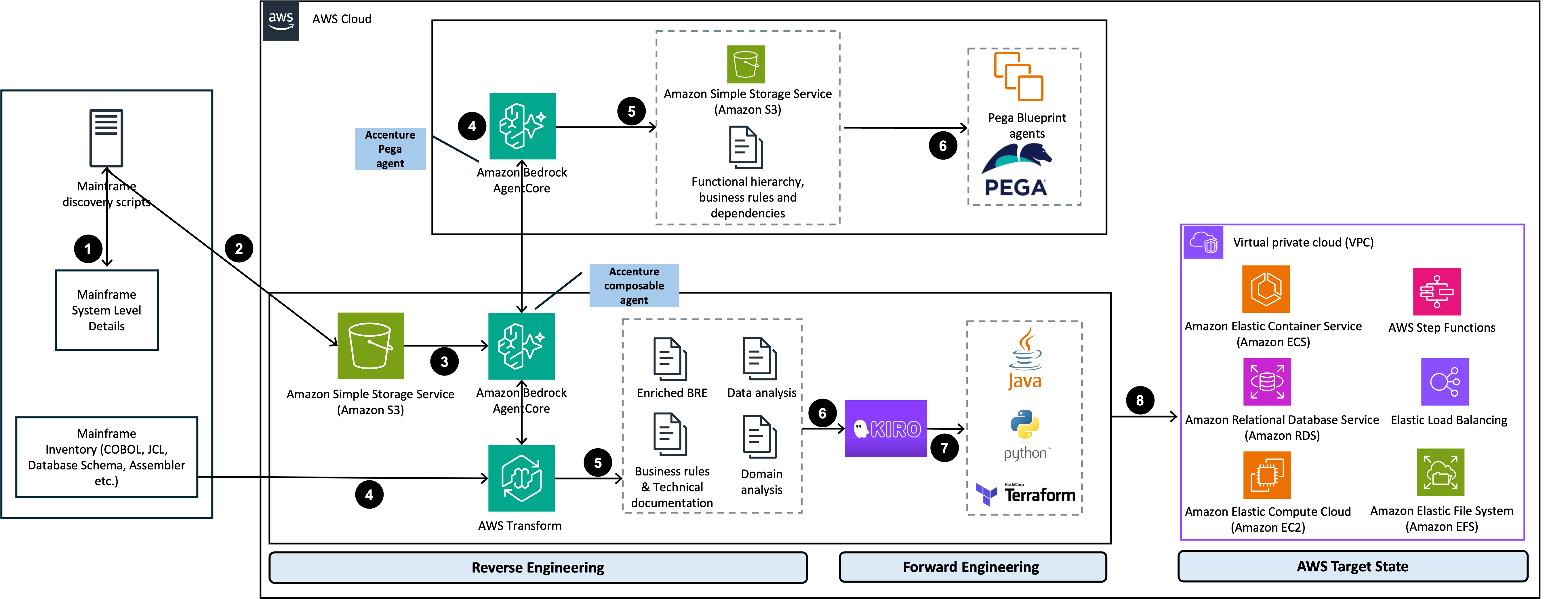
Figure 1 – Architecture diagram showing how Accenture extends AWS Transform with automated mainframe discovery, multi-platform coverage, and AI-driven reverse engineering agents connected to Amazon Bedrock AgentCore.
From moving source code to reimagining business functions
Mainframe modernization has moved beyond lift‑and‑shift ambition. The real challenge is reinvention: extracting business intent locked inside mainframe systems, modernizing data and workflows, and rebuilding core capabilities so the business can evolve, govern, and scale with confidence.
Why Reimagine and Why Now?
According to Accenture’s 2025 Mainframe Modernization Survey of 1,000 C-suite executives, 58% of organizations carry annual mainframe operating costs between $21 million and $100 million. And while 90% are pursuing mainframe-to-cloud modernization, only 19.5% of workloads have transitioned. That execution gap reflects more than pace alone – it points to a deeper problem with how modernization has been approached.
Incremental moves, replatforming and refactoring dominated mainframe modernization agendas for years. Those approaches can improve near-term economics. However, they often preserve the very constraints that limit enterprise change. These include rigid runtimes, fragile batch dependencies, tightly coupled data structures, and release models built for a different era. The question is no longer how to move existing workloads. It is how to redesign the business capabilities around them so the enterprise can operate at cloud speed and innovate faster.
Reimagine shifts the focus from “moving what exists” to rebuilding for what the business needs next. Cloud-native architectures unlock cleaner data access, faster release cycles, and modern engineering practices, including CI/CD, microservices, and infrastructure as code. The industry increasingly considers it one of the most sustainable end states as it creates true architectural freedom.
This transition is gaining momentum as the modernization landscape reaches a tipping point: reimagining mainframe applications is now both technically achievable and economically viable. Historically, organizations deferred this path due to high upfront costs and multi-year timelines. That equation has changed.
Specialized agentic AI tooling now automates traditionally effort-intensive tasks, including AWS Transform, Kiro (an agentic IDE for spec-driven development), and Accenture composable agents. These tools handle business logic extraction, data integration, testing, and cloud-native redesign. The result: organizations can typically reduce modernization timelines by 30–40%, with improved quality consistency driven by automation rather than manual effort alone.
Extending AWS Transform for enterprise-scale modernization: AI agents, industry intelligence, and multi-platform coverage
AWS Transform provides a strong foundation for mainframe modernization. However, enterprise-scale environments often require broader coverage across heterogeneous technology stack. They also need deeper domain insights tailored to specific business functions. Industry expertise helps ensure the target architecture reflects how the organization operates.
Accenture enhances and extends AWS Transform for mainframe capabilities through:
- Automated Mainframe Discovery extracts operational data, workload metrics, and subsystem insights directly from the mainframe using standardized, repeatable templates. It uses a wide range of System Management Facility (SMF) records to capture key operational insights, including:
- Batch job execution history
- Customer Information Control System (CICS) transaction activity
- IBM MQ (messaging queue) messaging events
- System performance and resource utilization
In addition, the solution analyzes core subsystems such as CICS for transaction mapping, Information Management System Database Manager (IMS DB) logs, schedulers, and file transfer activity. It also traces dynamic program call paths using CICS AUX trace data to build a comprehensive view of application behavior and dependencies. The discovery script runs in client environment and extracts mainframe system-level details.
The solution normalizes and consolidates all extracted data into a centralized knowledge base, serving as a single source of truth that AI-driven agents on Amazon Bedrock AgentCore consume. This enables accurate dependency mapping, informed modernization planning, and improved confidence in transformation decisions.
-
- Multi-platform coverage: Supporting both IBM zOS and Fujitsu GS21 platforms, Accenture extends modernization reach beyond AWS Transform native capabilities. For Fujitsu GS21 environments which extend beyond AWS Transform’s native platform coverage, Accenture provides automated transformation capabilities through MAJALIS, a solution validated across production engagements. MAJALIS also supports diverse legacy ecosystems including PL/I and Easytrieve. It uses AI to analyze complex program assets and accurately extract and transform application logic and data structures. This enables organizations to modernize across heterogeneous mainframe environments while maintaining consistency and quality.
- Automated Migration Technology (AMT) automates the transformation of mainframe systems into agile, cloud-ready applications using advanced automation tools and AI-driven refactoring. By converting legacy code to modern platforms like Java or C#, AMT accelerates modernization timelines, reduces operational risks, and enhances scalability.
- AI-driven reverse engineering workbench: Accenture’s purpose-built agents automate discovery. This workbench comprises purpose-built AI agents that automate the discovery, extraction, and analysis of mainframe application inventory. These agents span multiple categories: database schema extraction, program and code analysis, integration and middleware mapping, batch job processing, business rules extraction, testing, CICS infrastructure, and target code generation. They provide end-to-end coverage of the modernization lifecycle. Accenture designed each agent to operate autonomously on specific mainframe artifacts (such as COBOL, JCL, Copybooks, SMF records, BMS maps, DB2/IMS/IDMS schemas). The agents populate a centralized knowledge graph that serves as the single source of truth for downstream decision-making.
- Composable agentic extensions to AWS Transform: Accenture’s agents cover the following areas:
- Analyze code and extract business rules from non-supported languages like Assembler, Easytrieve, and REXX etc.
- SMF record analysis to enable transaction profiling, performance tuning, and sizing for cloud.
- Analyze mainframe batch workflow (CA7 – enterprise batch job scheduler from Broadcom) during discovery to understand long running jobs, job dependencies etc.
- Augment static code analysis through CICS AUX tracing reports.
- Parse CICS System Definition (CSD) to extract programs definition, transaction, files, transient data queue enabling service reengineering and API gateway modernization.
- Industry Knowledge Base Integration:
Accenture augments AWS Transform Business Logic Extraction (BLE) output by infusing domain-specific intelligence from its extensive industry knowledge base through specialized industry cartridges for Financial Services and Telecommunications. These cartridges embed predefined business rules, compliance validations (including Anti Money Laundering and regulatory checks), and domain-specific logic templates directly into the transformation workflow.
This integrated approach enhances accuracy and contextual relevance, reduces compliance risk, and accelerates regulatory alignment.
From enriched specifications to forward engineering – two transformation pathways
Building on the data-driven foundation, Accenture provides two reference patterns. Enriched specifications and technical design artifacts provide the basis for multiple forward-engineering pathways on AWS. These pathways enable modernization strategies aligned to specific business contexts, rather than relying on a single prescriptive approach. This section outlines the key transformation patterns that enable forward engineering.
Generative AI driven transformation does not focus on modernizing existing code structures. Instead, it rebuilds applications using cloud-native architecture aligned to evolving business requirements. More fundamentally, it reframes modernization from a legacy remediation effort to a strategic reinvention of the application estate – aligning technology decisions with the capabilities, operating models, and growth priorities the business needs next. It enables organizations to eliminate technical debt, adopt modern engineering practices, and create platforms designed for future growth and innovation.
There are two reference patterns that have emerged around reimagining mainframe workloads:
a) Cloud-native code generation (Composable Agents + Kiro)
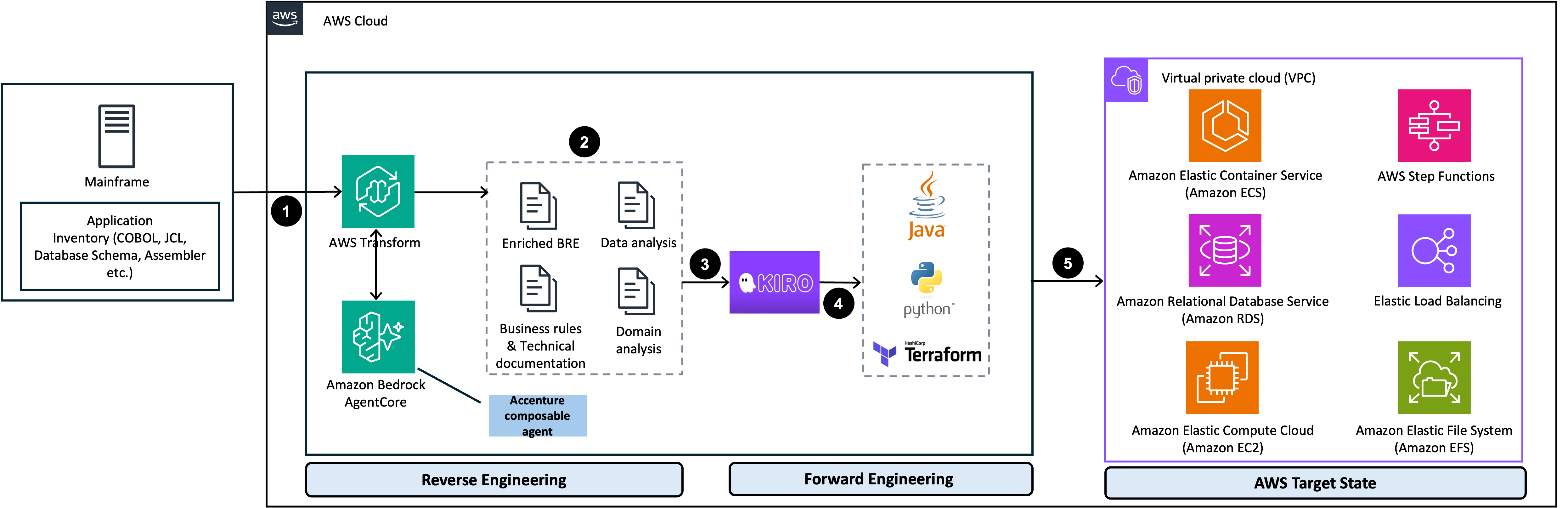
Figure 2 – Workflow diagram showing the end-to-end process from mainframe discovery through AWS Transform, to enriched business rule extraction, Kiro-based forward engineering generating cloud-native code, and infrastructure deployment via Terraform.
AWS Transform for mainframe + Kiro + Accenture composable agents
-
-
- AWS Transform for mainframe combined with Accenture composable AI agents analyze mainframe applications, perform code analysis, and generate Business Rules Extraction (BRE), which serves as a key input for forward engineering.
- Accenture AI agents aid in generating business-enriched BRE using its domain-specific industry cartridge along with technical documentation and data analysis reports.
- Kiro uses enriched BRE, technical documentation, and data analysis as context and uses its spec-driven development methodology to generate target applications in modern programming languages (Python, Java, React, Angular, JavaScript, TypeScript, and others) as part of forward engineering.
- Kiro also generates infrastructure as code (such as Terraform) that provisions infrastructure and deploys the application to AWS.
-
b) Low-code workflow generation (Pega Blueprint)
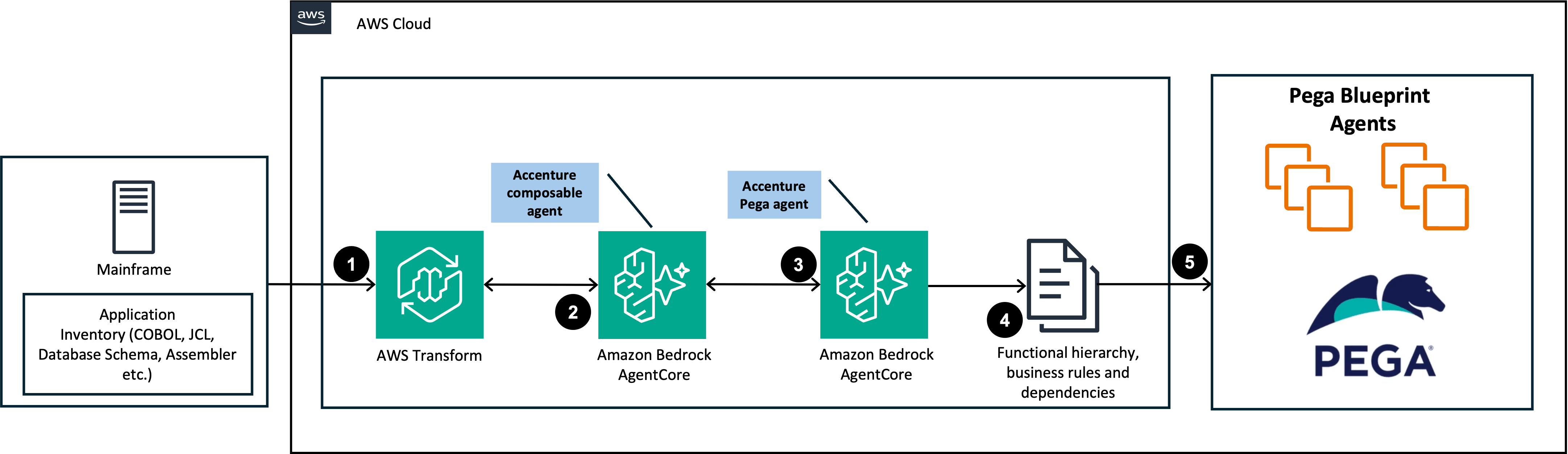
Figure 3 – Workflow diagram showing how AWS Transform and Accenture composable agents generate enriched BRE that feeds into Pega Modernization AI agent to create workflow-driven applications on the Pega low-code platform.
AWS Transform for mainframe + Pega Blueprint with Accenture Pega Modernization agent
Pega, a leading low-code platform, enables business process management, workflow automation, and enhanced customer engagement.
Key highlights:
-
-
- AWS Transform for mainframe combined with Accenture composable AI agents analyzes mainframe applications, performs domain analysis, and generates enriched BRE.
- Pega Modernization AI agent reads enriched BRE.
- It generates comprehensive BRE having functional hierarchy with dependency levels and business rules.
- Pega Blueprint uses this comprehensive BRE and generates workflow for the modernized application in Pega.
-
Organizations can also implement these patterns across other low-code platforms such as Appian and OutSystems.
Which pattern to choose and when?
Selecting the appropriate reimagine pattern depends on factors such as application complexity, time to market, target architecture, skills availability, and business priorities. The following table compares the composable agents + Kiro approach with the Pega Blueprint (Low-Code) approach across key dimensions to choose the optimal path forward.
| Dimension | Composable Agents + Kiro | Pega Blueprint (Low-Code) |
|---|---|---|
| Primary Use Case | Deep application reengineering | Rapid business workflow transformation |
| Complexity | High (complex, tightly coupled applications) | Medium (process-driven, modular workflows) |
| Time to Market | Moderate (engineering-intensive) | Fast (accelerated through low code) |
| Skill Requirements | Strong engineering expertise (cloud-native, microservices) | Functional + low-code development skills |
| Target Architecture | Custom cloud-native applications (Java/Python, microservices) | Workflow-driven applications on low-code platform |
| Flexibility | High (platform-independent, customizable) | Moderate (platform-optimized, faster delivery) |
These two reimagine pathways enable enterprises to balance speed, flexibility, and business alignment. Selecting the optimal strategy based on application complexity and target operating model. Accenture’s composable agent framework supports both paths.
A large financial services institution illustrates why this matters. Faced with limited documentation and scarce subject matter expert (SME) availability, the bank used generative AI to reverse engineering approximately 1.4 million lines of COBOL code across APIs and reporting systems. The program generated functional documentation, dependency maps, and test cases. In this engagement, the program reduced documentation effort by approximately 50% and achieved approximately 90% completeness in accuracy. Equally important, it reduced reliance on SMEs, improved forward-engineering productivity, and accelerated decision-making without compromising system understanding or quality.
Conclusion
Mainframe modernization has entered a new phase, one that prioritizes enterprise reinvention over incremental modernization. By extending AWS Transform with composable AI agents, automated discovery, and industry knowledge, as demonstrated in Accenture’s implementation, enterprises can extract business intent, enrich specifications with domain context, and accelerate forward engineering into cloud-native or low-code architectures.
Whether your goal is deep application reengineering or rapid workflow transformation, this approach offers a data-driven, scalable path that reduces timelines, improves consistency, and lowers transformation risk.
To get started:
-
- Getting started with AWS Transform: Launch a workspace and create your first modernization job.
- AWS Transform for mainframe documentation: Detailed capabilities and configuration.
- Accenture on AWS Marketplace: Learn more about Accenture’s modernization offerings.