Migration & Modernization
Your network is the migration bottleneck. It doesn’t have to be.
Every domain in a large-scale migration has tools. The network still has people: a handful of them, overbooked, carrying decades of accumulated decisions in their heads. That has just changed.
It starts with the network
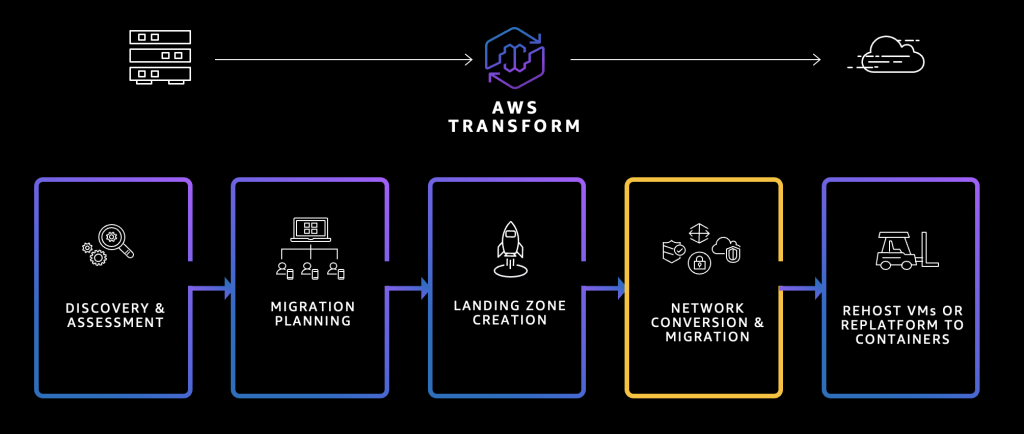
When approaching a large-scale migration to the cloud, nothing moves until the network is ready. Not the database. Not the application. Not a single server. The network is a day 1 need, the prerequisite for everything else. You can’t use a single server, test a single application, or validate a single workload until the network is in place, routable, and signed off by security. And it’s not just the first part of the journey, it’s the easiest place to make a mistake, and just one is enough to turn success into failure.
However, there’s a challenge that is often overlooked. Every domain in a large-scale migration has tools. Databases have migration services, servers have replication tools, applications have rehost and containerization paths. The network still has people: a handful of them, overbooked, carrying decades of accumulated decisions in their heads. This is the bottleneck you may not have planned for. The network requires weeks of manual analysis, tribal knowledge, and re-architecture by the scarcest engineers on the team. Every other domain got tools because its problem was execution. The network’s problem is comprehension. That is why it stayed manual long after everything else got automated: you cannot script your way through a system no single person fully understands. This is a comprehension gap, not a tooling gap. Closing it is what changes the timeline. And that has just changed.
Why network migration takes so long
Your migration program, with dozens of engineers and parallel workstreams, is gated by a single-threaded dependency. The network. You can’t split it across teams. You can’t throw more people at it. Every subnet, route, and firewall rule exists in relationship to everything else, so the work flows through a small number of experts who hold the full picture in their heads.
Understanding your network’s intent is what takes time. Enterprise networks carry decades of accumulated decisions: overlapping CIDR ranges, security rules that reference decommissioned systems, routing tables no single person fully understands. Making sense of this requires network architects fluent in both on-premises and cloud-native constructs. That combination is rare. The few who have it are already overbooked. The constructs don’t map cleanly. A Cisco ACL isn’t a Security Group. A VLAN isn’t a subnet. You can lift your topology as-is to get running fast, but cloud-native networking introduces constructs with no on-premises equivalent (Transit Gateways, centralized egress, segmented VPCs). Mapping without understanding intent means paying cloud prices for a data center design – same sprawl, higher price, none of the benefits. You want to bring your design decisions to the cloud. You don’t want to bring your implementation constraints with them. The cloud is a different paradigm, not a mirror of your data center. Just because you can replicate on-premises as-is doesn’t mean you should. The payoff for redesigning isn’t only cost. It’s operational efficiency and the room to scale as you grow, and AWS Transform gets you there.
Organizational friction. The network team is a separate organization from the migration team. So is the security team. Both have different reporting lines, different priorities, and different change-management processes. The migration project is ready to move, but it’s waiting in queue behind day-to-day network operations, competing initiatives, and approval gates designed for a world where network changes happen weekly, not daily or hourly. The network team needs to validate connectivity. The security team needs to validate that nothing opens exposure. Both queues run in sequence, not in parallel.
Single-threaded work, manual mapping, scarce expertise, organizational queues. Every week the network slips, the entire migration program slips with it. There is no “move on and come back to it later.” The network is a critical path.
The Network Migration Agent
You stay in control. The AWS Transform Network Migration Agent does the work that used to consume your scarcest engineers, and hands the decisions back to you.
What used to be a months-long program dependency becomes a design review session. The agent reads your network environment, reconstructs the intent behind your existing configuration, and surfaces what it finds: how traffic flows, where your security boundaries are, and what the current state of your rule set looks like. But configuration doesn’t capture everything. Your team provides business context in a conversational approach: which workloads are being consolidated, which environments are being retired, what the target operating model looks like. The agent incorporates both. Your experts review, adjust, and approve. The decisions stay with your team. The months of analysis do not.
The same applies to security review. Because the agent traces rule lineage and surfaces the intent behind each policy, security teams get what they actually need to sign off: not a flat list of 4,000 rules to re-audit, but a clear mapping of what each rule protects, which ones are active versus legacy, and how the target design preserves existing security posture. Their review becomes a validation exercise, not a reverse-engineering project. You choose the foundation the target lands on. Whether that’s AWS Control Tower, Landing Zone Accelerator, or your own landing zone, the agent preserves your security posture and applies best practices to the design it delivers.
From there, the agent designs a target architecture built on AWS-native primitives. Not a copy of what you had. A network redesigned around what you actually need: Transit Gateway topologies where hub-and-spoke makes sense, VPC boundaries aligned to workload isolation, Security Group policies that preserve your existing security behavior without carrying forward the dead weight. You can refine the generated network using AI-guided optimization before deployment to further align with AWS best practices. The output is deployable infrastructure as code, validated and ready to execute. From the source environment to running target, one workflow.
What changes when intent becomes portable
Close the comprehension gap and three things change downstream.
Quality stops depending on who was available. When you’re migrating 500 applications across dozens of business units, you don’t need hundreds of hours of network architects assigned to the project. Transform does the heavy lifting – inventorying, tracing, mapping – and the architect’s job becomes oversight, not execution. The same shift applies to the security team. Instead of re-deriving the rationale behind thousands of rules, they review a system that has already mapped intent to implementation. Their approval moves from weeks to days.
Knowledge stops being tribal. The shift here is bigger than the speed. For decades, network intent lived in people: the architect who knew why that subnet was isolated, the engineer who remembered which rule was safe to retire. When they left, the intent left with them, and the next team re-derived it by hand. The same fragmentation shows up in the configuration itself: naming, firewall policy, and subnet sizes drift with whoever built each environment, so no two look alike. Getting that consistency by hand, across a live on-premises estate, is close to impossible.
Picture the subnet that’s been isolated for five years. The architect who built it knew it carried cardholder data and had to stay walled off for PCI scope. She left in 2021. The rule stayed, uncommented, in a config no one wants to touch. At migration, her replacement faces a choice: spend a week reverse-engineering why the isolation exists or carry it forward untouched and hope it still matters. This is the hardest knowledge to lose, because it’s the knowledge the security team needs most. Multiply that by every rule in the estate.
What changed is that AI can now infer intent from the configuration itself, reconstructing the “why” behind a rule from the evidence the network leaves behind. When a system can read intent from configuration and carry it into a new design, that knowledge stops being tribal. It becomes portable. The migration is the first payoff, but the same capability applies to audits, disaster recovery, segmentation reviews, and every future change to the network. You are not just migrating faster. You are turning the most tribal knowledge in your infrastructure into something the organization owns.
The “optimize later” tax never comes due. AWS Transform designs AWS-native constructs from the start: proper segmentation, consolidated egress, workload-aligned VPC boundaries. No legacy design to rebuild, no “lift now, optimize later” debt waiting for you on the other side.
This changes the economics, not just the timeline. Network design is professional services work: specialized consultants engaged for weeks across every phase from assessment to cutover. When that work compresses from weeks to hours, the migration budget goes further, or the same budget moves more workloads.
What happens next
For years, the network stayed manual because comprehension could not be automated. That barrier just moved. The organizations that figure this out first won’t just migrate faster; they’ll be the ones whose network intent survives the next re-org, the next audit, the next architect’s departure.
The network was a domain where knowledge lived exclusively in people. It doesn’t have to anymore.
Learn how AWS Transform takes networking off your critical migration path and try it hands-on. Get started today.