AWS Cloud Operations Blog
How Banco BMG moved from reactive to autonomous operations with AWS DevOps Agent
Summary
Banco BMG is a Brazilian financial institution with 96 years of history. Its digital platform runs across AWS, other cloud providers, and on-premises infrastructure. At that scale, logs, metrics, alerts, and deployments come in faster than engineers can correlate them. When an incident hits a revenue-generating product such as PIX instant payments or payroll loans, every minute of investigation costs customer trust and revenue.
To address this, Banco BMG deployed AWS DevOps Agent as always-on teammate that spans software change and operations across its hybrid and multicloud environment. The bank connected DevOps Agent to its existing observability stack, encoded institutional knowledge into custom Skills, and extended its reach with custom Model Context Protocol (MCP) servers. This post covers the solution architecture, the phased rollout, four production use cases, and lessons learned from running autonomous investigation in a regulated financial institution.
“At Banco BMG, we believe the future of digital operations will be driven by the combination of observability, automation, and artificial intelligence. AWS DevOps Agent transforms operational signals into real-time actionable intelligence. More than automating operations, we are building the foundation for autonomous AI-driven operations focused on performance, reliability, and customer experience.” — Jadson dos Reis Vieira, Tech Manager, Banco BMG
Read the full Banco BMG story on the AWS DevOps Agent customers page.
The challenge
Before AWS DevOps Agent, a typical incident at Banco BMG went the same way every time. A threshold-based alert fired in the network operations center (NOC), or a customer reported that the payroll loan application, the bank’s primary revenue product, was timing out. By then, customers were already affected. The NOC opened a ticket and escalated it to the on-call engineer. The symptom showed up in one service, but the root cause was usually several hops away: a recent deployment, a saturated Redis cache, a Kubernetes pod stuck in a restart loop, or an upstream dependency degrading under load. To find it, the engineer worked through the tools one at a time. They checked metrics in Dynatrace, searched Elasticsearch logs, looked in Freshservice for recent changes, and inspected Kubernetes audit logs. When the trail went cold, they paged one of the few senior engineers who understood how the product was wired together. Each handoff added time, and resolution averaged about two hours while revenue was on the line.
That pain came from three sources of friction.
First, signal volume outpaced human capacity. The platform generates a continuous flood of logs, metrics, deployment events, and alerts across more than 1,150 services. Correlating a symptom in one service to a root cause several hops away, such as a deployment, a configuration change, or an upstream dependency, was slow, manual work that only a handful of senior engineers could do well.
Second, troubleshooting depended on a few people who knew how each product worked. The payroll loan application, for example, spans many services and integrations. Only a handful of engineers knew how those pieces connect and what a change in one place does to the rest. When an incident hit and none of them was available, the investigation waited until one of them could step in.
Third, operations were inherently reactive. Alerting depended on the network operations center (NOC) and threshold-based rules that only fire after a metric has already crossed a line. By the time an alert reached an engineer, customers were already affected, including on high-stakes flows like PIX instant payments.
These challenges translated directly into prolonged MTTR, high operational load, and a team stuck firefighting instead of improving the platform. Banco BMG needed a fundamental shift: from manual, siloed, reactive investigation to autonomous, correlated, proactive operations.
Solution overview
To solve these challenges, Banco BMG deployed AWS DevOps Agent as an investigation platform on top of its existing observability stack. Each part of the deployment targets one of the three problems. The agent correlates signals across tools so engineers don’t have to, which addresses signal volume. It captures product knowledge in reusable Skills, so investigations no longer wait on a few specific people. And it watches for anomalies continuously instead of waiting for threshold alerts, which moves the team from reactive to proactive. The result is a reasoned investigation, covering root cause, contributing factors, and business impact, delivered in minutes.
The deployment rests on four pillars:
- Broad integration coverage. AWS DevOps Agent connects to the Banco BMG’s observability and ITSM ecosystem — Dynatrace for causation-based observability, Elasticsearch for log analytics, Freshservice for incident and change management, and Kubernetes audit logs — so investigations draw on the full context of the environment rather than a single data source.
- Automatic service topology. The agent has mapped more than 57,000 relationships between services and entities, automatically correlating deployments, change events, and code changes to the symptoms they produce.
- Custom Skills that encode institutional knowledge. Tribal knowledge about how specific products behave — their dependencies, failure modes, and change sensitivities — is captured as reusable Skills, turning what used to live in one engineer’s head into investigation intelligence available to the whole organization.
- Custom MCP servers to extend reach. Where an integration didn’t exist out of the box, Banco BMG built custom MCP servers to give the agent access to additional internal systems and data, scaling the solution across AWS accounts, AWS services, and third-party tools.
This design lets a single investigation model scale horizontally: new accounts, new services, and new data sources are brought into scope by adding integrations and Skills, without re-architecting the core.
Figure 1 shows how this comes together. AWS DevOps Agent runs in a dedicated Agent Space, named ASRE, in a central monitor account. Engineers reach it three ways: SRE and Unified Operations teams use the web chat, developers use the aws-devops-agent power in Kiro IDE, and Dynatrace alerts trigger investigations automatically through a webhook. From the monitor account, the agent assumes an IAM role in each of 38 production AWS accounts, which gives it access to 28 production Amazon EKS clusters along with workload, platform, security, logging, and support accounts.
Outside AWS, the agent connects over MCP through a private connection to Dynatrace, Kibana (Elastic Agent Builder), Freshservice, and an internal ASRE CLI pipeline. It also reaches Banco BMG’s engineering toolchain on Azure DevOps, with 2,330 repositories across 299 projects and Microsoft Entra ID for identity, so it can link pull requests, pipelines, releases, and change records to the incidents they cause. Beyond investigation and root cause analysis, the same Agent Space supports mitigation and remediation, pre-merge code review, end-to-end topology, cost optimization, and knowledge and runbooks.
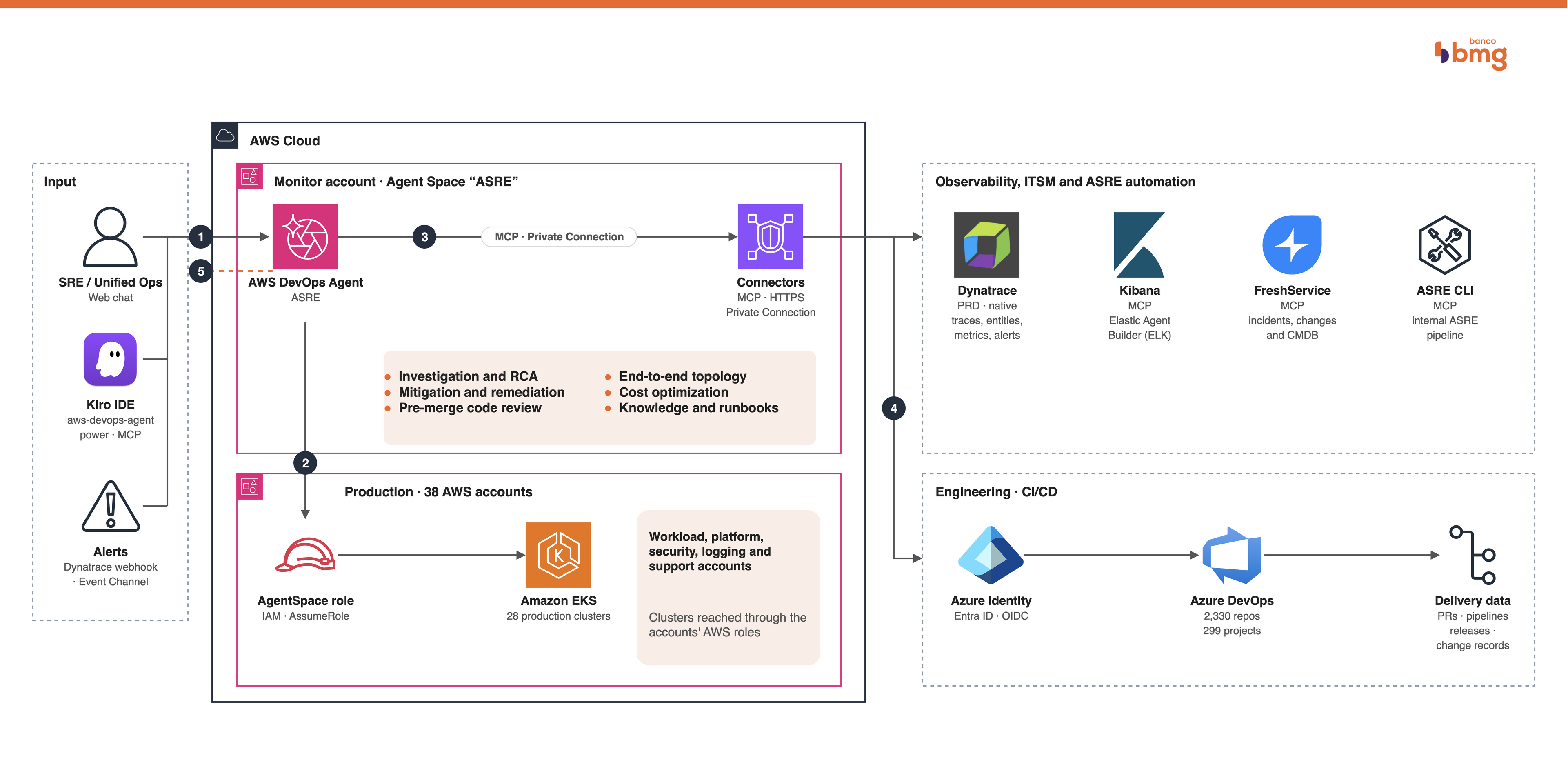
Figure 1: Banco BMG’s AWS DevOps Agent architecture: input channels, the ASRE Agent Space in the monitor account, 38 production AWS accounts, and connectors to observability, ITSM, and CI/CD tools.
Implementation approach
Banco BMG did not switch everything over at once. It rolled out AWS DevOps Agent in phases, one business domain at a time, and every phase followed the same loop: connect that domain’s signal sources, encode its product knowledge in Skills, and close any coverage gaps with custom MCP servers before moving to the next domain.
The team started where the need was greatest: the payroll loan application, where specialized knowledge was scarcest and diagnosis was slowest. The AWS Technical Account Manager (TAM) and Banco BMG’s Unified Operations team built the Skills together with the teams that own each system, so the investigation logic matched how each product actually behaves. Every domain added to the agent’s coverage, and the approach scaled across the bank without changing the core design.
The following four use cases show the approach in production.
Use case 1: Kubernetes stability at scale
Challenge. Banco BMG’s Kubernetes estate was experiencing roughly 25,000 pod restarts per day, degrading application availability and generating constant operational noise that masked real problems.
How the agent helped. For each spike in restarts, AWS DevOps Agent ran the same investigation. It started with the restarting pods and used the service topology to find which workloads, nodes, and dependencies were involved. Next, it lined up the restart timeline against everything else that happened in that window: CI/CD pipeline events and recent deployments, configuration changes in the Kubernetes audit logs, and resource pressure in Dynatrace metrics. It then checked the application and cluster logs for evidence that confirmed or ruled out each candidate cause. What came out was a root cause tied to a specific change or constraint, rather than a list of related alerts. Engineers no longer had to cross-reference those sources by hand.
Result. Pod restarts dropped from about 25,000 to under 1,000 per day, an improvement of more than 96%. That restored stability and removed a persistent source of noise from the platform.
Use case 2: Proactive incident detection
Challenge. Incident detection depended on the NOC and threshold-based alerting, an inherently reactive pattern: alerts fired only after a metric had already breached a limit, by which point customers were often already affected.
How the agent helped. AWS DevOps Agent doesn’t wait for a metric to cross a fixed limit. It watches how signals move together across the environment. When Dynatrace flags unusual behavior, such as rising latency, growing error rates, or resource pressure that builds slowly, a webhook starts an investigation automatically, long before any threshold alert would fire. The agent then uses the service topology to trace that early signal back through the services and dependencies involved. It also checks the same time window for recent deployments and change records. That way engineers get more than an early warning. They get a likely cause and the services at risk, while there is still time to act before customers notice.
Result. In a case involving PIX instant payments and Amazon ElastiCache (Redis), the agent detected the developing incident up to 6 hours before traditional NOC alerting would have triggered — turning what would have been a reactive scramble into a controlled, proactive response.
Use case 3: Critical business application protection
Challenge. The payroll loan application, Banco BMG’s primary revenue product, runs on a complex web of services and integrations. Only a few senior engineers knew how those pieces fit together and where a failure was most likely to start. When an incident hit, the investigation depended on getting one of them involved. If none of them was available, diagnosis could take hours, and every minute of uncertainty put revenue at risk.
How the agent helped. The team built a dedicated Skill for the payroll loan application, together with the AWS TAM and Banco BMG’s Unified Operations team. The Skill writes down what those senior engineers knew: the application’s architecture, its dependencies and integrations, and how a change in one place affects the rest. When an incident hits the payroll loan application, the agent uses that Skill to decide where to look first. It checks the components most likely to fail and traces the impact through the integrations the Skill describes. With that Skill active, the agent can reason about the product the way a senior engineer would, without waiting for one to be available.
Result. Diagnosis time for incidents affecting the payroll loan application dropped from hours to minutes, directly protecting revenue continuity for the bank’s most important product. In one investigation, faster diagnosis avoided an estimated $5,000 in impact.
Use case 4: Platform resilience through preventive analysis
Challenge. Banco BMG exposes many of its services through Amazon API Gateway, including flows customers depend on, such as payroll loan requests and PIX instant payments. Across more than 1,150 services, some applications had no timeouts configured for their downstream calls. Nobody noticed under normal traffic. Under load, though, a slow dependency would leave those services holding requests open instead of failing fast. Requests would pile up, threads and connections would run out, and the delay would spread upstream through API Gateway to the apps customers use. One slow component could become a broad outage. Finding these gaps by hand meant reviewing service configurations one at a time, and the team usually learned about them only after an incident exposed one.
How the agent helped. AWS DevOps Agent looked for the warning signs before an incident happened. It compared performance metrics across services and spotted the pattern a missing timeout leaves behind: requests that stay open far longer than their neighbors whenever a dependency slows down. It then used the service topology to trace each of those services through API Gateway to the customer flows that rely on it. That showed the team which gaps could do the most damage. Each finding went to the team flagged for remediation, along with the service, its dependencies, and the customer flows at risk.
Result. The team stopped waiting for a cascading failure to expose these gaps. Instead, they fixed the riskiest ones first, starting with the services behind customer-facing flows. Fixing these latent risks became planned work, not emergency incident response.
Results and business impact
AWS DevOps Agent has run in production at Banco BMG for months, not as a proof of concept. It covers more than 1,150 services on a platform that serves more than 9.1 million customers and handles more than 2 billion requests per month. Each day it investigates more than 350 production events on its own and analyzes over 1 TB of application logs.
The biggest change is in how quickly incidents get resolved. Mean time to resolution (MTTR) dropped 85%, from an average of 2 hours to 18 minutes. Across a sample of more than 300 investigations, the agent resolved 62% without a person stepping in. Together with the outcomes in each use case, these results show the bank moving from reactive firefighting to operations the agent leads: Kubernetes stability, detection up to 6 hours earlier, and payroll loan diagnosis in minutes.
Customers benefit as well. Combined with Dynatrace, the approach helped cut mobile app login time by 87% and bring API response times below 100 ms.
Lessons learned
Banco BMG’s journey from manual, siloed investigation to autonomous operations surfaced three lessons that can guide any organization building toward the same goal.
Lesson 1: Encode tribal knowledge into custom Skills
The single biggest accelerator was turning knowledge that lived in individual engineers’ heads into reusable Skills.
The team started with the payroll loan application, the product where specialized knowledge mattered most and diagnosis was slowest. They encoded the application’s architecture, dependencies, integrations, and change-impact patterns into a dedicated Skill. Once that expertise was captured, any investigation could draw on it, and diagnosis times for that product collapsed from hours to minutes. The lesson applies more widely: identify the products where knowledge is scarcest and impact is highest, and encode those first.
Lesson 2: Broad integration coverage drives correlation accuracy
The agent is only as good as the signals it can see.
Early on, the agent’s correlation was limited by how much of the environment it could observe. As the team connected Dynatrace, Elasticsearch, Freshservice, and Kubernetes audit logs, root cause analysis got much better. It improved again when they built custom MCP servers to reach systems that had no off-the-shelf integration. Investigations that once required an engineer to gather context from several tools by hand became a single correlated analysis. The lesson: invest early in connecting as many signal sources as you can, and treat custom MCP servers as a first-class way to close coverage gaps.
Lesson 3: Autonomous investigation changes the operating model
Autonomy is not just a faster version of the old workflow. It changes what the team does.
As the agent began resolving 62% of investigations without human intervention and detecting issues hours ahead of alerts, engineers were freed from reactive symptom-chasing. Their role shifted toward designing more resilient systems, building new Skills, and expanding the agent’s coverage. The bank planned for that shift instead of treating the agent as a drop-in replacement for existing runbooks, and that was key to realizing its full value.
Conclusion
Banco BMG’s experience demonstrates that autonomous operations require more than deploying an AI agent. They require connecting operational signals, integrating enterprise systems, and transforming institutional knowledge into reusable investigation capabilities. By combining AWS DevOps Agent with domain-specific Skills and custom MCP integrations, Banco BMG established a scalable foundation for faster investigations, improved operational resilience, and more proactive cloud operations. The approach provides a practical reference for financial institutions seeking to modernize operations across complex hybrid and multicloud environments.
Next, Banco BMG plans to go from finding root causes to fixing them, with automated response that keeps a person in charge. The goal is operations where engineers spend their time making systems more resilient, not chasing symptoms.
Banco BMG first shared this journey in a session at AWS Summit São Paulo 2026. The team will tell the full story at AWS re:Invent 2026 in the lightning talk COP202 – Autonomous operations: reducing MTTR at scale, feat. BMG Bank (Monday, November 30, 4:30–4:50 PM). Add it to your agenda to hear directly from the team behind the deployment.
Ready to get started?
To go hands-on and build on the pattern described in this post:
Build custom agents with the AWS DevOps Agent tools samples: sample tools and reference implementations for creating your own custom agents and Skills, the same approach Banco BMG used to encode institutional knowledge.
AWS Cloud Operations Enablement events: live sessions and workshops on operating and observing workloads on AWS at scale.