AWS Security Blog

Classify sensitive data in your environment using Amazon Macie
June 15, 2020: This blog is out of date. Please refer here for the updated info: https://aws.amazon.com/blogs/aws/new-enhanced-amazon-macie-now-available/ In this post, I’ll show you how to create a sample dataset for Amazon Macie, and how you can use Amazon Macie to implement data-centric compliance and security analytics in your Amazon S3 environment. I’ll also dive into […]

How to Use Service Control Policies in AWS Organizations
January 20, 2020: Based on customer feedback, we rephrased the fourth goal in the “An example structure with nested OUs and SCPs” section to try to improve clarity. With AWS Organizations, you can centrally manage policies across multiple AWS accounts without having to use custom scripts and manual processes. For example, you can apply service […]

Enable Federated API Access to your AWS Resources for up to 12 hours Using IAM Roles
Now, your applications and federated users can complete longer running workloads in a single session by increasing the maximum session duration up to 12 hours for an IAM role. Users and applications still retrieve temporary credentials by assuming roles using AWS Security Token Service (AWS STS), but these credentials can now be valid for up […]

How to Prepare for AWS’s Move to Its Own Certificate Authority
March 24, 2025: We’ve updated this post to remove an example that referenced an old CA. November 18, 2024: This post was updated to reflect the latest certificate authority information for Amazon issued public certificates. July 11, 2019: The service team has resolved an error that caused customers to see a “Certificate Transparency Required” […]

All AWS Services GDPR ready
Oct 3, 2019: We’ve updated a sentence to clarify that AWS services can be used in compliance with GDPR. Today, I’m very pleased to announce that all AWS services can be used in compliance with the General Data Protection Regulation (GDPR). This means that, in addition to benefiting from all of the measures that AWS […]

AWS Key Management Service now offers FIPS 140-2 validated cryptographic modules enabling easier adoption of the service for regulated workloads
May 24, 2023: As of May 2023, AWS KMS is now certified at FIPS 140-2 Security Level 3. AWS Key Management Service (KMS) now uses FIPS 140-2 validated hardware security modules (HSM) and supports FIPS 140-2 validated endpoints, which provide independent assurances about the confidentiality and integrity of your keys. Having additional third-party assurances about […]
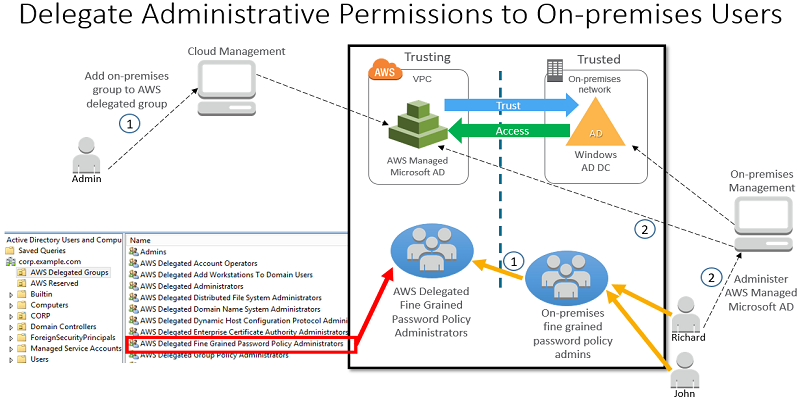
How to Delegate Administration of Your AWS Managed Microsoft AD Directory to Your On-Premises Active Directory Users
You can now enable your on-premises users administer your AWS Directory Service for Microsoft Active Directory, also known as AWS Managed Microsoft AD. Using an Active Directory (AD) trust and the new AWS delegated AD security groups, you can grant administrative permissions to your on-premises users by managing group membership in your on-premises AD directory. […]

AWS Secret Region expands to include 11 new services
As a follow up to our initial region availability on November 20, 2017, I’m happy to announce that we have expanded the number of accredited services available in the AWS Secret Region by an additional 11 services. We continue to be the only cloud service provider with accredited regions to address the full range of […]

How to Use Bucket Policies and Apply Defense-in-Depth to Help Secure Your Amazon S3 Data
Amazon S3 provides comprehensive security and compliance capabilities that meet even the most stringent regulatory requirements. It gives you flexibility in the way you manage data for cost optimization, access control, and compliance. However, because the service is flexible, a user could accidentally configure buckets in a manner that is not secure. For example, let’s […]

AWS Federated Authentication with Active Directory Federation Services (AD FS)
Today we’d like to walk you through AWS Identity and Access Management (IAM), federated sign-in through Active Directory (AD) and Active Directory Federation Services (ADFS). With IAM, you can centrally manage users, security credentials such as access keys, and permissions that control which resources users can access. Customers have the option of creating users and […]