AWS Skilling and Social Impact
AWS Breaking Barriers Chile: AI prototypes that can save lives, support teachers, and reach retirees
 Don Manuel was 68 years old and diabetic when his doctor referred him to an ophthalmologist. The referral was marked “non-urgent” and while he waited for an appointment he went to the emergency room twice for high blood sugar and was hospitalized. Nobody connected those hospital visits to his eyes. By the time he saw the specialist, his vision loss was permanent.
The data that could have saved Don Manuel’s eyesight existed, but it was scattered across healthcare systems and frozen in a wait list that couldn’t see his condition getting worse.
This story was one of eight real-world challenges on the table when 104 participants and 40 volunteers gathered in Santiago at Universidad de Chile for Breaking Barriers Chile, the first AWS Breaking Barriers hackathon in Latin America.
Over three days, participants built working AI prototypes to challenges submitted by local organizations—a public hospital, the country’s largest early childhood education network, its national social security agency, and two university research centers.
“Innovation only makes sense when it reaches people and amplifies communities,” said Alejandra Mizala, Rector at Universidad de Chile, during remarks at the event.
The winning teams kept people like Don Manuel at the heart of their solutions: AI-powered hospital wait lists that update as patients’ conditions change; a chatbot that reduces reporting time for teachers so they can focus on their students; and a personalized guide to help retirees navigate their retirement benefits.
As part of our commitment to improving access to AI and cloud technology in Chile, each winning team will be awarded Amazon Web Services (AWS) credits to build their innovation, put it into practice, and scale their impact to the communities that need it most.
Applying AI for good to real-world challenges
Breaking Barriers Chile is the latest in a global series of hackathons hosted by AWS that simultaneously offer free skill building opportunities while demonstrating how AI and cloud technology can be used to tackle urgent challenges in education, health, and climate resilience.
“Success is not measured in what each of us makes for ourselves, but in what we build for others,” said Rafael Mattje, AWS Country Manager in Chile, at opening remarks that grounded participants in what’s possible when we all come together to solve complex challenges. “You’ve got the talent and you’ve got the tech; you can change everything.”
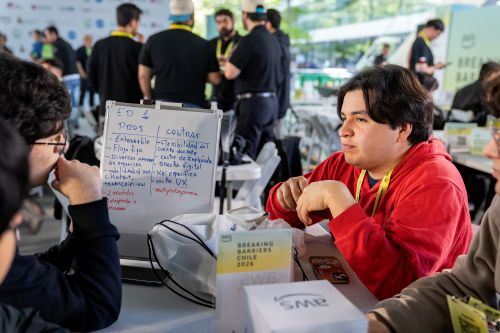
Breaking Barriers brings developers and organizations together to address pressing local issues. In Chile, representatives from the participating hospital, foundation, and government agencies didn’t just submit challenge statements for the hackathon, they were in the room working alongside the participants—answering questions, correcting assumptions, and reacting to prototypes in real time.
“User research is reading about someone else’s pain. A hackathon with the institutions [experiencing] that pain right next to you, interrupting you, correcting you when you assume wrong; it’s not just more efficient, it’s truer,” said Sebastián Wagner, a hackathon participant and startup founder. “In problems where the end user can’t vote with their wallet—children, patients, government beneficiaries—’truer’ is the only metric that matters.”
Building solutions for challenges close to home
 Hackathons like Breaking Barriers contribute to Future Ready 2030, Amazon’s $2.5 billion global commitment to prepare 50 million people for the future of work by expanding access to education and skills training for employees, students, and communities.
Before anyone wrote a line of code at the hackathon, AWS Chile Solutions Architects ran skilling workshops for registered participants, covering AWS and AI foundations and agentic development with Kiro, an AWS service that works alongside you to turn prompts into detailed specs, then into working code, docs, and tests.
Participants were ready to build, then Mother Nature threatened to cancel the event when a hailstorm and an EF0 tornado hit Santiago, flooding streets and cutting power to 48,000 households. Nevertheless, the team persevered to deliver for the community.
“On Tuesday, after the hailstorm, we said: ‘We can’t do it.’ But we decided to take a leap of faith on our students and what they have to offer,” said Susana Mondschein Prieto, Dean, Faculty of Physical and Mathematical Sciences, Universidad de Chile. “Hosting this event is a privilege, but it also reflects our faculty’s mission: we want to educate the leading engineers in our country and have our work make a direct impact in the lives of the Chilean people.”
The storm made one of the hackathon challenges even more relevant. Chile has no tornado radar network, and 5.5 million people live in the exposure zone. One team spent three days using satellite data to detect the conditions that form tornadoes before anyone can even see one.
“Our phenomena are different from those in other parts of the world, so we need to build different solutions too,” said Roberto Rondanelli, Director at the Center for Climate and Resilience Research (CR2), who presented the challenge to identify and classify tornados in Chile in order to mitigate their risks and impact.
Jaime Rojas, a data science master’s student who was part of the team focused on the tornado challenge, shared: “If this solution is implemented, we will help people get ahead of tornados, mitigating risks and possibly saving lives.”
Winning solutions
At the end of the event, each hackathon team presented their solution to a jury panel with representatives from Universidad de Chile, Startup Chile, and AWS. The judges equally weighed the social impact and technical innovation of each, and below are the inspiring solutions built by our three winning teams.
Each benefiting organization will be awarded AWS credits to fully build out their solution and extend its impact far beyond the hackathon and into the community.
First place
Making patient urgency visible
Project Manhattan, for Hospital Clínico Dra. Eloísa Díaz La Florida
At Hospital La Florida, 15 patients died over 18 months while waiting for a consult. A week before they died, half were still behind the 122nd spot on the list.
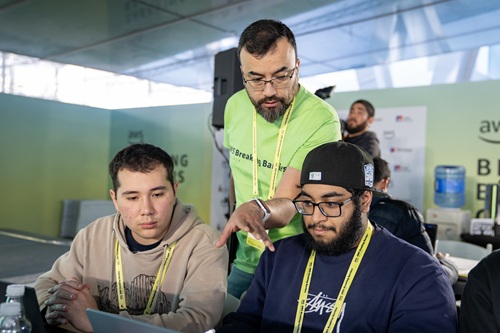
Project Manhattan built a dynamic prioritization system that links emergency room visits to the hospital’s wait list, so a patient like Don Manuel moves up when his condition changes. An AI agent compares each case against medical records and clinical literature and explains every suggested change. Physicians stay in control and approve every decision.
“We believe these competitions are essential for using the technical knowledge you gain to tackle real-world problems, especially in service to the community,” said Benjamín Vega of Project Manhattan.
Second place
Giving teachers their time back
Integra AI, for Fundación Integra
Fundación Integra serves more than 83,000 children in over 1,200 kindergartens and nurseries across Chile. Its 27,000 educators can spend hours each day on paperwork instead of with children during the most important years of their development. Integra AI built a WhatsApp chatbot that lets teachers log developmental milestones in real time, with no new software to learn. It could cut reporting time from about four hours a day to nearly zero.
“AWS makes it possible to build solutions, even if you don’t code that much. We have to come to these events, because we need more women in tech,” said Paulina, a Universidad de Chile student.
Third place
Reaching retirees before they fall through the cracks
Bombazo, for IPS ChileAtiende
About 2.2 million Chileans can benefit from the expanded Universal Guaranteed Pension (PGU), but navigating retirement often means a maze of acronyms and repeat office visits. Team Bombazo designed a proactive assistant for ChileAtiende that gives older adults personalized guidance and helps the government reach people at key life moments, before gaps in coverage become crises.
“This level of feedback confirms that we are aiming at solutions with true viability and tremendous public value,” said Gabriel Martín Huerta, participant and AI solutions architect.
Launching AWS in Chile
In November 2026, AWS officially launches in Chile, making it the newest AWS South America Region. Along with a $4 billion investment comes new opportunities to increase access to AI and cloud skilling opportunities for individuals and social enterprises.
Beyond the Breaking Barriers hackathon, AWS is supporting Universidad de Chile with a national literacy and math research initiative. We look forward to the opportunities ahead to further democratize access to AI and cloud technology in Chile, and across South America. Learn more about AWS impact.
This post is by Carolyn Vigil and Mechi Miguel, New Regions Leaders, AWS Skilling and Social Impact