AWS Skilling and Social Impact
How 42 social enterprises created 12-month AI and cloud roadmaps in three days
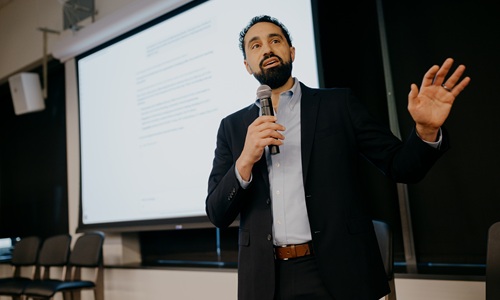 After Justin Steele and his wife co-founded a nonprofit in 2024 that connects urban families with nature experiences, he recalls needing just $9,000 for tent heaters and staying up late one night trying to find it online. He’d just spent a decade in corporate philanthropy directing hundreds of millions of dollars in giving, but now he couldn’t find the small amount his organization needed.
Looking to scale his nonprofit’s impact and identify new funding opportunities, Steele built a scrappy AI prospecting tool and brought it to the AWS Social Entrepreneur Accelerator (SEA) in 2025. There, Amazon Web Services (AWS) experts and consultants from Deloitte helped him shape a business and technology roadmap that became Kindora, an AI-powered platform that enables nonprofits and social enterprises to easily find investors and open grants they can apply for, then filter results based on their unique context.
In May 2026, Steele (pictured) returned to SEA as a guest speaker and shared his experience with 71 new leaders from 42 organizations across 17 countries. His story is the SEA program’s thesis in action: come with a mission, leave with a plan, and stay for the community that keeps you building.
“I walked into the accelerator with a beta product and a question from our users that we couldn’t answer yet: ‘What grants can I apply for right now?’” said Steele. “AWS helped us push the cloud infrastructure forward, Deloitte is helping us scale the solution to reach thousands more, and the SEA program changed our trajectory.”
Kindora now supports more than 2,800 social enterprises, serves over 1,000 queries a day through its Model Context Protocol (MCP) server, and was recently featured by Anthropic in a case study documenting how 90 percent of its codebase was built with AI tools. As Kindora transitions from a startup prototype to scaling the solution globally, Deloitte is providing strategic services and operational support.
Roadmaps that chart a course forward
The AWS Social Entrepreneur Accelerator in collaboration with Deloitte brings business and technical leaders together to build real skills and drive real action. Deloitte is an AWS Premier Tier Services Partner and brings deep consulting expertise in organizational strategy, operating model design, and technology implementation to help social enterprises translate technical possibilities into sustainable business plans.
Many of the social enterprises at SEA are startups and small mission-driven organizations using AI and cloud technology to address urgent and complex challenges in education, health, and climate. They have bold ideas but will benefit from deeper technical knowledge, strategic support, and peer networks to help bring their ideas to life. SEA creates a space for these leaders to ask hard questions, challenge assumptions, and dream big. Without it, their teams can stall when ambition outpaces infrastructure.
“After 35 years in IT, I’ve never experienced anything like the AWS Social Entrepreneur Accelerator,” said Aaron Osmond, CEO of Knowledge Pillars, an edtech organization that helps learners validate their job-ready skills. “The collaboration, openness, and shared commitment to impact created an unforgettable experience.”
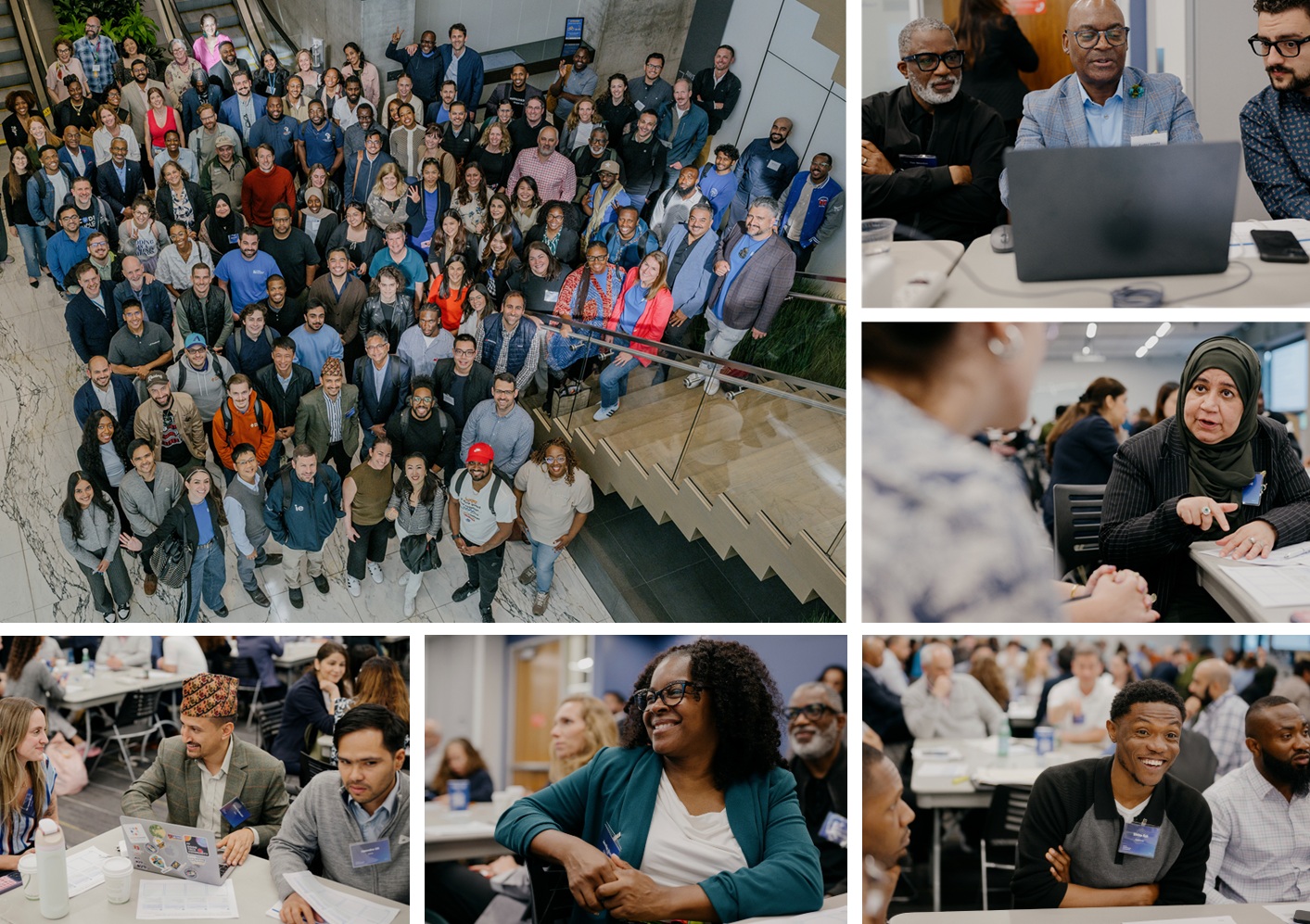
Over three days at the AWS Skills Center in Seattle, participants developed tailored 12-month business and technology roadmaps alongside AWS Solutions Architects, Deloitte consultants, and AWS Partners like Anthropic and RevStar. Both partners offered proof-of-concept engagements for the full cohort, so each organization left SEA with a robust plan and commitments to helping them execute it.
“I’m walking away with more than just notes; I’m walking away with the technical roadmap to reach our next milestone,” said Dr. Jennifer Nixon, Board Chair of Tech Turn Up, a nonprofit that boosts under-resourced youth in the Washington, D.C. area through free science, technology, engineering, arts, and mathematics (STEAM) education.
Breakthroughs that started with hard questions
For many participants, SEA provides an opportunity to explore AWS technologies, create business and technical roadmaps for the coming year, and connect with like-minded peers from around the world who are tackling similar challenges in key social impact spaces.
Founder and CEO Patricia Wilkins has spent 25 years building BASICS International and works with communities in Ghana to create long-term pathways to opportunity through education, workforce development, entrepreneurship, community development, and digital skills training. She used the experience at SEA to do something she hadn’t made time for in years: a full organizational deep dive. Like many nonprofits doing meaningful work, BASICS needed to strengthen its pillars—define them more clearly, integrate systems better, and ensure the organization is built to sustain and scale the impact it envisions.
“One of the most meaningful outcomes of SEA emerged during the post-program mentoring sessions, which helped us better articulate that BASICS is not simply a collection of individual programs but an integrated development ecosystem,” said Wilkins. “That clarity has become foundational to our strategic planning, technology roadmap, and vision for the next 25 years.”
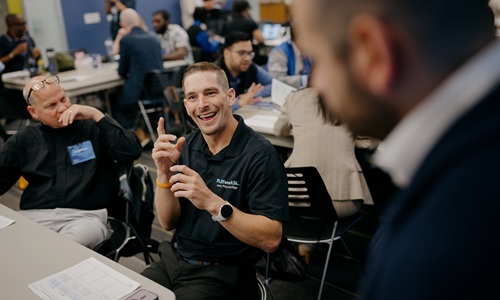 Not every breakthrough at SEA looks the same. Some leave with a sharper sense of who they are, while others leave with a blueprint for where they’re going.
Jon Mowl (pictured) is CEO of Play With ASL, which makes learning American Sign Language interactive, engaging, and enjoyable through gamified experiences. He’s the first Deaf person to attend SEA, and his roadmap included an architecture review mapping every API endpoint against institutional scale, and a partnership pipeline that opened doors to an education nonprofit serving 24,000 schools. Since SEA, Mowl’s team has moved from early conversations to active pilot discussions with institutional partners, turning the roadmap into real traction.
“The SEA program was just the tip of the iceberg,” said Mowl. “For Play With ASL, this is a key moment. We’re at the point where demand is clear, and the next step is turning that into scalable systems—product, partnerships, and infrastructure that can support real growth.”
Relationships that outlast the program
May’s accelerator was the fourth iteration of SEA, and the relationships each cohort forms with each other are rooted in shared values. Like Steele returning to share Kindora’s post-SEA journey, several other alumni came back to highlight what they have learned.
Leaders from U.S. Hunger, ThriveLink, and HelpLink returned this year as alumni to share how their experience forged a lasting partnership that’s benefitting all three organizations. Lost Glacier, which works on climate resilience and regenerative agriculture for farmers in Europe, also returned as alumni and described a “lightbulb moment” from their SEA cohort when they realized AI and cloud technology could help them leapfrog years of limitations. Now, their farmers get practical coaching, scientific guidance, and verification tools without needing to understand the technology underneath.
U.S. Hunger is a nonprofit that fights food insecurity by packing shelf-stable meals at volunteer events, and uses AI to understand the root causes—not just feeding people but determining why they are hungry. Rick Whitted is CEO of U.S. Hunger and knew before he even met his SEA cohort that something big was possible. “As soon as I got the attendee list, I immediately saw ThriveLink and went, oh, they know what they’re doing,” he said.
Both organizations have been solving pieces of the same problem, as ThriveLink builds AI agents that help families access food, housing, transportation, and healthcare through phone conversations. At SEA, U.S. Hunger and ThriveLink also connected with HelpLink, which removes barriers to work, health, and safety for families in moments of crisis. “We found our market, we found our funding structure through SEA, and we started using AI in a new way,” said Abagail McKiernan (pictured), CEO and cofounder of HelpLink. “AWS has given us the infrastructure we need to scale with confidence to help support users and usage as we continue to grow rapidly.”
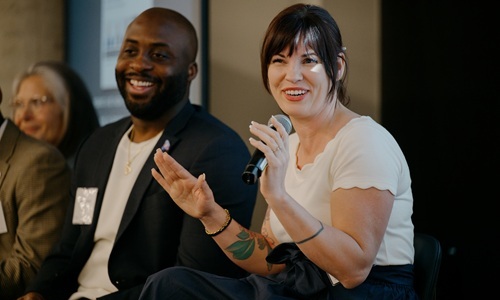 Now, these organizations are combining their platforms into one integrated solution powered by AWS. ThriveLink operates across 17 states and uses AI agents that connect families to resources, while HelpLink migrated to AWS and uses AI to help users maintain privacy and dignity when seeking support. Meanwhile, U.S. Hunger processes millions of records with fewer than 100 people, converting lived experiences into actionable social care insights.
“We came to SEA intentionally to solve a problem, but you realize there is no way you could possibly solve it on your own, nor should you try because you’re going to miss so many things that you’re just not good at,” said Whitted. “We have to connect the ecosystem together and the players in the ecosystem have to become unsiloed and, in a sense, unselfish.”
The road ahead
The next AWS Social Entrepreneur Accelerator will take place at the Arlington Skills Center this September. The hardest challenges in education, health, and climate won’t be solved by any single organization working in isolation. They’ll be solved by founders who show up, build a plan, and stay connected.
A year ago, Justin Steele walked into SEA with a beta product and a question he couldn’t answer about where to find $9,000 for tent heaters. Today, thousands of social enterprises use the tool he built with a 12-month SEA roadmap, and now he was back in the room helping the next SEA cohort build theirs.
“Coming back as an alum, I got to hand the next cohort what someone handed me,” said Steele. “When we show each other what’s possible, it gives us the courage to try.”
That’s what the SEA program creates—a compounding cycle where every founder who succeeds makes it easier for the next one to start.
This post was co-authored by Kat Esser, Principal, Impact Accelerators at AWS, and Nicole Kelm, Associate Director, Social Impact and Investments at Deloitte.
The AWS Social Entrepreneur Accelerator (SEA) equips organizations to build and scale their solutions with AI and cloud technology. Learn more about AWS impact.