Canada's AI Innovators
Creating breakthroughs in Canada and beyond
Variational AI: How generative AI is accelerating the search for life-saving medicines
Drug discovery is flawed. From oncology to rare diseases, patients who desperately need new treatments wait for years. Diseases affecting small populations never get investigated because the economics don't work. And brilliant molecules that could save lives go undiscovered because the traditional approach to findingthem is simply too slow.
This isn't just a business problem. It's a human problem.
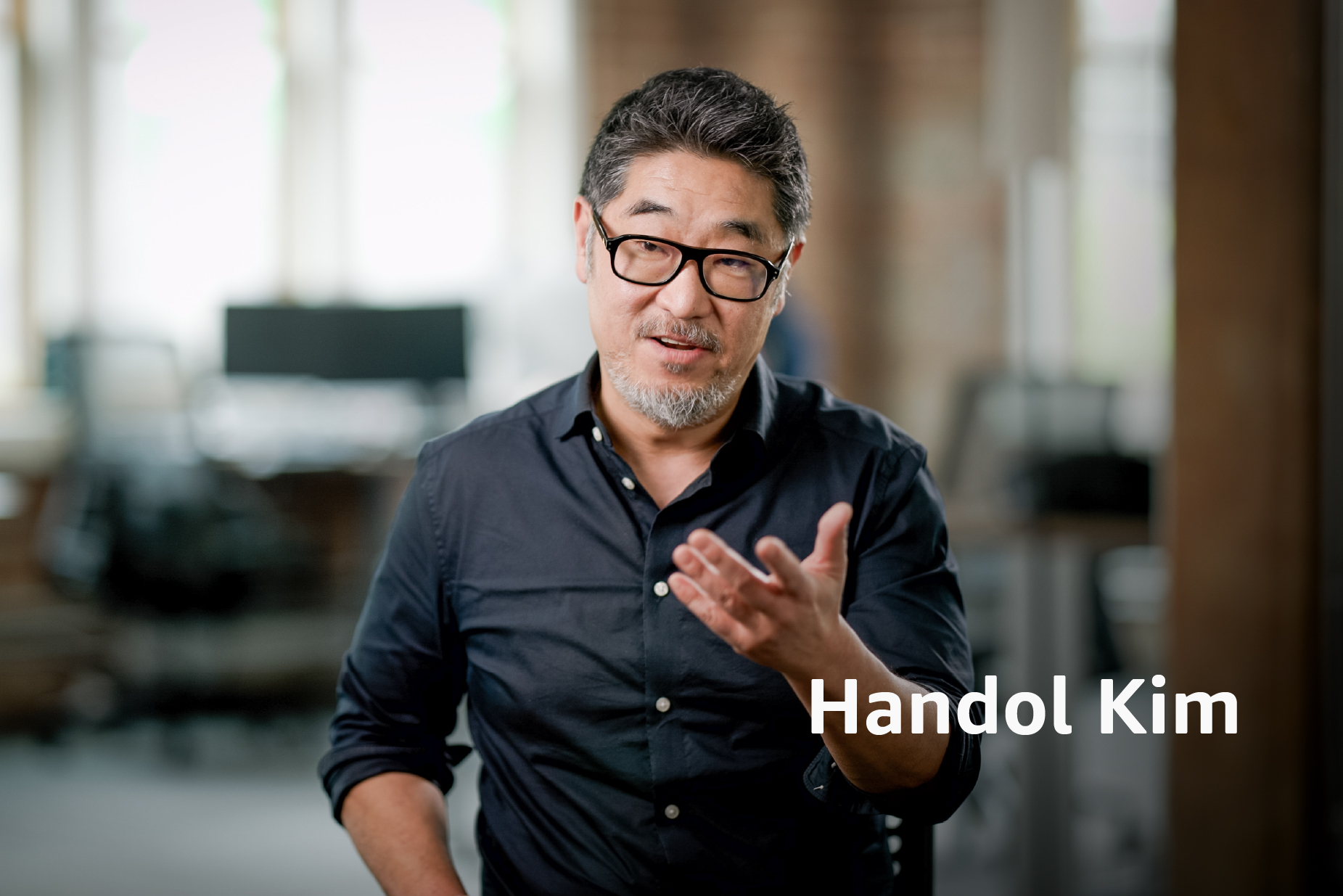
Meet Handol Kim
Co-founder and CEO, Variational AI
Handol Kim and his team at Variational AI knew there had to be a better way to predict how drugs interact with proteins and targets—before ever stepping into a wet lab.
That conviction would reshape everything.
A mission that drives every decision
Handol Kim is the co-founder and CEO of Variational AI, a Vancouver-based biotech company launched in 2019 and built on a purpose that runs deeper than business metrics.
"Why do I get up in the morning? Why do I love what I do?" Kim asks. "I don't think there's any other problem that I could be working on than developing medicines to help patients. There's no cooler mission that exists."
When COVID-19 emerged, Variational AI pivoted to focus on the most urgent need: developing a small molecule antiviral targeting SARS-CoV-2's main protease to help alleviate the suffering unfolding globally.
Speed was critical—but it also revealed something fundamental about drug discovery itself. The bottleneck wasn't biology. It was the process.
The broken economics of drug discovery
The numbers paint a stark picture of a system under strain.
"It takes about 10 to 12 years to get a drug from start to approval," Kim explains. "And you've got a rate of maybe 10% probability of success when you're already in clinical testing in humans."
The economics are tough companies must "buy a lottery ticket" worth hundreds of millions of dollars for a ten to one odd of winning.
But the real problem sits even earlier—in the drug discovery phase itself.
"Every drug is based around a novel molecule, which is something that has a lot of properties around efficacy, potency, safety, and selectivity," Kim notes. "These things are all really hard to do. And these are problems that need to be solved in early discovery."
Traditional drug discovery relies on synthesizing and testing compounds one by one, iterating through countless failures to find rare molecules with the right combination of properties. It's slow, expensive, and leaves countless potential treatments undiscovered.
Redesigning discovery with generative AI
Variational AI's breakthrough was a simple but revolutionary insight: drug discovery could be reimagined as a generative problem.
Just as AI can generate images from text prompts, Variational AI realized they could generate novel drug molecules by focusing on the properties and laws of chemistry.
"We use generative AI to essentially design a molecule based on target properties," Kim explains. "Very similar to how you would use a model to generate an image based on text prompts, except we use the language of chemistry."
The result is transformative: "We're able to do this 100 times more efficiently than the status quo, thereby lowering the cost of drugs, increasing the speed, and ensuring that we can get medications and medicines to people that need it and are underserved."
The Enki™ Platform: Foundation models for molecular design
Powering this acceleration is Enki—Variational AI’s generative AI platform built on a foundation model trained on virtually every published, approved and patented drug. By learning what makes a molecule effective, safe, and potent, Enki generates novel candidates optimized across all these properties at once — solving the multi-parameter problem that drives most clinical failures.
"We take that data, we train our model, and the model is generative in the sense that it knows what makes a drug a drug," Kim explains. "And then you say, make me a new drug. And then it's able to make a new drug to test."
This is the critical innovation: rather than starting from scratch for each project, the AI arrives pre-trained with deep knowledge of how biology and chemistry intersect. Enki doesn't just speed up existing processes. It transforms drug discovery from trial-and-error into a directed search powered by AI.
"Our goal really is to become the default first step for any biotech company looking to develop a small molecule drug," Kim says.
Building trust through secure infrastructure
Revolutionary technology means nothing if companies can't deploy it securely. Pharmaceutical companies hold decades of research and competitive advantages in proprietary data. They're extraordinarily sensitive about security—and rightly so. Deploying an AI platform that touches that data requires more than promises. It requires architecture built on trust.
"Without AWS, you know, we probably wouldn't be here today," Kim says candidly.
AWS provided the compute that helped Variational AI develop its very first model. Today, it underpins how the company serves pharma customers—from high-performance GPUs for faster discovery to the foundation of their security architecture.
For each pharma partner, Variational AI deploys a dedicated AWS Virtual Private Cloud (VPC)."We do all of the compute within that VPC and deliver the outputs there," Kim explains. "That ensures their security and a strict barrier between our internal compute and the pharma's data and their proprietary knowledge."
This means Variational AI can collaborate securely with partners like Merck, enabling collaboration at scale while keeping proprietary data strictly separated, and turning AI into real-world outcomes.
Unlocking what was impossible
By making drug discovery 100 times more efficient, Variational AI is expanding what's possible in medicine itself.
Diseases affecting small populations become economically viable to pursue. Patient groups previously considered too niche now warrant investigation. Rare conditions get the attention of researchers who can now afford to look. The entire landscape of what's treatable shifts. And patients who were waiting for years for new treatment options begin to see possibilities.
A Canadian vision for health sovereignty
Kim sees Variational AI’s work as part of something bigger than one company: a shift in what’s
"Canada has the seventh most pre-clinical programs in the world," Kim says. "And yet we have no homegrown non-generic pharma companies in the top 100. Wouldn't it be great if we did
It's a bold ambition: leveraging Canada's AI talent, research depth, and cloud infrastructure to build a globally competitive pharmaceutical industry from the ground up.
Making the impossible real
"At the end of the day, it's really about making the impossible real or trying," Kim reflects. "I feel good about our mission, and I feel excited about the possibilities of us making an impact in a positive way."
By combining generative AI, foundation models trained on biological knowledge, and secure cloud infrastructure built on trust, Variational AI represents a new model for biotech innovation—one where computational intelligence accelerates discovery, where security enables enterprise collaboration, and where the pace of progress is limited not by laboratory capacity or economic constraint, but by imagination.
The next generation of life-saving medicines isn't waiting for the slow churn of traditional drug discovery. It's being designed by AI, secured by cloud infrastructure, and delivered to patients who need it most.
Did you find what you were looking for today?
Let us know so we can improve the quality of the content on our pages