Canada's AI Innovators
Creating breakthroughs in Canada and beyond
Waabi: Revolutionizing autonomous transportation through Physical AI
Twenty-seven years ago, long before the rest of the world caught on, Raquel Urtasun began building a new kind of artificial intelligence.
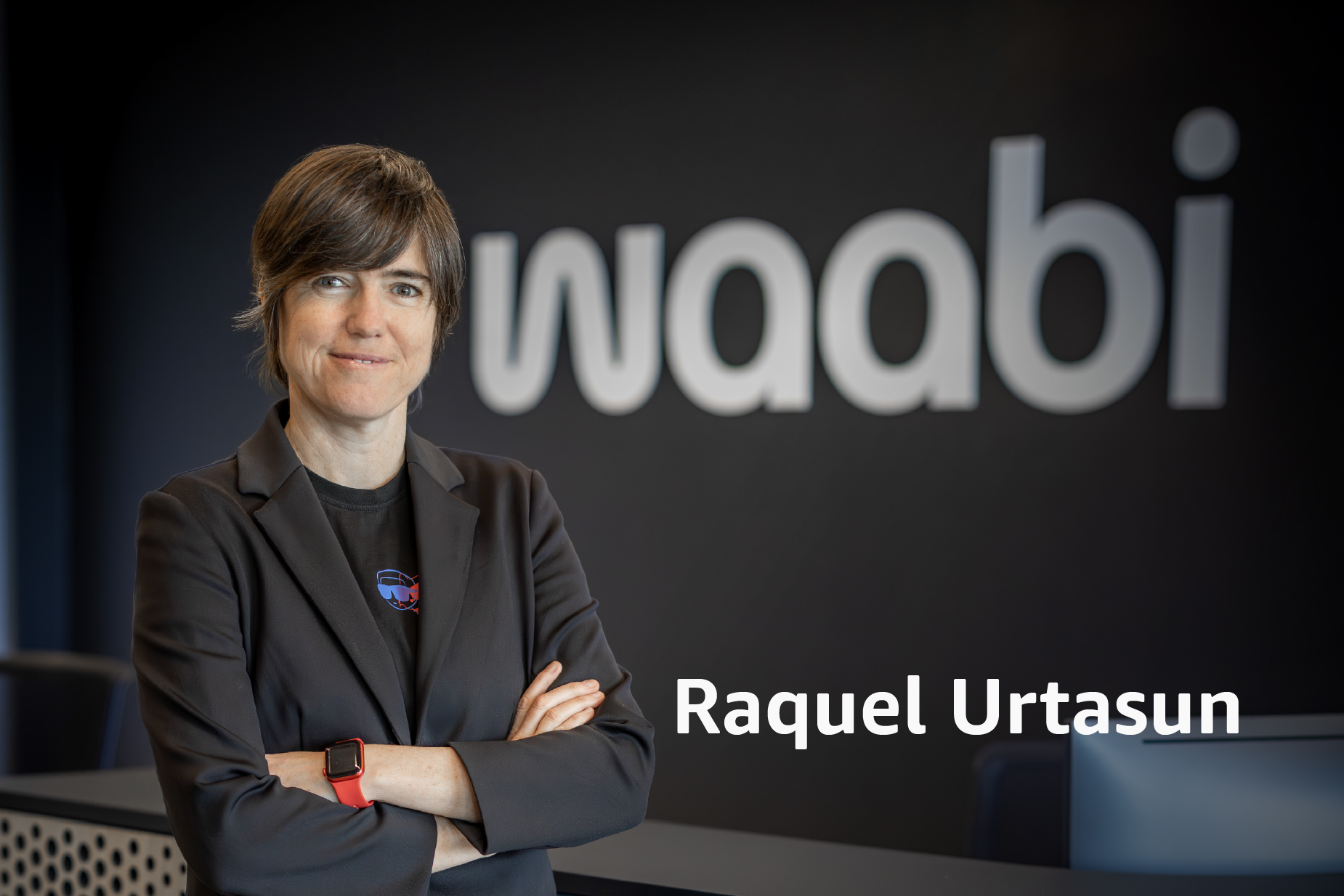
Meet Raquel Urtasun
Founder and CEO, Waabi
What researchers now call Physical AI: systems and machines that can perceive, reason and act with the world around them. This technology can act and learn like humans do—generalizing from very few examples, scaling across environments, and adapting to new conditions faster than anything the industry has seen before.
The applications are vast. But when Urtasun looked for where that work could have the greatest impact, the answer was clear: self-driving vehicles.
Transportation moves everything. People, food, medicine, the raw materials of daily life.
And it was breaking.
Long-haul trucking faces a growing driver shortage. Urban roads are increasingly congested and inefficient. The systems that move people and goods are straining under their own weight.
"This is where machines can really come to our rescue," Urtasun says.
So she built Waabi. Based in Toronto, the company is pioneering Physical AI by taking a fundamentally different approach, starting with autonomous vehicles like long-haul trucks and robotaxis.
Where others spent years hand-coding rules for every driving scenario, Urtasun and her team at Waabi built an AI system that learns, one that can adapt to new conditions, scale faster, and reach markets sooner. She named it after the Ojibwe word meaning "she has vision," a tribute from an immigrant to the original inhabitants of the land where she chose to build.
"I wanted to honour that connection," she says. "And it reflects what we're doing: bringing a completely new vision to solving self-driving.”
Breaking away from the road-testing trap
The traditional approach to self-driving technology was focused on putting a prototype on the road and driving many kilometres in order to continue iterating. Billions of dollars were invested into this strategy across the industry.
But there was a fundamental problem.
"This approach doesn't scale," Urtasun notes. "Training autonomous vehicles this way is not sustainable, it’s not efficient."
The industry was chasing a dead end—one that required endless real-world testing, exposed safety risks, and demanded an unsustainable volume of human-driven kilometres to discover edge cases and train systems.
Urtasun knew there was a better way.
Waabi’s fundamentally different approach
Instead of the traditional "prototype and iterate on roads" model, Waabi pioneered an AI-first approach to development.
Waabi unlocked an industry first. They created the Waabi Driver, which is a fully autonomous system, comprised of both hardware and software, that acts as a shared brain capable of driving both long haul trucks and robotaxis. It combines vehicle-mounted sensors that observe the world, onboard compute that handles all safety-critical processing, and an AI system that synthesizes that information to navigate safely, reach its destination, and scale across applications.
"We have reinvented the way that you can do software development in self-driving in simulation, which is a much safer, and more efficient way," she explains.
The novel simulation system called the Waabi World is a breakthrough technology unlocking new standards for the testing and validation of safe autonomous systems.
This changes everything.
"We don't need more data from the real world… we can really train and test the system under all conditions, so that we can deploy it safely," Urtasun says.
Infrastructure at scale: AWS as the enabling partner
Making all of this possible requires more than just innovative AI.
"In order to be able to really train, as well as test the system, it is tremendously important that you have access to best-in-class infrastructure," Urtasun explains.
AWS has been Waabi's infrastructure partner since it was founded five years ago, providing the backbone that enables the company's approach. Waabi runs heterogeneous workflows on AWS using services like Amazon Elastic Compute Cloud (Amazon EC2) and Amazon Simple Storage Service (Amazon S3) that allows them to execute massive amounts of simulations, testing and training jobs in the cloud—the computational foundation that makes their simulation-first approach feasible at scale.
This means Waabi can simulate millions of driving scenarios overnight, testing conditions that would take years to encounter on real roads.
"AWS has really enabled Waabi to arrive where we are today," she says.
Real-world deployment: Safety-critical technology arrives
What Waabi is doing carries extraordinary responsibility.
Urtasun explains that before deployment in the real world, fully autonomous systems need to be validated and verified with robust scientific evidence.
This is precisely where Waabi's simulation-first approach does something the industry hasn’t been able to do before. Rather than waiting for safety critical situations to appear on public roads, Waabi World trains and tests thousands of safety-critical scenarios—building an evidence base that validates the technology before it touches public roads.
The stakes are high: in Canada alone, nearly 10,000 people are seriously injured in road accidents every year, with human error as the leading cause.
“We are building safety-critical technology deployed in the real world, and we're doing it with a fully validated platform,” Urtasun notes.
The result? "You're going to see driverless trucks on public roads across Texas without a human on board. And swiftly after that, driverless deployment across many geographies, starting in the US, and potentially in other countries as well,” she continues. This isn't a pilot program or a limited test. This is a real deployment of fully autonomous vehicles on public roads—a milestone that represents a fundamental shift in what the industry thought was possible.
And this is just the beginning.
A generational moment
While autonomous trucking is Waabi's first application, the platform Waabi built was always meant to extend far beyond it.
For the first time in the industry, Waabi has built a shared brain across both autonomous trucks and robotaxis—the same AI model powering both applications and continuously improving as both scale.
And the momentum is undeniable.
Volvo has integrated the Waabi Driver into the Volvo VNL Autonomous truck, a partnership to bring their next-generation AI technology directly into an OEM’s vehicle production. Through a landmark partnership with Uber, the companies plan to deploy 25,000 robotaxis powered by the Waabi Driver. And in 2026, Waabi raised over a billion dollars—the largest funding round in Canadian history—validating Waabi as a leader in Physical AI and self-driving.
“In the next five years, you're going to see physical AI become mainstream—truly transforming the world we live in and providing us with so many opportunities in terms of how this technology can impact our day to day in a very positive way.” Urtasun says. “We are building an incredible generational company here in Canada that is going to change the world.”


Did you find what you were looking for today?
Let us know so we can improve the quality of the content on our pages