Canada's AI Innovators
Creating breakthroughs in Canada and beyond
Waste Robotics: How computer vision and robotics are turning waste into the world's next resource
Every second, humanity generates 45 trucks of waste. Everysingle second. That staggering reality—10 billion tonnes of waste generated annually—demands action on every front.
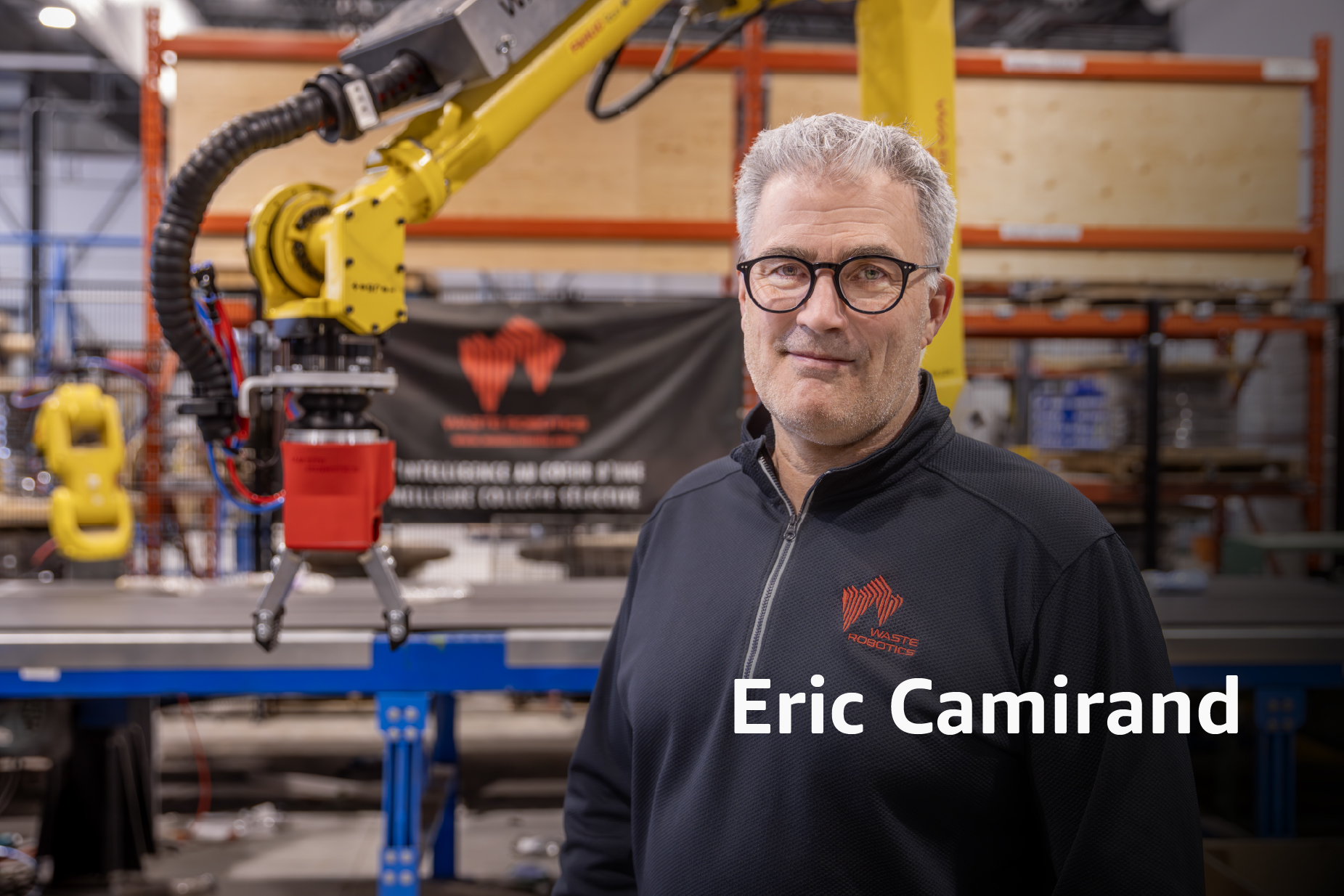
Meet Eric Camirand
Co-founder and CEO, Waste Robotics
Reducing consumption, eliminating unnecessary packaging, redesigning products for reuse: these upstream changes are essential. But even as society works towards producing less waste, the materials that already exist still need to go somewhere. And right now, too much of it ends up in landfills.
This gap—between the waste we’ve already created and the circular economy we’re building—is where Eric Camirand, co-founder and CEO of Waste Robotics, saw his role after twenty years focused on environmental problems.
"Having efficient sorting centres is really at the heart of solving the problem," Camirand explains.
Not the solution. A part of it. Because the best sorting technology in the world cannot replace the need to consume less. But it can ensure that what we do discard gets recovered rather than buried.
The bottleneck in today's sorting lines
Walk into a modern waste sorting facility, and you'll find the same fundamental problem that has plagued the industry for decades: humans sorting through endless streams of material, trying to identify what can be recycled, recovered, or processed.
"The reality on sorting lines today is that it's becoming increasingly difficult," Camirand notes.
It doesn't make economic sense. It doesn't scale. And as regulations tighten around landfill diversion targets, manual sorting simply cannot deliver the precision required to meet them.
"It doesn't make sense to have humans doing that when we have technologies like robotics," he says.
The challenge isn't about processing more waste—it's about recovering more value from the waste that already exists.
Building robots with computer vision
Waste Robotics was founded on a simple but powerful premise: equip machines with the ability to perceive and process waste ways humans cannot.
"At Waste Robotics, we make robots able to sort waste using artificial intelligence and robotics in all kinds of sorting conditions," Camirand explains.
The system starts with perception. An array of specialized cameras,2D, 3D, colour, and spectral imaging--continuously observes material flowing through sorting lines.
"We capture images with cameras, in real time, and transfer the images to a processing system that performs object recognition at very, very high levels—about 98 to 99% accuracy," he says.
That precision enables something critical: the ability to recover materials that would otherwise be lost to landfill. When the system identifies what it sees, it sends commands to different types of robots positioned throughout the sorting line, diverting recoverable material with consistency, continuity, and speed that manual sorting cannot match.
AI that learns for every facility
But Waste Robotics didn't stop at building smart robots. The team developed a retraining pipeline that allows their AI to adapt to each customer's unique waste stream.
"We've developed a pipeline that allows us to retrain specifically for each waste facility. And push the precision and performance of the machines for each of our customers," Camirand explains.
This client-specific approach proved critical. Construction and demolition of debris look nothing like municipal waste. Recyclable materials vary by region and by facility. A one-size-fits-all solution would miss too much.
By retraining for each deployment, Waste Robotics ensures its robots can identify and recover materials tailored to the specific environment—whether that's in Canada, the United-States, Europe or Australia.
Scaling globally with connected intelligence
Today, Waste Robotics machines operate in sorting facilities around the world. But what truly differentiates the company is how their globally connected system learns and adapts.
"Today, each of the systems is connected to servers, which allows us to collect data from around the world, train AI models, increase performance, and develop increasingly intelligent models, which allows it to even adapt to the local laws and regulations surrounding recycling and trash for each site," Camirand says.
This connected architecture means every sorting decision feeds back into the central AI system. Every facility’s waste stream teaches the models something new. And critically, local regulations—which define what should be diverted from landfill—are baked into the system’s intelligence.
The robots aren't just sorting waste. They're continuously learning what each community needs recovered.
Powering scale with AWS infrastructure
Building and operating a globally distributed system of intelligent robots requires robust infrastructure. That's where Amazon Web Services became essential.
"We benefit greatly from AWS expertise and product infrastructure to really help us develop beyond just moving data," Camirand says.
AWS provides the computational backbone: real-time image processing, increasingly sophisticated AI model training, collecting data across facilities worldwide, and performance improvements pushed back to machines in the field.
"We use AWS to support us in computing and processing models. AWS is really what helps us communicate with our clients, improve our models, and leverage our data," he explains.
The vision: one piece of the circularity puzzle
"Now, we have eyes on the waste," Camirand says. "Because now, we can have production that is stable and predictable."
This stability creates possibility. With robots sorting consistently and accurately, recycling facilities can recover materials that previously slipped through to landfill. Contamination decreases. The economics of recycling improve—making it viable for communities to divert more, bury less.
While the waste crisis demands solutions at every stage, Waste Robotics addresses one critical link in the circularity chain: ensuring that when materials do reach end-of-life, they're recovered rather than lost.
"Today, we have all the tools to achieve the circularity of the products we consume. We’re pushing the limits of what we can do in terms of circularity with AI and robotics," Camirand says. "Undeniably."


Did you find what you were looking for today?
Let us know so we can improve the quality of the content on our pages