Canada's AI Innovators
Creating breakthroughs in Canada and beyond
Voxelis AI: Giving wildfire crews the eyes they need to save lives
From the sky, a wildfire looks almost alive. Shifting.Spreading. Changing direction without warning.
Helicopters are on the front lines of this fight. But most weren't built for fires that move this fast. And when crews are forced to make critical decisions without seeing the full picture, lives hang in the balance.
That's the problem Colin O'Neill set out to solve.
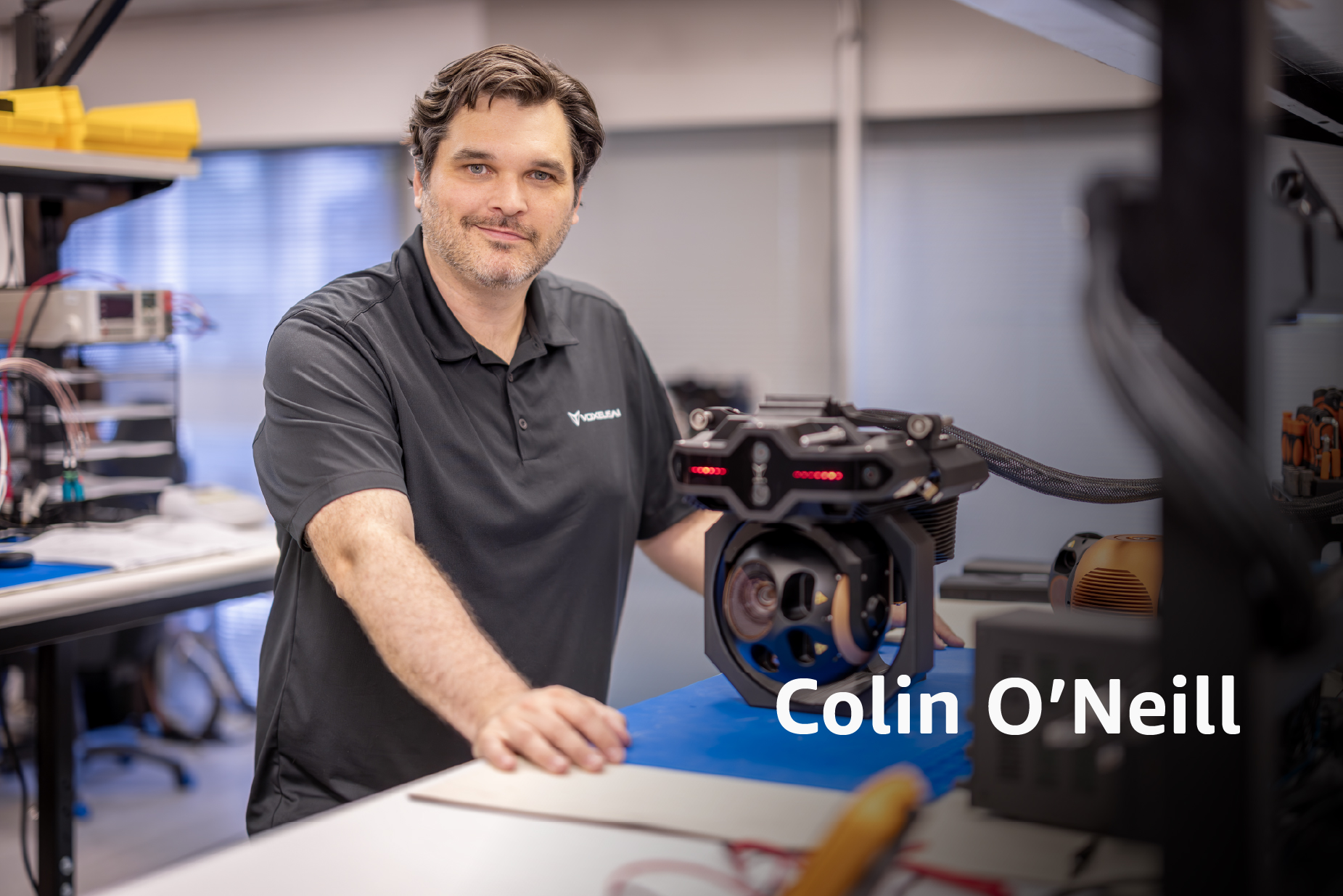
Meet Colin O’Neill
Co-founder and CEO, Voxelis AI
As a second-generation helicopter pilot, Colin O’Neill understood the challenges crews face when battling modern wildfires.
That realization led to the founding of Vancouver-founded Voxelis AI and the development of VoxVision, a system designed for what modern wildfire operations demand: real-time intelligence, seamless coordination, and the ability to see what matters most when every second counts.
A wildfire crisis outpacing firefighting capability
On average, every year, more than 8,000 wildfires burn about 2.1 million hectares across Canada, according to Natural Resources Canada. Climate change has created conditions where fires move faster, burn hotter, and behave more unpredictably than the systems designed to fight them were ever built to handle.
Helicopters remain critical assets in wildfire response. Yet most don’t have any kind of technology on board to assist airborne crews or incident commanders in understanding what is happening on the ground.
The gap between what's happening on the ground and what decision-makers is real. Crews lack real-time visibility into fire behaviour, environmental conditions, and the most strategic points for intervention.
Enabling real-time wildfire intelligence
To bridge this gap, O'Neill and his team developed VoxVision, a smart bowling-ball size device retrofitted onto a helicopter that transforms insights into actionable intelligence.
"VoxVision is like strapping a robot to an aircraft, bringing the latest in edge computing technologies, connectivity and AI into the air in a certified platform at low cost, so it can be deployed on the front lines for firefighting at scale.”
What makes VoxVision revolutionary is its simplicity and accessibility. From a mobile device in the helicopter cockpit, crews can control the system instantly and see what matters most. Every data point is automatically tagged by time, location, and user then shared with the people who need it, when they need it.
But VoxVision is more than just a data collection tool. It's fundamentally a platform for democratizing real-time intelligence across an entire emergency response network.
"With VoxVision, we're giving crews a new set of eyes and a new crewmember on board to help them do their mission more effectively," O'Neill says.
For the first time, everyone in a wildfire operation has access to the same real-time picture.
AI: the intelligence engine
The true power of VoxVision emerges from its integration of artificial intelligence. AI transforms raw data into actionable insight.
Machine learning models analyze thermal imagery and environmental data, from vegetation to humidity levels, temperature, and pressure, identifying patterns and anomalies that human operators might miss. The system can detect fire behaviour indicators, track the spread of flames, and flag areas where intervention will have the greatest impact.
But unlike static systems, VoxVision improves over time. As it’s deployed across more incidents, it accumulates knowledge from thousands of real-world fire scenarios—learning how fires behave under different conditions, which interventions prove most effective, and how to predict fire movement with increasing accuracy.
AWS powers real-time coordination and product development
Building a system that processes high-definition thermal imagery, environmental data, and machine learning models in real time—while sharing that intelligence seamlessly across helicopters, ground crews, and command centres—demands infrastructure that can scale instantly and operate reliably under pressure.
That’s where AWS comes in.
VoxVision captures data at the edge—on board the aircraft—but the intelligence doesn’t stop there. Once collected, thermal scans, environmental readings, and AI-generated insights flow through the AWS infrastructure, where they’re processed, stored and distributed to authorized users across the response network in near real time. The result: pilots, ground crews, incident commanders, and provincial wildfire agencies all working from the same operational picture, updated continuously as conditions evolve.
"AWS allows us to take what we're capturing in the air and get it into the hands of decision-makers on the ground instantly," O'Neill explains. "That connectivity is what turns raw data into coordinated action."
But AWS's contribution extends beyond infrastructure. The development team is leveraging AWS agentic AI capabilities—including Kiro, AWS’s agentic development environment—to rapidly build and enhance dashboards and tools that crews and agencies rely on.
This matters because wildfire response isn’t static. Every fire season reveals new operational needs: a better way to visualise fire perimeters, a faster way to spot fires, and a more intuitive interface for incident commanders. With Kiro, Voxelis can respond to that feedback in near real time, getting critical capabilities to the front lines while the season is still active.
"Kiro has allowed us to accelerate our development process, particularly in the workflows between non-technical staff and our development team," O'Neill explains. "Features that used to take months are now shipping in weeks."
Real-world impact and the future
Wildfires today are global climate events. They erase ecosystems in hours and disrupt lives across entire regions and demand a fundamentally different approach to detection, response, and coordination. By equipping helicopters with AI-powered intelligence, Voxelis AI is creating a new model for emergency response.
"We want to turn every aircraft that’s out there doing wildfire suppression into an intelligent node that’s contributing to helping wildfire agencies and people on the ground make better decisions to put the fires out faster," O'Neill explains.
Every mission brings the system closer to its ultimate goal: predicting fire behaviour in real time and enabling responses faster than ever before. As VoxVision's AI models are trained on more wildfire data, the system's ability to forecast fire movement and identify optimal intervention points will only improve.
"Wildfire is a foundation," O'Neill says. "But it’s a starting point for us." The team believes every aircraft can become a piece of a national airborne geospatial intelligence system, helping society respond to other large-scale emergencies: from search and rescue operations to disaster assessment to critical infrastructure monitoring.


Did you find what you were looking for today?
Let us know so we can improve the quality of the content on our pages