How Diligent Robotics Is Redefining Clinical Care with AWS
Learn how AI company Diligent Robotics worked alongside AWS to save healthcare workers critical time with hospital-ready robots.
Benefits
hospitals served
million deliveries
Overview
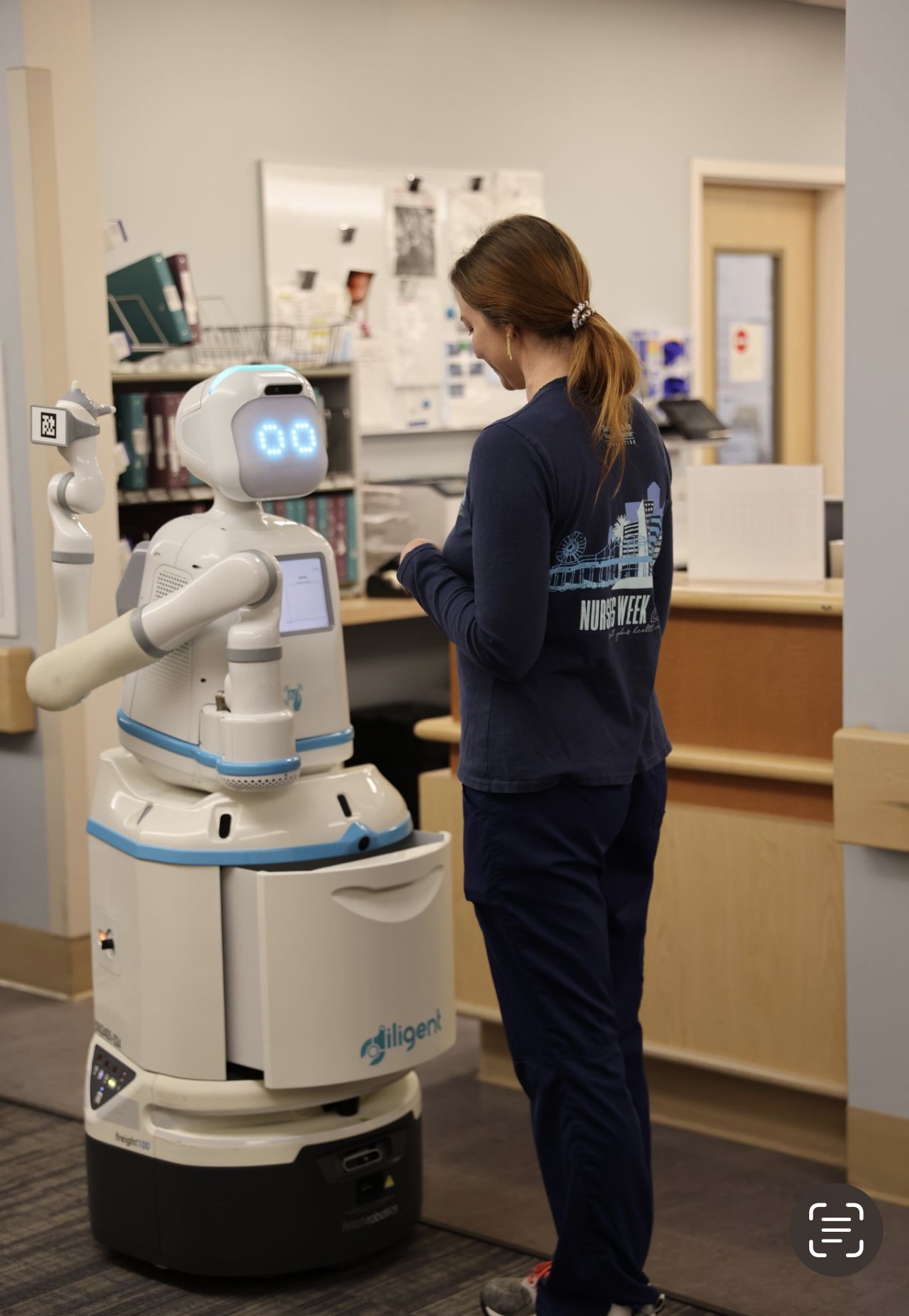
Healthcare systems face ongoing challenges to productivity, from high patient volumes to staff shortages. Diligent Robotics set out to help by creating Moxi, a physical AI robot that relieves clinicians of time-consuming, non-patient-facing tasks. Built using Amazon Web Services (AWS) edge computing and deep learning technology services for physical AI, Moxi, as a physical AI agent, can transport medical supplies across hospitals without disrupting foot traffic or compromising patient security. Since Diligent Robotics introduced Moxi, the robots have completed over 1 million deliveries in over two dozen hospitals, giving hundreds of thousands of hours back to clinicians to focus on patient care.
About Diligent Robotics
Founded in 2017, Diligent Robotics is a women-owned physical AI company that has developed robot assistants to take on hospital busywork. It was recently acquired by Serve Robotics, which develops AI-powered, low-emissions sidewalk delivery robots.
Opportunity | Using AI to save clinicians time for Diligent Robotics
Today, healthcare professionals use 30 percent of their time transporting medications, shuttling lab samples, and moving supplies between departments—activities that distract from the core mission of healing. “There’s a lot that has to move around a hospital for each patient, and doing that often pulls clinicians away from patient care,” says Andrea Thomaz, CEO and cofounder of Diligent Robotics. “We saw an opportunity to use AI and robotics to handle these repetitive duties and return valuable time to healthcare professionals—time they can reinvest in what matters most: their patients.”
The result was Moxi, a robot designed to handle hospital logistics so that clinicians can focus on healing. It delivers medications, lab samples, and medical supplies across multiple hospital floors and scans ID badges so that sensitive materials like medications are handled securely. It safely navigates crowded hallways and rides elevators to deliver essential supplies while interacting with staff and patients—all autonomously.
Getting Moxi hospital ready demanded critical infrastructure support. Diligent Robotics needed enterprise-grade AI services that could support autonomous decision-making in near real time, facilitate continuous learning, and maintain responsible AI practices in sensitive clinical environments. “Moxi’s edge computing functions collect several terabytes of environmental data a day, and our dataset is close to 500 TB,” says Harjatin Baweja, machine learning lead at Diligent Robotics. “We needed a cloud provider that could handle that sort of scale easily.”
Solution | Training robots to adapt to unpredictable real-world spaces
Diligent Robotics had already been running machine learning pipelines on AWS to develop Moxi. Additional advancements came about when the company was selected for the inaugural Physical AI Fellowship, a 10-week collaboration with the AWS Generative AI Innovation Center, MassRobotics, and NVIDIA. AWS scientists and strategists provided deep expertise in AI infrastructure and training methods. Diligent Robotics used these to train Moxi’s vision-language-action model—the AI that teaches the robot to connect what it sees and does—to better navigate and participate in unpredictable real-world hospital environments.
The AWS team recommended Amazon Elastic Compute Cloud (Amazon EC2) for its broad, deep compute platform with over 1,000 instances and high-bandwidth capabilities—critical for handling Moxi’s massive data requirements. Diligent Robotics built, ran, and scaled a production-ready cloud infrastructure that creates a continuous feedback loop: Data gathered from deployed robots in hospitals inform new world model iterations, which are refined in the cloud and pushed back into the robots, improving performance with each cycle.
Amazon SageMaker HyperPod helped quickly scale development of Moxi’s vision-language-action model. Moxi is capable of facilitating near-real-time decision-making, like knowing how to find an elevator, identifying and pressing the correct button, getting off at the right floor, and repeating the process. Moxi can also integrate with existing hospital workflows automatically. “Cardiac patients, for example, need specialized equipment. Moxi can deliver it to the patient’s room automatically upon admission, something that’s usually up to the clinician,” says Thomaz.
Handling hundreds of terabytes of hospital data demands strict privacy protocols, so Diligent Robotics used AWS AI services to implement anonymization. “We blur the faces and text that Moxi sees in case the robot goes by a whiteboard with a patient’s name written on it, in accordance with client contracts,” says Baweja. “That’s just one piece of a multilayer security and privacy strategy.”
Outcome | Saving 600,000 clinician hours in 1.3 million deliveries
Since deployment, Diligent Robotics has placed Moxi in 25 US hospitals, where they have completed more than 1.3 million deliveries—returning over 600,000 staff hours to patient care, equivalent to adding 150 full-time employees. Moxi continues to advance through edge computing and imitation learning, seamlessly adapting to hospital routines, navigating high-traffic corridors, and completing thousands of autonomous elevator rides weekly. On the business side, this proof that Diligent Robotics could safely and reliably deploy robots at scale in complex environments led to its acquisition by Serve Robotics.
Clinical teams haven’t just accepted Moxi—they’ve embraced it. Staff dress the robots up for holidays and celebrate their presence as part of the team. “It’s really simple for the chief nursing officer to introduce Moxi to their team,” says Thomaz. “Using AWS, we created a product that takes on tasks that don’t need medical expertise, so the medical experts can focus on the patient.”
Diligent Robotics is pushing further, planning to advance Moxi’s vision-language-action models and task range. “We see a future set of product features and functionalities where Moxi could do more dexterous manipulation tasks, helping expand the skills and duties it can take on in the hospital,” says Thomaz. “We have a follow-up proposal for the AWS Generative AI Innovation Center because everyone was so excited about the work we did together in the fellowship.”

Using AWS, we created a product that takes on tasks that don’t need medical expertise, so the medical experts can focus on the patient.
Andrea Thomaz
CEO and Cofounder, Diligent RoboticsAWS Services Used
Did you find what you were looking for today?
Let us know so we can improve the quality of the content on our pages